A Zestimate is a free ballpark. An appraisal is the legally defensible number lenders, courts, and the IRS accept. Use the first to get oriented and the second when money, financing, or legal outcomes are on the line.
Zillow’s own Zestimate documentation calls it an automated estimate, not an appraisal, built from public records and market data with no one setting foot inside your home. A licensed appraiser inspects the property, applies USPAP standards, and produces a report that a bank or judge will actually rely on.
Here’s the quick math on why this matters. Zillow reports a median error rate of roughly 1.9% to 2.4% for on-market homes and 6.9% to 7.5% for off-market homes. On a $600,000 house, that off-market range alone can swing $40,000 or more.
Use this rule of thumb:
- Curious what your house might be worth right now? The Zestimate is fine for orientation.
- Getting ready to list or negotiate a sale? Get a comparative market analysis (CMA) from an agent.
- Refinancing, settling an estate, or fighting a tax assessment? Order a licensed appraisal. Nothing else will hold up.
Key Takeaways
An accurate home valuation depends on matching the right tool, Zestimate, CMA, or licensed appraisal, to the financial or legal stakes of your specific decision.
| Point | Details |
|---|---|
| Zestimate is a starting point | Zillow’s own guidance says it’s an automated estimate, not an appraisal, and shouldn’t replace one for major decisions. |
| Accuracy varies by listing status | Median error runs about 1.9% to 2.4% on-market versus 6.9% to 7.5% off-market. |
| Dollar impact scales with price | A 7% error on a $500,000 home equals a $35,000 miss, larger than most appraisal fees. |
| CMAs bridge the gap | A free agent CMA uses real recent comps and is the right step before setting a list price. |
| Appraisals carry legal weight | Only a licensed, USPAP-governed appraisal satisfies lenders, courts, and tax authorities. |
| Documentation resolves disputes | Permits, receipts, and photos of upgrades are what actually move a reconsideration of value. |
Table of Contents
- Zestimate vs Appraisal: How the Zestimate Actually Works
- What a CMA and a Licensed Appraisal Actually Involve
- How Accurate Is a Zestimate Compared to an Appraisal?
- Why Your Zestimate and Appraisal Don’t Match
- Zestimate, CMA, or Appraisal: Which One Do You Actually Need?
- What to Do When the Zestimate and Appraisal Don’t Agree
- Ready to Get a Real Number on Your Home?
- Why the Zestimate Debate Misses the Real Point
- Sources
Zestimate vs Appraisal: How the Zestimate Actually Works
A Zestimate is what real estate professionals call an automated valuation model, or AVM. It’s a statistical estimate generated by software that never sees the inside of your home. Instead, it pulls from a mix of data sources and runs them through an algorithm to spit out a number.
Zillow builds each Zestimate from several inputs:
- Public tax assessor records (lot size, bedroom and bathroom counts, year built)
- MLS listing feeds when a home is actively for sale
- User-submitted updates homeowners enter directly through their Zillow profile
- Recent sale prices of comparable homes in the area
- Listing photos and description text, which Zillow’s model increasingly factors into condition estimates
The model then attaches a confidence indicator to the number, essentially Zillow’s own admission of how much it trusts its guess for that specific property. A condo in a subdivision with hundreds of recent, nearly identical sales gets a tighter, more reliable estimate. A one-of-a-kind hillside home with a custom addition gets a wider margin for error, because the algorithm has fewer good comparisons to lean on.
That’s the core weakness. An AVM can’t walk through your kitchen and notice the marble countertops you installed last year, and it can’t smell the water damage in the crawl space either. It relies heavily on public records that are frequently outdated. Counties often take months (sometimes over a year) to update records after a permit closes, which means your new bathroom or finished basement may be invisible to the model for a long stretch.
Zillow itself states plainly that a Zestimate is not an appraisal and shouldn’t be used in place of one. That’s not a legal disclaimer buried in fine print. It’s the company telling you directly what the tool is and isn’t built to do.
What a CMA and a Licensed Appraisal Actually Involve
A comparative market analysis and a licensed appraisal solve the same basic question. Both put a human being between the data and the number, but they operate at very different levels of rigor.
A CMA is typically prepared by a real estate agent, and it’s usually free. An agent pulls recent comparable sales, adjusts for differences in size, condition, and location, and applies local market knowledge that no algorithm captures, things like which street commands a premium because of school boundaries or which block has noise from a nearby freeway. A CMA is often the right first move before setting a list price, because it’s fast, free, and grounded in what’s actually selling nearby.
A licensed appraisal goes further and carries legal weight. The process follows a defined sequence:
- The appraiser physically inspects the interior and exterior, measuring square footage and noting condition, upgrades, and any deferred maintenance.
- The appraiser selects comparable sales and makes line-item adjustments for differences (an extra bedroom, a bigger lot, a finished garage).
- Those adjusted comparables get reconciled into a single supported value, documented in a formal report.
- The report is signed and becomes a legal document, governed by the Uniform Standards of Professional Appraisal Practice, or USPAP.
That paper trail is exactly what lenders and courts require for mortgages, refinances, HELOCs, and legal proceedings like estate settlements, divorce, or property tax appeals. A CMA, no matter how well done, won’t satisfy any of those requirements. Appraisals typically run a few hundred dollars and take about a week to ten days, depending on the appraiser’s schedule and property complexity.
How Accurate Is a Zestimate Compared to an Appraisal?
The published numbers tell a clear story: Zestimates get noticeably more accurate once a home hits the market, and noticeably less accurate for homes that aren’t listed.
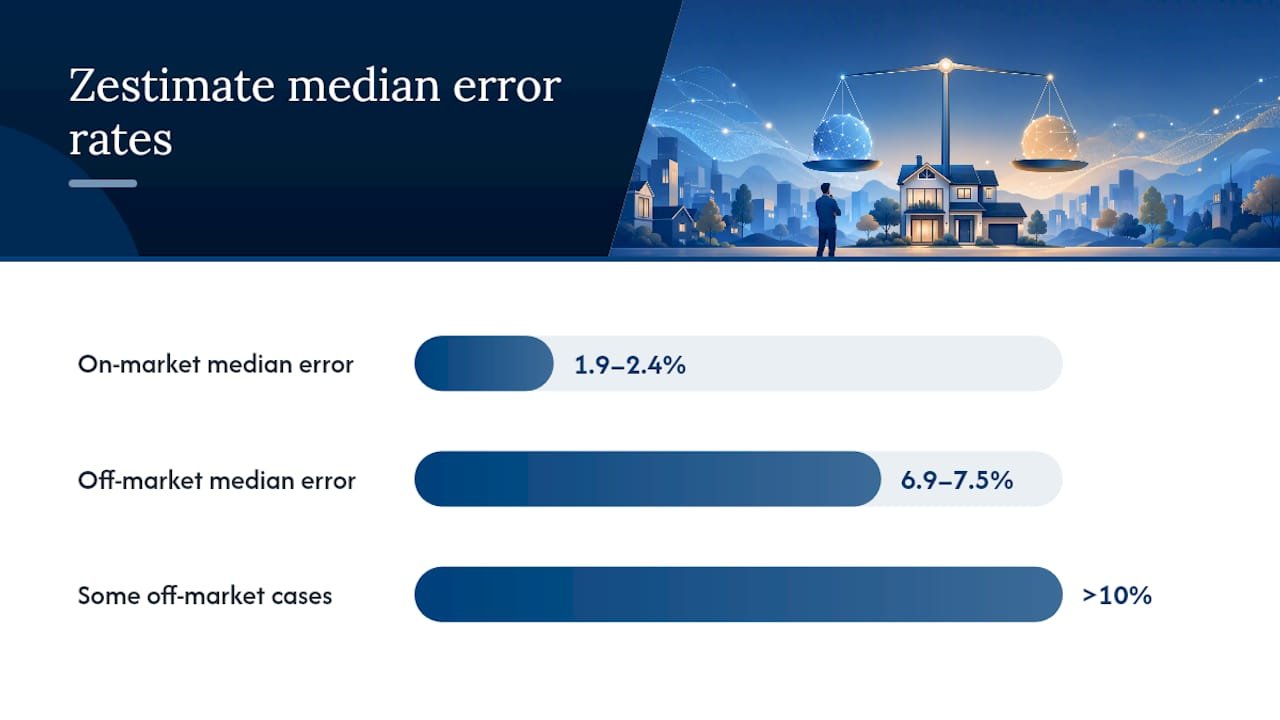
Zillow’s data shows a median error rate around 1.9% to 2.4% for on-market properties, compared to 6.9% to 7.5% for off-market properties. That gap exists partly because active listings feed the algorithm fresh signals, current photos, an asking price, agent-written descriptions, that off-market homes simply don’t provide. Appraiser-reviewed case studies have found off-market AVM errors exceeding 10% for some properties, particularly ones with unusual layouts or limited nearby comps.
Turn those percentages into dollars and the stakes get real fast:
- $300,000 home: a 7% off-market error is a $21,000 miss
- $500,000 home: the same 7% error swings by $35,000
- $900,000 home: even a modest 5% miss on a high-value property is $45,000, and a 7% miss climbs past $60,000
Accuracy also depends heavily on where you live. AVMs perform best in high-volume, uniform markets where tract homes sell frequently and comps are plentiful. Rural properties, custom builds, and neighborhoods with few recent sales push the algorithm into guesswork, and the error rate climbs accordingly.
Why Your Zestimate and Appraisal Don’t Match
Most divergences trace back to one of a handful of predictable causes. Run through this checklist before you assume either number is simply wrong.
- Wrong square footage or bed/bath count in public records. County data entry errors are more common than people realize, and they cascade directly into the Zestimate.
- Unrecorded renovations. That kitchen remodel or converted garage won’t show up until the permit paperwork works its way through the county system.
- Condition differences the algorithm can’t see. Fresh paint and a leaking roof look identical to an AVM.
- A unique lot, view, or layout. Waterfront access, a corner lot, or an unusual floor plan often gets averaged away in an automated model.
- Thin comps or a shifting market. Fast-moving price changes in either direction take time to filter into an AVM’s data feed.
- Listing price influence. If a home was recently listed too high or too low, that number can temporarily skew the Zestimate.
Start by pulling up your county assessor’s public record and comparing it against your Zillow property page. Mismatched square footage or bedroom counts are an easy fix once flagged.
Pro Tip: Keep a simple folder, digital or physical, with permit approvals, renovation receipts, and before-and-after photos. If you ever need to challenge a valuation, having documentation ready saves weeks.
Zestimate, CMA, or Appraisal: Which One Do You Actually Need?
Match the tool to what you’re actually trying to accomplish, because paying for more precision than a situation requires wastes money, and relying on too little precision costs you far more.
- Just curious or tracking equity over time? The Zestimate works fine. It’s free, instant, and good enough for casual monitoring.
- Thinking about listing in the next several months? Request a free CMA from a local agent. It reflects real comparable sales and current buyer behavior in a way an algorithm can’t replicate.
- Actively pricing a home to list, or negotiating an offer? Lean on the CMA, refined with the agent’s read on current buyer demand and competing listings.
- Applying for a mortgage, refinance, or HELOC? Your lender will require a licensed appraisal. No shortcut exists here.
- Handling an estate, divorce, or property tax appeal? Order a licensed appraisal. Courts and tax authorities won’t accept a CMA or a Zestimate as evidence.
A useful three-step flow for most sellers looks like this:
- Step 1: Check your Zestimate for a rough sense of range and flag any obvious data errors.
- Step 2: Get a free CMA from an agent to sharpen that range against real, recent sales.
- Step 3: Order a licensed appraisal only when a lender, court, or tax authority requires one.
Zillow’s own guidance backs this sequence, recommending homeowners supplement the Zestimate with a physical walkthrough, a CMA, or a full appraisal before making any high-stakes decision.
What to Do When the Zestimate and Appraisal Don’t Agree
A gap between the two numbers isn’t a crisis. It’s a signal to gather better evidence and, if the stakes warrant it, push back.
- Verify the basics first. Pull your county assessor’s record and your Zillow listing page side by side. Confirm square footage, lot size, and bedroom and bathroom counts match reality.
- Compile documentation. Gather permit approvals, renovation receipts, and dated photos showing upgrades an appraiser or algorithm might not know about.
- Present the evidence to the appraiser. If an appraisal comes in lower than expected, most appraisers will accept a reconsideration of value request when you bring documented, comparable evidence, not just an opinion that the number feels wrong.
- Request a second opinion when the stakes justify it. For a contested estate valuation or a large refinance gap, a review appraisal from a second licensed professional can resolve a genuine dispute.
- Loop in the right party for the situation. A lender’s underwriter handles reconsideration requests for mortgage appraisals. A county assessor’s office handles tax appeal disputes. Legal counsel gets involved for estate or divorce valuations where the number affects a settlement.
Pro Tip: Never walk into a reconsideration conversation with just a Zestimate printout. Appraisers see that constantly and it carries no evidentiary weight. Bring permits, receipts, and comps instead.
If you’re gathering evidence of upgrades that might not show up in county records yet, documenting recent interior improvements with photos and receipts gives an appraiser something concrete to work with, rather than asking them to take your word for it.
Sellers who come to the table with a CMA, comparable sales, and a clear list of upgrades close the gap between an automated guess and a real offer faster than anyone who just argues about the number. Precision on paper wins negotiations, not frustration.
This is exactly where a targeted marketing approach earns its keep. Listings placed through Zillow Showcase get better visibility and richer photo presentation, which feeds more accurate signals back into the Zestimate itself while also pulling in serious buyers through an established database rather than passive scrollers. A well-priced, well-marketed listing narrows the gap between what an algorithm guesses and what a buyer actually pays.
Ready to Get a Real Number on Your Home?
A Zestimate can tell you if you’re in the right neighborhood, financially speaking. It can’t tell you what your home will actually sell for, and it definitely can’t get you the highest offer a buyer is willing to pay.
If you’re in San Diego County and thinking about selling, Ryan Case offers a free, no-obligation home analysis that goes beyond an algorithm’s guesswork. That means a real comparative market analysis built on current comps, a pricing strategy tuned to your specific property, and access to a buyer database and marketing tools like Zillow Showcase designed to get your home in front of serious buyers, not just casual browsers. Request your personalized home value analysis and find out what your property is actually worth in today’s market.
Why the Zestimate Debate Misses the Real Point
Most articles on this topic treat Zestimate accuracy like a trivia question, arguing over a percentage point here or there. That misses what actually matters to a seller: what the gap costs you in a real transaction.
The conventional advice, “just check your Zestimate,” undersells how much a free CMA changes the picture. I’ve watched sellers anchor to a number an algorithm generated from stale tax records, then get surprised when real market feedback tells a different story. The fix isn’t complicated. Pull your CMA before you set expectations, not after.
If you’re serious about selling, prioritize documentation early. Photos, permits, and receipts for upgrades matter more than arguing with an algorithm. Bring evidence, not opinions, when a number seems off. That’s what actually moves a valuation, whether you’re negotiating with a buyer or requesting a reconsideration from an appraiser.
— Ryan Case