Run every open house as a small sales event that fills your pipeline, not as a passive showing where you sit behind a sign-in sheet and hope. That single shift in mindset changes everything about how you prep, staff, and follow up.
Two facts should anchor your expectations. First, only about 4% of home sales close because of an open house or its signage, while a substantial portion of buyers find homes through listing portals and social media. Second, top-producing agents treat the open house as a repeatable lead system, not a one-off event, using the same neighbors-hour, sign trail, and follow-up sequence every single weekend.
What that means in practice:
- Stop measuring success by “did it sell the house.”
- Start measuring appointments booked, phone numbers captured, and neighbor leads generated.
- Treat every open as an audition for your services, not just a showcase for the listing.
Key Takeaways
Open houses generate consistent pipeline only when treated as a repeatable sales system with scripts, timed follow-up, and measurable KPIs, not as passive foot traffic.
| Point | Details |
|---|---|
| Reframe the goal | Measure appointments booked and leads captured, not whether the open house directly sells the home. |
| Use the pre-open checklist | Confirm the listing, shoot a video, door-knock, and build your brain book in the 7 to 14 days before opening. |
| Qualify visitors fast | Ask the proximity question first, then run the four-question sequence to surface real buying readiness within minutes. |
| Follow up on a fixed cadence | Send a personalized message the same evening and call warm leads by 10:00 AM Monday. |
| Work with Ryan Case | The Premier Selling System applies this open-house playbook in San Diego, turning weekend traffic into a working buyer and seller pipeline. |
Table of Contents
- How Does Weather Affect Open House Attendance?
- When Is the Best Day and Time to Hold an Open House?
- What Should You Do When Turnout Is Low?
- What Legal and Safety Steps Should You Take Before Opening the Door?
- How Should You Use Virtual Tours and QR Codes at an Open House?
- Should You Invite Other Agents or Brokers to Your Open House?
- Building the 7-to-14-Day Pre-Open Checklist
- Marketing and Promotion Channels That Actually Drive Turnout
- Staging and Photos That Keep Buyers in the House Longer
- Scripts and Flow That Turn Visitors Into Appointments
- Follow-Up Timing That Actually Converts
- Which Listings Are Worth an Open House?
- How Ryan Case Applies This System in San Diego
- Why Repetition Is the Real Strategy Here
- Ready to Put This System to Work in San Diego?
- Sources
How Does Weather Affect Open House Attendance?
Rain, heat waves, and cold fronts can cut open house turnout by half or more, and the agents who plan around weather instead of reacting to it are the ones who still get a full afternoon of traffic. Check the ten-day forecast the moment you lock in a date, and build a plan B before you need one.
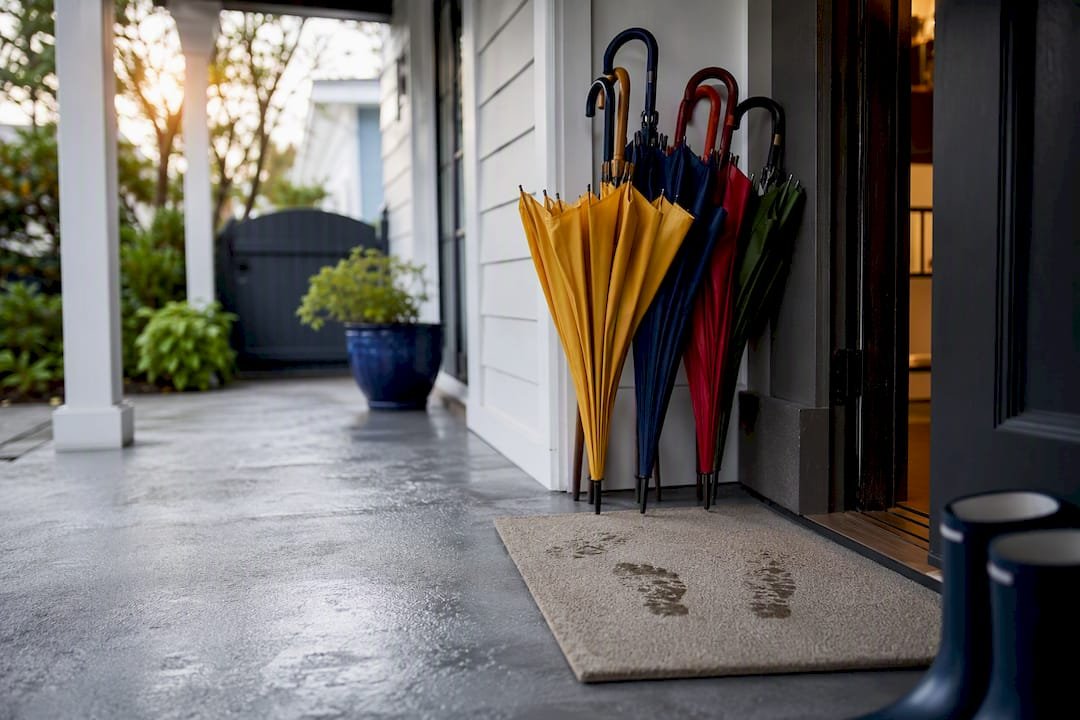
If rain is likely, shift your promotion budget toward paid social and email rather than relying on walk-up traffic from directional signs, since fewer people wander outside in a downpour. A covered entry, umbrellas by the door, and a floor mat for wet shoes keep the experience pleasant even when the sky isn’t cooperating. Extreme heat calls for the opposite fix: run the air conditioning an hour before doors open, keep cold water visible, and consider a shorter, tighter window rather than a marathon four-hour slot that burns out both you and any visitors.
Snow or ice is the one condition where you should seriously consider rescheduling rather than pushing through, especially in markets where driveways and walkways become liability concerns. When you do reschedule, message your existing RSVP list and any neighbors you door-knocked within a few hours of the decision, not the night before. A short, honest text (“Rescheduling Saturday’s open due to the forecast, new date is Sunday at 1pm”) keeps trust intact and actually gets more people to show up the second time, because you demonstrated you’re paying attention to their experience, not just your calendar.
Build weather contingency into your pre-open checklist the same way you’d plan for a low-inventory market. It’s not an afterthought. It’s a line item.
When Is the Best Day and Time to Hold an Open House?
Sunday between 1:00 PM and 4:00 PM remains the strongest default window in most residential markets, largely because it sits after church schedules and family brunches but well before evening commitments. That said, the “best” time shifts depending on your buyer pool, and treating this as a fixed rule rather than a starting hypothesis costs agents traffic every year.
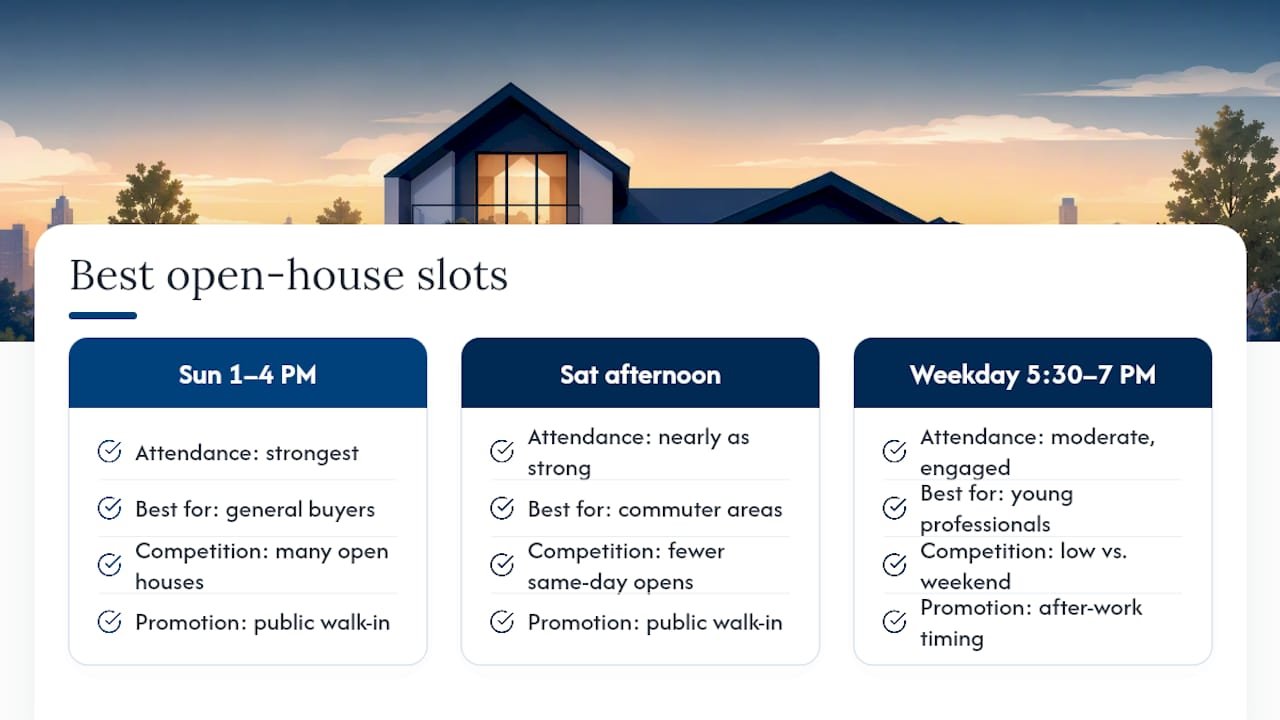
Saturday afternoons work nearly as well and can outperform Sunday in neighborhoods with a heavy weekend-commuter population, where families use Saturday for errands and Sunday for out-of-town trips. If your target buyer is a young professional couple, an early evening weekday slot right after work, say 5:30 to 7:00 PM, sometimes pulls a surprisingly engaged crowd because they’re not competing with a dozen other open houses on the same Sunday.
Luxury listings and condos in dense urban cores often do better with a tighter, invite-only window promoted heavily through agent networks rather than a wide-open Sunday crawl, since the buyer pool is smaller and more relationship-driven.
Whatever slot you pick, consistency matters more than perfection. Running your opens at the same general time each weekend trains your local buyer pool and fellow agents to expect you there, which builds the kind of market recognition that compounds over months. Track your own numbers by day and hour for a few listings before you assume you know your market’s rhythm. What works in one zip code can flop three miles away.
What Should You Do When Turnout Is Low?
A quiet open house isn’t a wasted afternoon if you treat the visitors you do get differently. Low turnout usually traces back to one of three causes: weak promotion timing, a saturated market with too many competing opens that same weekend, or a listing that’s priced or positioned in a way that isn’t generating urgency. Diagnose which one it is before you blame the weekend.
If only three or four people show up, spend real time with each of them instead of rushing through a script. A slow open is actually the best environment to run your full four-question qualifier and walk someone through your brain book of comparable listings, because you’re not splitting attention six ways.
No-shows on RSVPs deserve a same-day text, not silence. Something like: “Missed you at today’s open on Maple Street. Happy to set up a private walkthrough this week if you’re still interested.” Private showings convert at a noticeably higher rate than open house foot traffic precisely because the buyer has already self-selected as serious, and a missed open is often just a scheduling conflict, not a loss of interest.
Low turnout weekends are also your best opportunity to work the neighbors angle harder. Knock on five more doors than usual, since you have the bandwidth, and offer a private evening viewing to anyone who couldn’t make the window. A quiet open with three qualified conversations often produces more pipeline than a packed one where you never got past small talk with anyone.
What Legal and Safety Steps Should You Take Before Opening the Door?
Every open house creates real exposure, both legal and physical, and skipping the basics is the fastest way to turn a good lead-gen day into a liability problem.
Start with disclosure compliance. Make sure the seller’s disclosure packet and any required property condition reports are printed, accessible, and something you can speak to accurately if a buyer asks a direct question. Fair housing rules apply at every open house exactly as they do in any other transaction, so keep your language about the property and the neighborhood strictly factual. Never answer questions framed around school quality, demographics, or “who lives around here,” and redirect those conversations to public data sources instead.
Physical safety is just as important. Walk the property before doors open and secure or remove prescription medications, firearms, jewelry, cash, and any documents with personal financial information, since open houses are one of the few times strangers move freely through someone’s private space. Have a co-host or a colleague present whenever possible, both for safety and because two people can qualify twice as many visitors. Position yourself near the entrance rather than a back room, and always know a clear path to the exit.
Sign-in sheets or digital check-ins aren’t just for lead capture. They create a record of who was in the home, which matters if anything is ever reported missing or damaged. Confirm with the seller ahead of time whether pets have been secured and whether any areas of the home are off-limits, then communicate those boundaries clearly to visitors as they arrive.
How Should You Use Virtual Tours and QR Codes at an Open House?
Technology at an open house should do one job well: reduce friction between a curious visitor and the next step you want them to take. A QR code on your directional signs and printed flyers that links straight to a mobile-friendly property page lets a driver-by capture the listing without stopping to write anything down, and you can track how many scans convert into a saved contact.
Inside the home, a QR code near the entry that opens a digital sign-in form usually gets a higher completion rate than a paper clipboard, mainly because people already have their phones out and it feels less like handing over their information to a stranger. Pair that digital sign-in with a short incentive, like early access to a listing alert for similar homes, to raise your completion rate further.
A recorded virtual tour or 3D walkthrough serves a different purpose than the live event. Post it in your pre-open marketing so out-of-town buyers or busy locals who can’t make the window still get a real feel for the layout, and mention it again in your same-evening follow-up for anyone who wants to revisit a specific room. Don’t rely on the virtual tour as a replacement for the in-person walkthrough itself. The value of the live open is the conversation you have while someone stands in the kitchen, not the video.
Should You Invite Other Agents or Brokers to Your Open House?
Co-hosting or cross-promoting an open house with another agent can roughly double your working hours on-site, which means twice the qualifying conversations without diluting your own follow-up list, as long as you set clear rules upfront about who owns which leads.
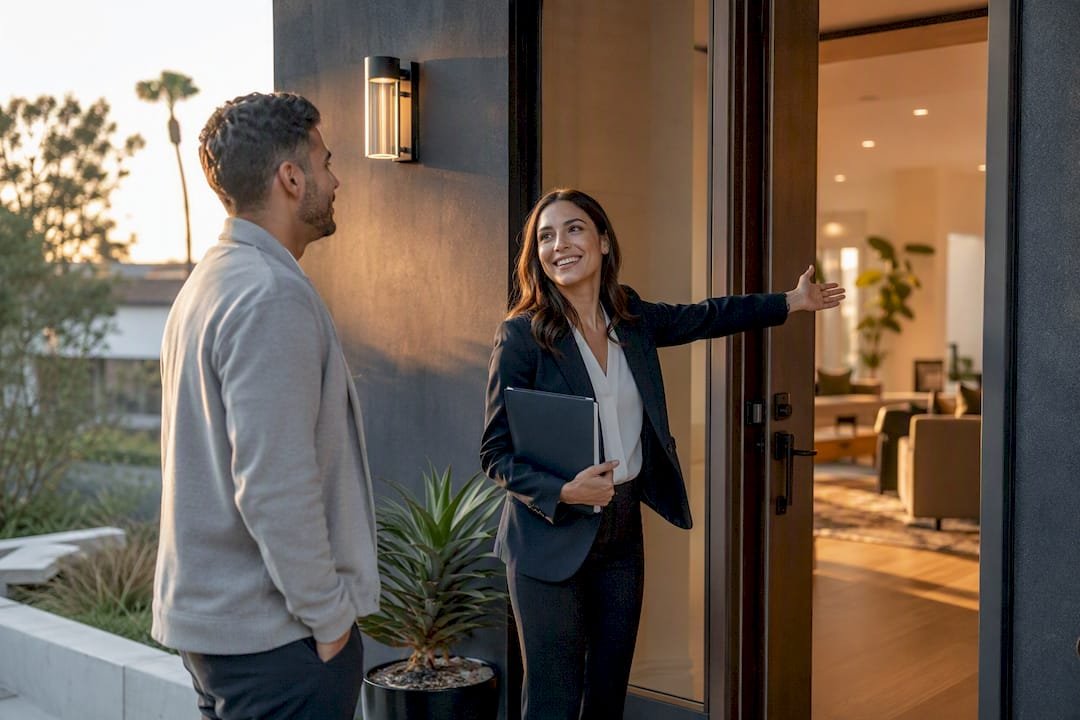
Broker opens, sessions held specifically for other agents rather than the public, remain one of the most underused tools for exposure in a slow market. Inviting agents from your office or brokerage to preview a new listing on a weekday morning gets the property in front of people actively working with buyers right now, and it costs you nothing but coffee and a printed flyer. Ask attending agents directly whether they have a buyer in mind for this specific home. That single question generates more real leads than a generic “thanks for coming.”
Cooperative marketing with a buyer’s agent from another brokerage works well too, particularly when that agent already has a client circling the neighborhood. Splitting hosting duties lets one of you work the front door while the other runs the qualifying conversations inside. A referral network connection can be a useful source of these cross-agent relationships if you’re building out your open house coverage in a market where you don’t yet have deep broker relationships.
Just be explicit about lead ownership before the open, not after someone signs in. A quick verbal agreement, confirmed by text, avoids the awkward conversation later about whose CRM a hot lead belongs in.
Building the 7-to-14-Day Pre-Open Checklist
The week before an open house determines most of what happens during it, and agents who wing this stretch consistently show up to a thin crowd and a seller who’s already nervous.
- Fourteen days out: Confirm the listing is fully live on MLS and every major portal, with accurate photos and pricing.
- Ten days out: Shoot a short walkthrough video of the home for social promotion, since listing videos consistently outperform static photos for building pre-event interest.
- Seven days out: Start door-knocking the surrounding blocks with a simple script: “Hi, I’m previewing this home before it hits the open market Sunday. Want a sneak peek this evening between 5 and 6?”
- Five days out: Confirm parking arrangements, pet logistics, and key access with the seller directly. Don’t assume the lockbox code still works.
- Three days out: Build or update your brain book, a one-mile-radius cheat sheet of active listings, pendings, recent solds, expired listings, and FSBOs so you can offer alternatives on the spot.
- One day out: Print your Flipper Folder materials, sign-in sheets, feature sheets, and comparable listings for anyone who wants a physical takeaway.
- Morning of: Run a final walkthrough for staging, lighting, and signage placement.
The neighbors-only preview hour, that quiet evening slot before the public open, is worth protecting on your calendar even when it feels like extra work. Neighbors are frequently future sellers doing quiet market research, and treating them as insiders instead of an afterthought is one of the highest-return moves in the entire process.
Pro Tip: Ask the seller to be gone at least thirty minutes before your neighbors-only preview starts. Sellers lingering in the driveway make neighbors uncomfortable being candid about price expectations, which is exactly the intel you want to overhear.
Marketing and Promotion Channels That Actually Drive Turnout
Promotion for an open house isn’t one post the morning of. It’s a sequence that builds over roughly a week, with each channel doing a different job.
- Seven to ten days out: Push the listing live across MLS-fed portals and schedule your first social announcement.
- Five days out: Launch a targeted paid social campaign geo-fenced to a five-to-ten-mile radius, timed to run through the weekend.
- Three to four days out: Post the short walkthrough video, which reliably builds more anticipation than another round of static photos.
- Two days out: Send an email blast to your buyer database and past client list, and post in relevant local groups or Nextdoor.
- One day out: Confirm directional sign placement and check local sign-permission rules for the neighborhood.
- Morning of: Deploy the signs. Top producers place 10 or more directional signs to build a visible trail from the nearest main road all the way to the front door.
Your listing video should hit three things in under sixty seconds: one striking exterior shot, the best room in the house, and a clear call to the open house date and time. That’s it. Overproduced videos with music and slow pans lose the urgency that a quick, honest walkthrough creates.
Paid ad budgets don’t need to be large to be effective. A modest spend concentrated in the five days before the open, targeted narrowly by geography and home-buying intent, outperforms a larger budget spread thin over a month.
Pro Tip: Always check with your city or HOA about directional sign rules before placing more than one or two. Some municipalities cap sign counts or restrict placement on public right-of-way, and a fine on open house morning is a bad way to start the day.
Staging and Photos That Keep Buyers in the House Longer
The goal of staging for an open house isn’t perfection. It’s removing anything that stops a buyer from picturing themselves living there.
- Declutter every surface, especially kitchen counters and bathroom vanities, and remove family photos and personal mail.
- Open every blind and turn on every light, even during the day, since brighter rooms consistently read as larger and better maintained.
- Use a light, neutral scent, not a heavy air freshener, and skip anything food-scented near lunchtime.
- Small staging investments (fresh towels, a bowl of lemons on the counter, one new throw pillow) go further than a full furniture rental for most price points.
- Removing personal items measurably increases buyer imagination and helps buyers picture the home as theirs rather than the current owner’s.
For photos used in your promotion, emphasize the room that will hook someone scrolling fast: usually the kitchen, the primary bedroom, or a standout outdoor space. Save wider, more technical shots for the printed packet you hand out on-site. Recommend a professional stager for listings above your local median price point or homes that have sat vacant, since empty rooms photograph poorly and read as cold in person. On the day itself, light refreshments and quiet background music extend how long visitors linger, and longer dwell time is one of the simplest predictors of a serious conversation.
Scripts and Flow That Turn Visitors Into Appointments
The first two minutes at the door decide whether a visitor becomes a lead or just a name on a sign-in sheet. Greet warmly, then ask one simple proximity question before anything else: “Are you familiar with this neighborhood, or is this your first time in the area?” That single question tells you immediately whether you’re talking to a serious local buyer, a curious neighbor, or someone just starting their search from out of town, and it shapes everything you say next.
From there, a short qualifying sequence usually surfaces real buying readiness within two minutes:
- “Are you working with an agent already?”
- “What’s your timeline, are you hoping to move in the next few months or just starting to look?”
- “Have you made an offer on anything else recently?”
- “If the right home came along today, would you be in a position to move on it?”
That fourth question is the one that separates a tire-kicker from someone ready to book a showing this week.
Sign-in should offer a digital option, a QR code linked to a short form, alongside a paper backup for anyone who prefers it. Frame it as an exchange of value rather than a formality: “I’ll text you the listing sheet and a couple of comparable homes if you leave your number.” Take brief notes on each visitor immediately after they leave, not at the end of the day when details blur together.
This is where the brain book earns its place. If a visitor says the home doesn’t quite fit, whether it’s price, layout, or lot size, flip straight to your one-mile-radius cheat sheet and offer three alternatives on the spot. Someone who came in “just looking” often leaves with a private showing booked for Tuesday because you had an answer ready instead of a shrug.
Pro Tip: Keep a small stack of “flipper” showing slips, pre-printed cards where you jot down an address, a time, and your number, so a visitor walks out with a concrete next step in hand instead of a vague promise to follow up.
Follow-Up Timing That Actually Converts
Follow-up is where most agents leave money on the table, mostly because they treat it as an afterthought rather than the second half of the open house itself.
- Same evening: Send a personalized text or email to every visitor within a few hours, referencing something specific from your conversation (“Great chatting about the backyard, here’s that school district link you asked about”). Generic mass messages get ignored; specific ones get replies.
- Monday by 10:00 AM: Call every warm lead directly rather than relying on email alone. A next-business-morning phone call to serious prospects consistently outperforms email-only follow-up, since it puts you back in front of the buyer before they’ve toured five other homes over the weekend.
- Within 48 hours: Segment your list into three tiers: ready-now buyers who need a showing booked, neighbors who are potential future sellers, and casual lookers who go into a long-term nurture sequence.
Practical segmentation matters more than volume. A visitor who asked about school ratings and move-in timelines goes in a different bucket than a neighbor who spent ten minutes asking about your commission structure.
Build your CRM fields around what you actually asked at the door: timeline, working with an agent (yes/no), motivation to sell their current home, and a note field for anything personal that came up in conversation. Schedule the next touch before you close the record, not as a vague “follow up later” task that quietly dies in your task list.
Pro Tip: Block thirty minutes immediately after every open house, before you leave the property, to log notes while the conversations are still fresh. Waiting until the next morning loses half the detail that makes your follow-up feel personal.
Which Listings Are Worth an Open House?
Not every listing deserves a public open. The best candidates sit in walkable or highly visible neighborhoods, fall within a price band that matches strong local buyer demand, and offer easy parking plus genuine curb appeal that photographs and shows well in person.
- Strong candidates: corner lots, homes near parks or main roads, listings priced at or below the neighborhood median.
- Weak candidates: gated communities with limited walk-up traffic, homes with serious access or security concerns, listings in a price band with very few active local buyers.
Skip the open entirely when a seller has real safety concerns, when the property has restricted access that makes a public event impractical, or when the home simply isn’t ready to show its best side yet. A rushed open on an unprepared listing damages your reputation more than skipping the weekend.
Even a modest turnout that converts three neighbor conversations into future listing leads often outperforms a packed house that produces zero follow-up calls.
How Ryan Case Applies This System in San Diego
The Premier Selling System treats every open house as a database-building event, not a one-off showcase. Each open feeds directly into a growing pool of qualified buyers and future sellers that gets worked systematically long after the sign-in sheet is filled.
- Neighbor conversations from a single open regularly turn into listing appointments within the surrounding blocks.
- The brain book concept gets adapted to San Diego’s micro-markets, since a buyer priced out of one neighborhood often fits perfectly two zip codes over.
- Same-evening follow-up and a Monday call cadence stay consistent across every listing, regardless of price point.
Consistency across dozens of open houses, not a single standout weekend, is what actually builds a durable pipeline and a recognizable local presence.
Adapting this to your own market starts with the same core moves: a real brain book, a disciplined follow-up cadence, and treating neighbors as future clients rather than casual foot traffic.
Why Repetition Is the Real Strategy Here
None of this works as a one-time push. The agents who build real pipeline from open houses are the ones who show up nearly every weekend with the same system, the same scripts, and the same follow-up discipline, because that repetition is what builds marketplace recognition. A single strong open house might produce one or two leads. A dozen run the same way, over three months, is what actually fills a calendar.
Track your numbers honestly for twelve weeks: visitors, appointments booked, and listing leads generated. Most agents who commit to that stretch see their neighbor-to-listing conversion climb noticeably by week eight or nine, simply because the same faces start recognizing them at the door.
— Ryan Case
Ready to Put This System to Work in San Diego?
Reading the playbook is one thing. Running it every weekend, on the right listings, with a follow-up system that doesn’t slip, is where most agents and sellers actually struggle. Ryan Case built the Premier Selling System around exactly that gap: a repeatable open house process backed by strategic pricing, targeted marketing across platforms like Zillow Showcase, and an existing buyer database that turns a single Sunday open into multiple qualified conversations.
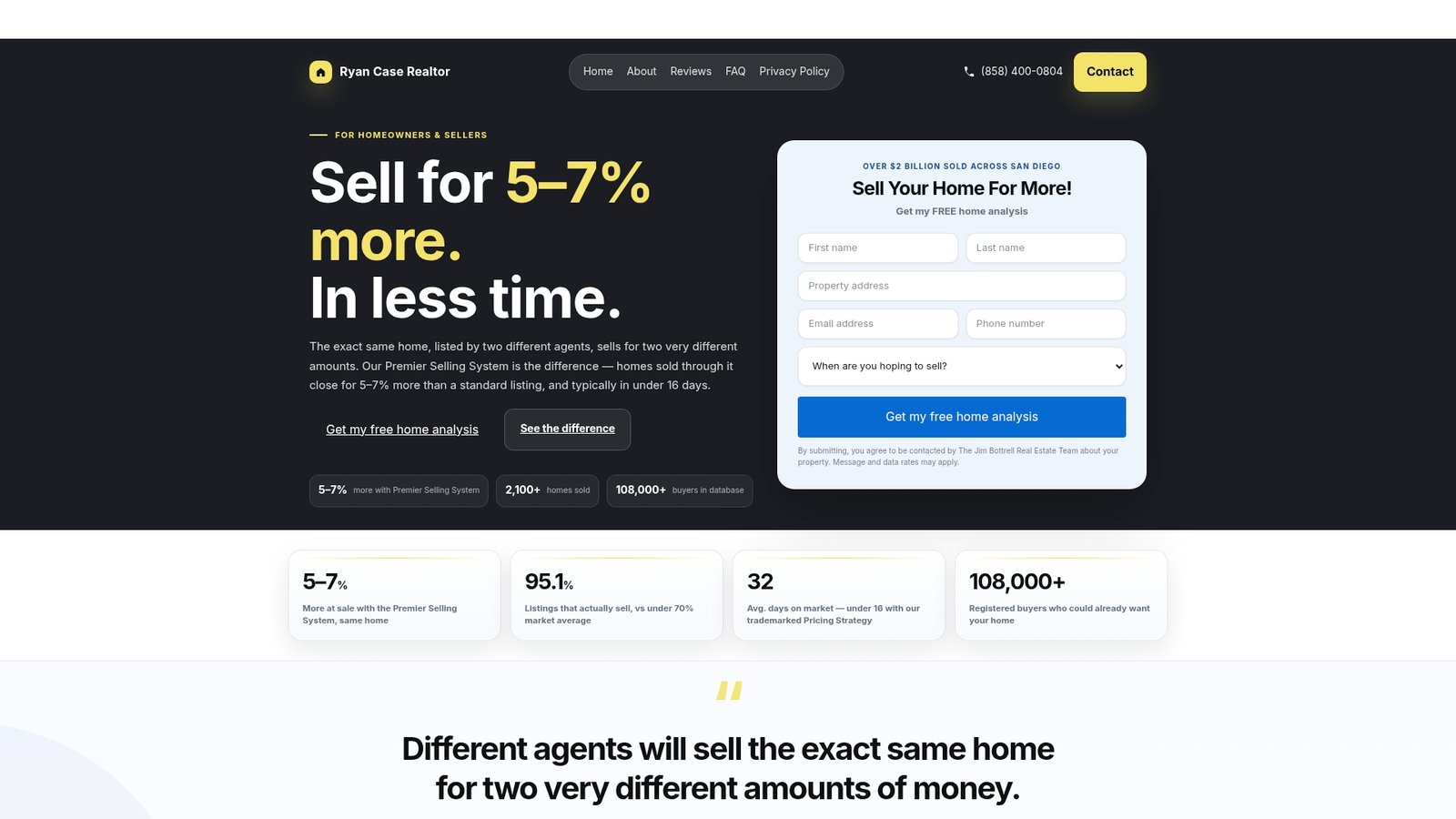
If you’re a San Diego County homeowner weighing your options for selling, contacting Ryan Case gets you a personalized home analysis, a clear open-house execution plan tailored to your property, and access to a buyer network built over years of consistent weekend work. Start with a home analysis to see what a fully executed open house strategy could look like for your listing, or review service and pricing tiers to find the right fit for your sale.
Sources
- What Percentage of Homes Sell from an Open House? – Charles Rutenberg Realty
- The step-by-step open house lead system that fills your pipeline | Inman
- How to Run an Open House That Actually Produces Leads | Harris Real Estate Daily
- Open House Marketing: The Complete Playbook for Agents