A comparative market analysis (CMA) is an agent’s data-backed estimate of a home’s market value based on recent comparable sales, used to set a competitive listing price and marketing strategy. It is the single most important document you’ll review before putting a sign in the yard.
- Purpose: It sets the foundation for your asking price and negotiation range, not just a guess pulled from Zillow.
- Authority: A CMA is an agent’s professional opinion. It carries real weight, but it is not a licensed valuation.
- Timing: You should get one before listing, and again if your home sits on the market longer than expected.
Key Takeaways
A CMA works because it turns recent, verified sold comps into a defensible price range instead of a single unsupported guess.
| Point | Details |
|---|---|
| Definition matters | A CMA is an agent’s data-backed opinion of value, not a licensed appraisal. |
| Comps drive accuracy | Prioritize sold comps from the last three months, with adjustments for older data in slow markets. |
| Range beats single number | A quality CMA gives a price band with reasoning, not one unsupported figure. |
| Update it regularly | Request a new CMA if your home sits unsold past 30 days without showings. |
| Ryan Case builds strategy from data | The Premier Selling System turns a CMA’s comps and adjustments into a pricing and buyer-targeting plan. |
Table of Contents
- What Is a CMA and What Goes Into One?
- CMA vs. Appraisal: What’s the Real Difference?
- Turning Your CMA Into a Pricing and Marketing Plan
- A Seller’s Checklist for Evaluating Any CMA
- The Misconceptions That Trip Up Sellers and Buyers
- How Ryan Case Uses a CMA to Build a Real Strategy
- Get a Personalized CMA for Your San Diego Home
- Sources
What Is a CMA and What Goes Into One?
Building a real CMA takes more than pulling three addresses off the MLS and calling it a day. A quality report starts with a full snapshot of your property: square footage, bedroom and bathroom count, lot size, age, condition, and any upgrades that separate your home from the one next door. That baseline is what everything else gets measured against.
From there, agents commonly build a CMA in four steps: study the subject property, pull comparable sales, adjust for differences, and land on a price range.
- Study the property. Condition, layout, and recent renovations all shift value up or down.
- Pull comps. Agents look at sold, pending, and active listings, prioritizing homes similar in size, age, and location.
- Adjust for differences. A comp with a remodeled kitchen or an extra bathroom gets a dollar adjustment up or down to make it comparable to your home.
- Set the range. The adjusted comps get averaged and weighted into a realistic price band, not a single number.
Timeframe matters here. Sold comps within the last three months are the gold standard for accuracy. In slower markets, agents sometimes reach back to six months, but they need to manually adjust for any shift in pricing trends since those sales closed.
A finished CMA should hand you more than a spreadsheet. Expect a narrative that explains why the comps were chosen, a visual map showing where they sit relative to your home, and a clear price range with the reasoning behind it spelled out in plain language.

Pro Tip: Ask your agent to walk you through at least one adjustment line by line. If they can’t explain why a comp got a $15,000 bump for a finished basement, the whole analysis is worth questioning.
CMA vs. Appraisal: What’s the Real Difference?
A CMA and an appraisal look similar on paper. One is a professional opinion; the other is a licensed valuation with legal weight.
- Who prepares it: A real estate agent prepares a CMA. A state-licensed appraiser prepares an appraisal.
- Standards: Appraisals follow the Uniform Standards of Professional Appraisal Practice (USPAP), while a CMA has no governing standard beyond the agent’s own methodology.
- When each is required: Lenders require an appraisal before funding a mortgage. A CMA is what you use earlier, to decide your listing price in the first place.
Cost and timing diverge sharply too. Appraisals typically run $400 to $700 and happen during escrow, long after you’ve already committed to a list price. A CMA usually comes free from your agent, delivered before you ever go live on the market.
Turning Your CMA Into a Pricing and Marketing Plan
A price range is not a number to stare at. It’s a decision framework. The low end of the range positions you for a fast sale and multiple offers. The high end tests the market’s ceiling, at the risk of longer days on market. Your agent should help you pick a spot based on your timeline and how motivated you actually are to sell quickly.
Watch three signals inside the CMA to sanity check the strategy:
- Days on market (DOM) for comparable homes tells you how fast similar properties are moving right now, not six months ago.
- Sale-to-list price ratios show whether homes in your area are selling above, at, or below asking. A ratio consistently above 100% signals a hot market where pricing slightly under value can spark a bidding war.
- The spread between active and sold prices reveals whether current sellers are overreaching. A wide gap often means active listings are stale and overpriced.
These numbers should also guide what you fix before listing. A CMA that flags which features actually move value locally tells you whether that kitchen remodel is worth doing or whether fresh paint and decluttering will do just as much for a fraction of the cost.
Pro Tip: If your home sits unsold past 30 days without a single showing, that’s your signal to request an updated CMA. Markets shift fast, and the comps that justified your price a month ago may no longer apply.
A Seller’s Checklist for Evaluating Any CMA
Before you trust a number, ask the agent handing it to you these questions:
- “Can I see the full comp list, including addresses and sale dates?”
- “Why did you choose these comps over other recently sold homes nearby?”
- “What adjustments did you make, and what’s the reasoning behind each one?”
- “Are these comps sold, pending, or still active?”
A strong CMA shows its work. Look for recent sold comps (not six-month-old data padded to look current), MLS screenshots you can actually verify, and a written narrative that connects the numbers to a recommendation. Red flags include vague comps with no addresses, stale sales data, or a single price with zero explanation of how the agent got there.
If you’re interviewing multiple agents, compare their CMAs on the same terms:
- Line up their comp counts. Most solid CMAs cite at least three sold comps, with stronger ones pulling six to ten when the market has enough inventory.
- Check whether each agent adjusted for the same differences (square footage, condition, upgrades) or skipped that step entirely.
- Compare the reasoning, not just the final number. The agent who explains their logic is usually the one who understands your market better.
The Misconceptions That Trip Up Sellers and Buyers
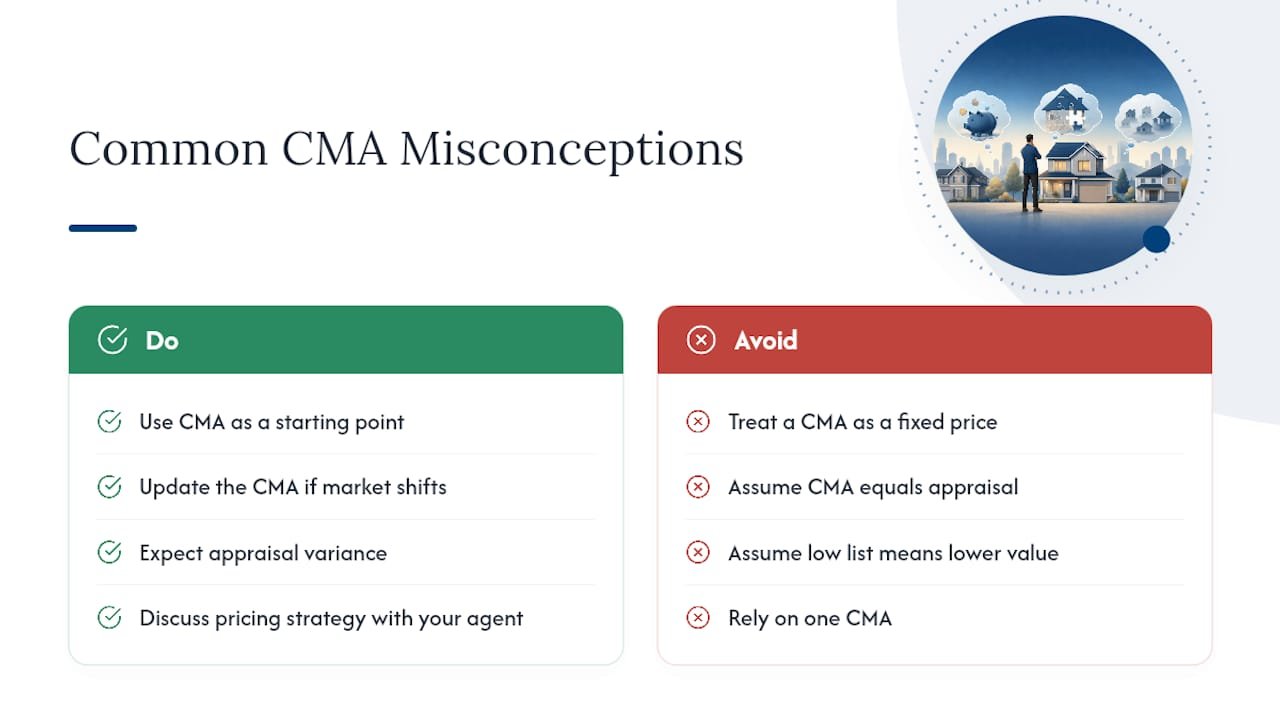
The biggest misconception is treating a CMA’s price range like a fixed asking price. It’s a starting point for a conversation, not a number carved in stone. Markets move, and a range that made sense in January can look off by March.
Another common mix-up: assuming a CMA and an appraisal will always land in the same place. They often come close, but they’re built with different purposes. A CMA leans on an agent’s read of buyer psychology and current competition. An appraisal follows a more rigid, standardized process focused strictly on defensible value for a lender. Sellers sometimes panic when an appraisal comes in below their CMA range, not realizing some variance is normal and expected.
Buyers misunderstand CMAs too. Some assume a low list price backed by a CMA means the home is worth less than similar properties. In reality, agents sometimes price intentionally at the low end of a range to generate competition and multiple offers, a strategy that often pushes the final sale price above the CMA’s midpoint.
Finally, plenty of sellers think one CMA is good for the entire selling process. It isn’t. A CMA reflects a snapshot in time, built from comps available on the day it’s prepared. If your home lingers on the market, new sales close nearby, or interest rates shift buyer behavior, the original analysis stops being accurate. Treating it as permanent is one of the fastest ways to misprice a home for weeks without realizing it.
How Ryan Case Uses a CMA to Build a Real Strategy
A CMA is only as useful as what happens after it lands in your inbox. Inside the Premier Selling System, the CMA is the starting point for a full pricing position, not a document that gets filed away. Every comp, adjustment, and market signal feeds directly into where your home gets priced relative to competing listings and which buyer segments get targeted first.
That’s the gap between a generic CMA and one delivered by an agent who’s spent years reading the same San Diego neighborhoods. You’re not just getting a number. You’re getting a plan built around how buyers in your specific market actually behave.
— Ryan Case
Get a Personalized CMA for Your San Diego Home
If you’ve read this far, you already know a generic online estimate won’t cut it when real money is on the line. Ryan Case builds every CMA by hand, pulling recent sold comps and current market data specific to your San Diego neighborhood, then walking you through the pricing logic in a language you can actually use.

A consultation starts with a conversation about your home’s condition, timeline, and goals. Bring your recent upgrades, any past appraisals, and your target moving date. From there, Ryan builds a full comparative market analysis as part of a broader listing strategy under the Premier Selling System, one designed around your specific price point and competition. If you’re ready to see what your home is actually worth in today’s market, request your personalized home analysis and get a straight answer instead of a guess.
Pingback: 2.4% vs 7.49%: What Sellers Should Know About Online Home Valuations