A preemptive offer strategy works when a buyer pairs a strong price with real financing proof and a short deadline, before the seller ever sets an offer date. Prepared, cash-ready buyers gain the most leverage; sellers gain certainty in exchange for a likely premium. The tradeoff cuts both ways: buyers risk overpaying or waiving protections, and sellers risk leaving money on the table by accepting too fast.
TL;DR:
- Preemptive offers are most effective early in a seller’s market with high showings and motivated sellers, especially within two days of listing.
- A credible bid combines a premium price with proven financing, a realistic closing plan, and a short expiration, typically less than 24 hours.
- Sellers should verify proof of funds and financing directly before accepting or countering, as a strong on-paper offer may still fall apart due to unverified funding.
- Buyers need readiness in financing proof, a short window for contract execution, and a clear minimum price they are willing to accept to make a preemptive bid credible.
- Accelerating an offer deadline can be a smarter move for sellers to preserve competition instead of accepting a fast early bid.
Table of Contents
- What Makes an Offer Preemptive, Not Just Early?
- When Does a Preemptive Offer Strategy Actually Work?
- How Should Buyers Structure a Credible Preemptive Offer?
- How Should Sellers Evaluate and Respond to a Preemptive Offer?
- What Risks Should Buyers and Sellers Watch For?
- What Should You Prepare Before Making or Evaluating an Offer?
- How Does Professional Representation Change the Odds?
- When Do I Recommend a Preemptive Offer?
- How Ryan Case Helps You Handle Early Offers With Confidence
- Sources
- FAQ
What Makes an Offer Preemptive, Not Just Early?
A preemptive offer arrives before the seller’s scheduled offer date, sometimes within days of the first showing. It is submitted early and pairs an above-asking price with minimal contingencies and a short expiration window to persuade the seller to skip the competitive bidding process entirely. Some agents call it a “bully offer,” a term borrowed from Canadian real estate.
Three things separate it from a routine early offer:
- A price premium commonly above the asking price depending on the market
- Compressed or waived contingencies, backed by proof of funds or lender commitment
- A short fuse, with an expiration window commonly less than two days
Timing matters as much as price. A preemptive offer made two days after listing, before showings pile up, carries far more leverage than one submitted the night before the scheduled offer date.
When Does a Preemptive Offer Strategy Actually Work?
Preemptive offers thrive in tight sellers’ markets. They work best when inventory is thin, showings are stacking up fast, and a seller can already sense a bidding war brewing. Preemptive offers are most common in seller’s markets, where a buyer’s goal is avoiding a multi-bid scenario altogether rather than winning one.
Seller motivation matters just as much as market temperature; understanding timelines and logistics can be critical when planning a move, as explained by Residential Moving Services | Affordable Movers Netherlands. A seller relocating for a job, closing an estate, or juggling a second purchase often values certainty over an extra few thousand dollars from a drawn-out auction.
Preemption tends to fail when:
- The home has been listed for more than two weeks with light showing traffic
- The seller has explicitly committed to a review date and told agents they won’t deviate
- The buyer’s financing is unclear or the price premium is thin
In slow or balanced markets, a preemptive offer rarely beats the price a seller would get by simply waiting for competing bids.
How Should Buyers Structure a Credible Preemptive Offer?
A number alone won’t move a seller. A credible preemptive bid combines a price premium with execution certainty: proof of funds or committed financing, a realistic closing plan, and contingencies trimmed to what actually matters. Here’s how to build the package.
- Set the price using showing activity, not guesswork. If a home has had ten showings in three days, a 5% cushion may not be enough. If it’s had two, you may be overpaying at 8% over asking.
- Bring financing proof that goes beyond pre-approval. A lender underwriting letter or full cash proof of funds carries more weight than a generic pre-approval PDF, since it signals the loan has already cleared the riskiest steps.
- Trim contingencies instead of nuking them all. A pre-offer inspection, when the seller allows access, can cost $300 to $1,000 and lets a buyer waive the inspection contingency with actual knowledge instead of blind faith. An appraisal-gap clause caps your exposure without waiving the appraisal contingency outright.
- Raise the earnest money deposit. A deposit at 3% to 5% of price, rather than the standard 1%, signals seriousness in a way a cover letter never will.
- Have your contract and attorney lined up before you submit. A genuinely short window (12 to 24 hours) only works if you can actually execute inside it.
- Have your agent call the listing agent first. Listing agents favor offers with real execution certainty and tend to dismiss thin, unverified bids on sight.
Pro Tip: Never set an expiration you’re not willing to enforce. Extending a deadline on request signals the offer was never really preemptive, and it kills your leverage on the next house.
How Should Sellers Evaluate and Respond to a Preemptive Offer?
Verify before you get excited. Confirm proof of funds, call the buyer’s lender directly, and check how quickly earnest money actually lands in escrow. A preemptive offer that looks strong on paper can fall apart if financing was never fully underwritten.
From there, sellers generally have three paths:
- Accept outright when the premium and certainty clearly beat what a full marketing campaign would likely deliver.
- Counter if you want more, more earnest money, a shorter inspection period, a stronger appraisal-gap clause, or a higher price.
- Accelerate the deadline instead of accepting immediately. Setting an earlier offer date preserves competition while still respecting the buyer’s urgency, often the smartest middle ground.
Whatever you decide, document why you accepted an early offer and verify the buyer’s financing in writing. That record protects you if the deal later falls through or a disappointed buyer questions how the sale was handled.
Pro Tip: If you’re weighing a preemptive offer while also planning your own move, understanding how a home sale contingency works helps you judge whether a buyer’s timeline actually lines up with yours.
What Risks Should Buyers and Sellers Watch For?
Buyers face three real dangers: overpaying without market feedback, missing a hidden defect by skipping inspection, and getting stuck covering an appraisal gap. A pre-offer inspection and a capped appraisal-gap clause address the first two directly.
Sellers face the mirror risk, accepting too early and leaving money on the table if the market would have delivered more. The fix is simple: accelerate the deadline instead of caving immediately, and verify certainty before assuming it exists.
Common mistakes on both sides:
- Buyers submitting a premium price with no financing proof to back it up
- Sellers accepting verbally before confirming funds are real
- Either side treating a “short window” as negotiable once pressure builds
What Should You Prepare Before Making or Evaluating an Offer?
Buyers need five things ready before they ever submit: financing proof, a pre-offer inspector on call, an attorney who can turn a contract fast, earnest money staged for a same-day wire, and a firm walk-away number.
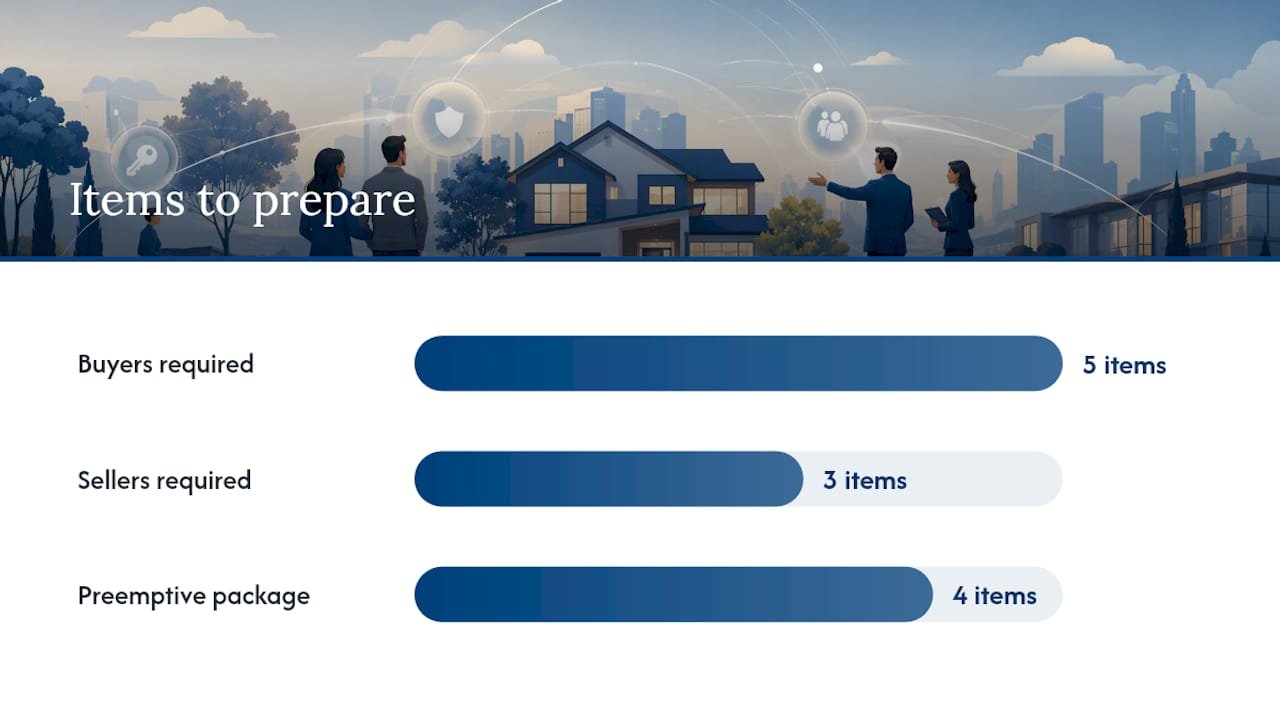
Sellers need three: a way to confirm the buyer’s lender directly, an escrow plan for earnest money, and a clear minimum premium and timeline you’d actually accept.
A basic preemptive offer package should include:
- A short cover letter stating the price, timeline, and expiration
- Proof of funds or a lender underwriting letter
- Direct lender contact information for verification
- Contract riders covering inspection, appraisal gap, and closing date
Keep the package tight. A bloated offer with too many attachments and too little clarity reads as inexperienced, exactly the impression that kills a preemptive bid before the listing agent finishes reading it.
How Does Professional Representation Change the Odds?
A seller weighing an early offer is really asking one question: is this better than what a full campaign would bring? That’s a marketing and buyer-reach problem as much as a negotiation one. A proprietary selling system built around strategic pricing, targeted exposure through tools like Zillow Showcase, and access to a database of active buyers aims to give sellers a clearer read on whether a preemptive offer beats the market rather than beats them to it.
Professional preparation also lowers a seller’s exposure in ways that matter here:
- Contract readiness means a strong preemptive offer can be evaluated and countered within hours, not days
- Buyer database access gives a seller a real benchmark for what competing bids might look like
- Negotiation experience helps separate a genuinely certain buyer from one who just sounds confident
None of that guarantees a specific outcome for any individual sale, but it replaces guesswork with a benchmark, which is exactly what a preemptive decision needs.
When Do I Recommend a Preemptive Offer?
My rule of thumb: preemption makes sense when the buyer’s certainty is real and the seller’s upside is genuinely uncertain, not just theoretical. I’ve seen buyers win a home two days after listing with a clean, well-financed offer no one else could match yet. I’ve also seen sellers regret accepting fast when a little patience would have surfaced a stronger bid. Talk to a professional before you commit either way.
— Ryan Case
How Ryan Case Helps You Handle Early Offers With Confidence
Most buyers guess at a preemptive premium; most sellers guess at whether waiting would pay off. Ryan Case replaces both guesses with data, strategic pricing built from real showing activity and buyer demand, backed by a database of active San Diego buyers and marketing exposure through tools like Zillow Showcase.

The Premier Selling System and related listing options, from Limited Listing to full service, give sellers a benchmark before they accept, counter, or accelerate a deadline on a preemptive bid. For sellers who want certainty without gambling on a full campaign, the Guaranteed Home Sale program offers a lower-risk path that mirrors the same tradeoff a preemptive offer represents: speed and certainty in exchange for a defined outcome. If you’ve received an early offer, or you’re a buyer trying to build one that actually lands, request a personalized home analysis and get a straight read on where you stand before the clock runs out.
Sources
- What Is a Preemptive Offer in Real Estate? – LegalClarity
- What is a Preemptive Offer? Bidding Strategies to Succeed
- Pre-emptive bidding — How to win before the competition starts | Botway Docs
FAQ
What Is a Preemptive Offer?
A preemptive offer is a bid submitted before a seller’s scheduled offer date, combining an above-asking price with minimal contingencies and a short expiration window. It’s designed to persuade the seller to skip the competitive bidding process entirely rather than wait for multiple bids.
What Is the 3-3-3 Rule in Real Estate?
The 3-3-3 rule generally refers to a mortgage readiness guideline: spend no more than three days shopping for a loan, keep monthly housing costs under roughly a third of income, and hold savings equal to three months of expenses. It’s a budgeting rule of thumb rather than a formal industry standard, and it isn’t specific to preemptive offers.
Can You Put an Offer on a House Before It Hits the Market?
Yes, and this is often exactly how a preemptive offer strategy plays out. Buyers who move fast after a listing goes live, or who learn about a pending listing through an agent, can submit before showings even begin, which is when preemptive offers carry the most leverage.
What Is the Hardest Month to Sell a House?
Winter months, particularly December and January, tend to see the slowest buyer activity in most markets, which also makes preemptive offers less common since fewer buyers are actively competing. Sellers listing during these months should weigh that against Ryan Case’s pricing strategy resources before assuming a preemptive bid reflects real competitive pressure.
Should a Seller Always Accept a Preemptive Offer?
No. Sellers should verify the buyer’s financing and compare the offer against what a full marketing campaign would likely produce before deciding. Accelerating the offer deadline instead of accepting immediately often preserves competition while respecting the buyer’s timeline.