If you have the cash reserves or lender options to carry two mortgages for a few months, buy first and take control of your search. If you’re counting on your home’s sale proceeds to fund the down payment on the next one, sell first. Everything else is a variation on those two paths.
Two things decide which path fits you. First: your cash cushion. Can you cover a second mortgage payment, or a bridge loan, for 60 to 90 days without stress? Second: your local market. In a seller’s market, your current home might move fast enough that buying first is low risk. In a buyer’s market, expect your sale to take longer, which tips the math toward selling first or negotiating a rent-back.
- Buy first if: you have sufficient liquid reserves, strong preapproval, or access to a HELOC.
- Sell first if: your equity is tied up and you need proceeds to qualify for the next purchase.
- Middle ground: negotiate a rent-back agreement or bridge financing to close the gap.
Roughly a third of sellers who buy again say timing the two transactions was their biggest source of stress during the move. It’s manageable, but it requires a plan before you list or write an offer.
Key Takeaways
Buying and selling simultaneously succeeds when your cash reserves, lender preapproval, and closing-date negotiations are locked in before you list or make an offer.
| Point | Details |
|---|---|
| Match strategy to cash position | Buy first only if you can carry two mortgages; otherwise sell first or use a bridge tool. |
| Get preapproved early | Confirm your DTI room with a lender before opening any new credit or loan. |
| Negotiate rent-backs upfront | Build a two to four week rent-back clause into your sale contract rather than requesting it later. |
| Keep a fallback ready | Line up short-term storage, a rental, or a bridge loan in case closings miss by more than a few days. |
| Work with a coordinating agent | Ryan Case’s Premier Selling System times listings and buyer outreach around your purchase timeline. |
Table of Contents
- Should You Sell First or Buy First?
- What Financing Options Bridge the Gap?
- How Do You Time Two Closings Together?
- What Does a Real Estate Agent Actually Do Here?
- What If the Closings Don’t Line Up?
- What I Tell Every Client Before They List
- Get a Coordinated Plan for Your Sale and Purchase
- Frequently Asked Questions
- Sources
Should You Sell First or Buy First?
There’s no universal right answer here, only a right answer for your finances and your local market. Buying before selling puts you in the driver’s seat. You get to shop without a deadline, avoid a rushed move, and negotiate from a position of strength instead of desperation. The tradeoff is real: you might carry two mortgages, two insurance bills, and two sets of utility costs for a stretch of time you can’t fully predict.
Selling first removes that financial risk. You know exactly how much cash you’re working with, and you’re not gambling on a sale closing on schedule. The downside is logistical, not financial: you may need to move twice, into a rental or a relative’s guest room, while you hunt for your next place.
Run through this checklist before you commit to either direction:
- Cash cushion. Do you have three to six months of expenses set aside beyond your down payment?
- Preapproval status. Has a lender confirmed you qualify to carry both properties, even briefly?
- Debt-to-income ratio. Would a second mortgage push your DTI past what underwriters accept?
- Market temperature. Are homes in your area selling in days or sitting for months?
- Contingency tolerance. Are sellers in your market actually accepting sale-contingent offers?
That last point matters more than most buyers realize. A sale contingency tells a seller your offer depends on your own home selling first, and in competitive markets, sellers routinely pass over contingent offers in favor of a clean one. In slower markets, the same contingency might get accepted without a fight. Know which market you’re in before you build your offer strategy around it.
Set your expectations accordingly: buying first means budgeting for overlap costs you can absorb. Selling first means budgeting for temporary housing you’d rather skip. Neither path is free of friction, but knowing which friction you’re signing up for changes how you negotiate everything downstream.
What Financing Options Bridge the Gap?
The tools below exist specifically for people trying to own two homes for a short window without breaking their budget. Each fits a different financial profile, so talk through your numbers with a mortgage professional before you assume one is off the table.
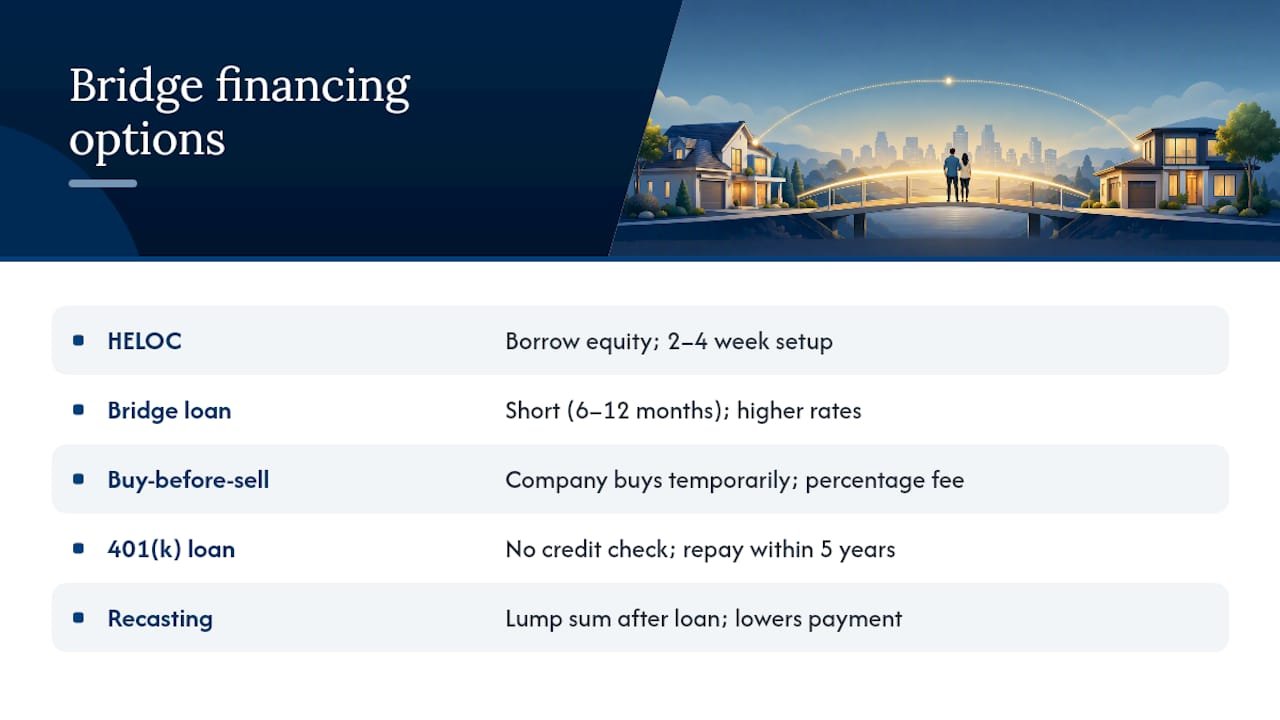
HELOC and cash-out refinance. A home equity line of credit lets you borrow against your current home’s equity to fund a down payment on the next one. Setup typically takes two to four weeks, so apply while your home is still listed, not after you’re under contract on a new purchase. Cash-out refinancing works similarly but replaces your existing mortgage entirely, which usually means a higher rate reset. Lenders will factor the new payment into your debt-to-income ratio immediately.

Bridge loans. These short-term loans, usually six to twelve months, use your current home’s equity as collateral to cover a down payment before it sells. Expect higher interest rates than a standard mortgage and origination fees in the low single digits of the loan amount. Repayment comes due when your old home sells, which means you’re still exposed if that sale slips.
Buy-before-you-sell services. A newer category of company will purchase your next home in their name, let you move in as if you’re the buyer, and give you time to sell your current property before finalizing the purchase in your own name. It’s a convenient workaround for timing, but it comes with service fees that typically run a percentage of the home’s price, so weigh the cost against how much stress it actually removes.
401(k) loans. Borrowing against your retirement account avoids a credit check and skips the early withdrawal penalty, but you’re on the hook to repay it, often within five years, and you lose potential market growth on that money while it’s out of the account.
Mortgage recasting. If you get a windfall, like proceeds from your home sale arriving late, recasting lets you put a lump sum toward your new mortgage’s principal and get your monthly payment recalculated, without refinancing. It’s cheaper than a refinance since there’s no new rate or full underwriting, but it only works after you already have the loan in place.
Pro Tip: Talk to your mortgage professional about these options before you list your home, not after you’ve found the next one. Underwriters get nervous about new credit lines opened mid-process, and knowing your options in advance keeps your debt-to-income ratio predictable when it matters most.
Every one of these tools changes your DTI calculation the moment you use it. A lender consulted early in the process can tell you exactly how much room you have before a second loan pushes you out of qualification range.
How Do You Time Two Closings Together?
Aligning a sale and a purchase is mostly a scheduling problem, and scheduling problems get solved with a written plan. Here’s the sequence that keeps most transactions from colliding:
- Get preapproved before you list, so you know your buying power the moment your home goes under contract.
- List your home with a closing timeline in mind, not just a listing date.
- Negotiate your sale contract to include a rent-back clause or an extended closing date if you haven’t found your next home yet.
- Shop and make an offer on your next home once your sale is firm, or run both processes in parallel if your market allows contingent offers.
- Align both closing dates, ideally within a few days of each other, with your title company and lender confirming both simultaneously.
- Book movers early, since the weeks around month’s end get booked up fast in most markets.
Rent-back agreements are the most common negotiating tool for closing the gap. You sell your home, then pay the new buyer rent to stay in it for a set period while you finish your own purchase. Most rent-backs run two to four weeks, though some buyers will agree to 60 days if the terms are clear in the contract, including a daily rate and a firm move-out date with consequences if you overstay.
If your closings land more than a few days apart despite your best planning, build in a fallback: a short-term storage unit, a month-to-month rental, or a few nights with family. It’s not glamorous, but it’s cheaper than panic-buying the wrong house to avoid it.

Pro Tip: Put every key date on one shared calendar, your lender’s closing date, your title company’s deadline, your movers’ booking window, and your rent-back expiration, and share it with your agent so nothing slips through a gap between two transactions.
What Does a Real Estate Agent Actually Do Here?
Coordinating two closings at once isn’t something you want to manage with spreadsheets and hope. An experienced agent negotiates the rent-back terms, times the listing launch to your buying timeline, and pushes back on buyers who want an unreasonable move-out date.
Ryan Case’s Premier Selling System is built around exactly this kind of coordination. It combines strategic pricing with targeted outreach through an established buyer database, so homes move faster and with fewer days sitting on market, which matters enormously when your next purchase is waiting on that sale to close. Faster marketing exposure through tools like Zillow Showcase shortens the runway between listing and offer, giving you more control over when your rent-back clock starts.
A seller juggling two transactions doesn’t need more listings shown to more people. They need the right buyer found fast, with a closing date that matches their own move, and an agent willing to negotiate the rent-back terms as hard as the sale price itself.
Negotiation scripts matter more than most homeowners expect. When a buyer offers full price but wants immediate possession, an experienced agent counters with a rent-back clause built into the purchase price instead of treating it as a favor. When a buyer’s lender is slow, the agent pushes for a closing date extension rather than losing the deal outright.
What If the Closings Don’t Line Up?
Even careful planning sometimes leaves a gap between your sale and your purchase. A rent-back agreement is the fastest fix if your buyer will agree to it. A short-term loan or a family loan can cover a week or two of overlap without the paperwork of a bridge loan.
- Rent-back or temporary rental buys you days or weeks without a permanent commitment.
- Storage plus a short hotel stay works for gaps under two weeks.
- A 401(k) loan or bridge loan covers longer gaps but adds interest and repayment terms.
- Renting out your home instead of selling gives you breathing room but delays your equity payout.
- A quick-cash buyer trades a lower sale price for a fast, certain close, worth considering only if speed matters more than maximizing price.
Whatever fallback you choose, get the terms in writing: a fixed daily rate for a rent-back, a firm repayment date on any loan, and a clear move-out deadline with a penalty if it’s missed.
What I Tell Every Client Before They List
The biggest mistake I see is homeowners assuming their sale will close exactly on schedule, then signing a purchase contract with no cushion for delay. Build in a week of slack on both ends before you commit to a closing date.
One client recently needed a 45-day rent-back to align with a new construction delay, something a straightforward offer wouldn’t have supported. Negotiating that clause into the sale contract upfront, rather than scrambling for it later, saved the entire deal.
If you’re weighing this move, reach out before you list. A quick conversation now saves a scramble later.
Get a Coordinated Plan for Your Sale and Purchase
Juggling two closings, two lenders, and two sets of paperwork is exactly the kind of coordination problem a full-service agent should be solving for you, not leaving you to figure out with a spreadsheet and a hope. Ryan Case’s Premier Selling System pairs strategic pricing and targeted buyer outreach with hands-on negotiation on rent-backs, extended closings, and contingency terms, the details that decide whether your two transactions land on the same calendar or two months apart.

A consult starts with a home analysis: current market value, expected days on market, and a realistic closing timeline based on what’s actually moving in your neighborhood right now. From there, Ryan Case builds the sale strategy around your next purchase, not the other way around. If you’re planning a move that depends on getting both transactions right, request your home analysis and start the conversation before you list.
Frequently Asked Questions
Can you buy and sell simultaneously without carrying two mortgages?
Yes, through a rent-back agreement, a bridge loan, or a buy-before-you-sell service that covers the gap. Each option shifts the risk differently, so match the tool to how much cash cushion you actually have.
How long can a rent-back agreement last?
Most run two to four weeks, though some buyers will agree to 60 days if the contract spells out a daily rate and a firm move-out deadline.
Does a HELOC affect my mortgage approval on the next home?
Yes. Lenders count the HELOC payment in your debt-to-income ratio, so get preapproved with the HELOC already factored in before you make an offer.
Is it better to sell first or buy first in a slow market?
In a buyer’s market, sell first. Homes take longer to move, and a sale-contingent offer is far less likely to get accepted when buyers have more inventory to choose from.
What happens if my home doesn’t sell in time to close on my new purchase?
You’ll need a fallback: a bridge loan, a short-term family loan, or negotiating an extension on your purchase closing date with the seller.
Sources
Verify any lender or loan originator through NMLS Consumer Access before signing paperwork. For fair housing protections during your transaction, HUD’s Fair Housing and Equal Opportunity office outlines your rights as a buyer or seller. Practical timing and financing guidance is also available through U.S. Bank and quick-close alternatives are described by services like AAS Home Buyers.
- How to buy and sell a house at the same time – NerdWallet
- Buying and Selling at the Same Time: A Survival Guide | Zillow
- Selling and buying a home at the same time? How to make it work | U.S. Bank