Yes, you can sell a San Diego property in probate, but the exact path depends on who holds legal authority and whether a Notice of Proposed Action can replace court confirmation. Confirm your authority under the Letters issued by the court. Order a probate referee appraisal right away, and bring in a probate-aware real estate agent or attorney before you list anything.
TL;DR:
- Full IAEA authority allows a probate sale to proceed with a Notice of Proposed Action, saving roughly three to six months compared to court confirmation.
- The accepted offer must typically reach at least 90% of the referee’s appraised value if the estate requires limited authority, influencing initial pricing strategies.
- A sale that requires court confirmation involves an overbid hearing, which can slow the process and introduces the risk of a higher bid from other buyers.
- Using a probate-aware real estate agent to coordinate appraisals, marketing, and legal filings can significantly reduce overall sales timelines.
- Promptly verifying authority and ordering the referee appraisal at the start can prevent delays and is crucial for an efficient probate sale process.
Table of Contents
- Probate Sale San Diego: The Step-by-Step Process
- What Do IAEA Authority, NOPA, and Court Confirmation Actually Mean?
- Preparing and Marketing a Probate Home for Sale
- How Offers, Deposits, and Overbids Work at Closing
- San Diego Probate Rules, Timelines, and Costs to Expect
- Finding Probate Listings and Preparing a Competitive Offer
- How a Local Listing Specialist Shortens Probate Timelines
- What Executors Get Wrong Most Often
- Selling Your Probate Home the Right Way in San Diego
- Sources
- FAQ
Probate Sale San Diego: The Step-by-Step Process
Selling probate real estate in San Diego follows a fixed order. Skip a step and you either delay closing or expose the sale to a challenge at confirmation.
- File the probate petition and receive Letters. File at the San Diego Superior Court Probate Business Office, which handles wills, estates, and related filings for the county. The court issues Letters Testamentary or Letters of Administration naming the executor or administrator.
- Confirm your authority to sell. If the property sits in a living trust, there’s no probate at all, since a trustee sells under the trust document, not a court order. This is the core difference between a probate sale and a trust sale in San Diego.
- Order the probate referee appraisal. A court-appointed referee values the estate’s real property; this figure drives everything that follows.
- Publish notices and assemble documentation. Prepare the estate inventory, publish required legal notices, and pull together title history, tax records, and any existing liens.
- List the property. Once authority and appraisal are settled, you can put the home on the MLS using a probate purchase agreement rather than a standard residential contract.
What Do IAEA Authority, NOPA, and Court Confirmation Actually Mean?
This is the fork that decides your timeline more than any other factor. The Independent Administration of Estates Act lets a personal representative sell property with reduced court oversight, but only if the court grants that authority when it issues Letters.
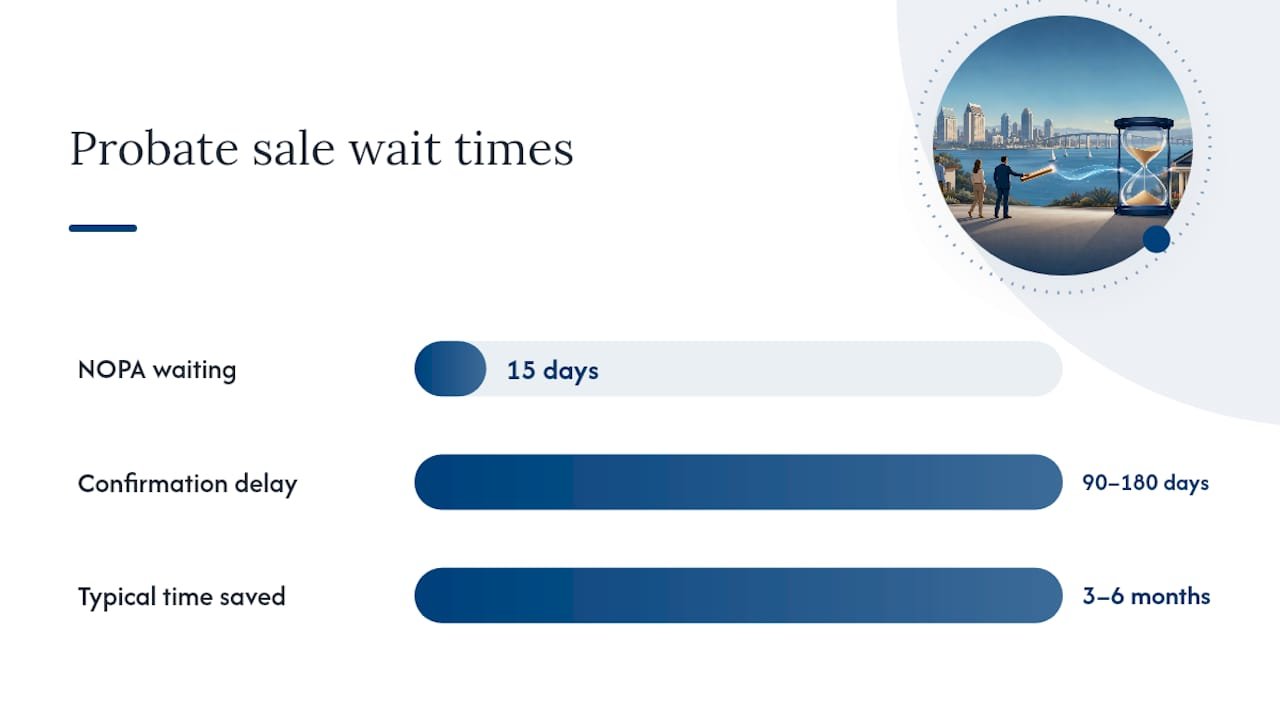
- Full IAEA authority lets you sell using a Notice of Proposed Action. You notify heirs and interested parties, wait out the objection period, and close without a confirmation hearing.
- Limited IAEA authority (or no IAEA authority at all) means every sale needs a judge’s confirmation, complete with a public overbid hearing where other buyers can outbid the accepted offer in open court.
- NOPA timing typically runs 15 days from mailing before you can proceed, far shorter than scheduling a confirmation hearing on a crowded probate calendar.
Full authority with a NOPA can save roughly 3 to 6 months compared with a sale that requires confirmation. That gap is the single biggest lever an executor controls.
Pro Tip: Ask your attorney to request full IAEA authority at the outset of the petition, even if you’re not sure you’ll need it. Requesting it later means another court filing and another delay.
Preparing and Marketing a Probate Home for Sale
The referee’s appraised value sets your price floor before you ever talk to a buyer. Under limited authority, California law generally requires the accepted offer to reach at least 90% of the appraised value, which shapes your entire pricing strategy from day one.
Most probate homes sell as-is, and that’s usually the right call. Courts and heirs want speed and certainty, not a renovation project that drags the estate open for another six months.
- Skip cosmetic remodels; focus only on repairs that affect safety or financing (a broken water heater, exposed wiring).
- Coordinate an estate sale for personal property before photos and showings begin.
- Use professional photography and broad digital exposure, including tools like Zillow Showcase, to pull in more competing offers.
- Ask any agent you’re considering how many probate transactions they’ve closed with the San Diego Superior Court in the past two years.
Pro Tip: A door that sticks or a cracked window screen sounds trivial, but buyers touring an estate sale property notice every small flaw twice as hard. A local pro like One Day Doors & Closets can knock out interior door fixes in a single visit before your first open house.
How Offers, Deposits, and Overbids Work at Closing
Offers on probate property come with rules that catch first-time buyers off guard.
- Submit a probate purchase agreement, not a standard California residential contract, along with proof of funds.
- Expect a firm deposit, commonly around 10% of the offer price for county-managed listings, and understand that deposit can become non-refundable once accepted.
- If the sale requires confirmation, the accepted offer goes to a hearing where any qualified buyer in the courtroom can overbid, usually in set increments over the original price.
- Escrow closes only after the judge signs the confirmation order (or the NOPA period expires without objection), and title must be clear before funds transfer.
Buyers who show up to overbid without proof of funds in hand get turned away at the courthouse door. That single detail trips up more casual bidders than anything else in the process.
San Diego Probate Rules, Timelines, and Costs to Expect
San Diego’s Local Rule 4.13 governs publication requirements, bonds on sale, and commission limits specific to this county.
- Filing and Letters: typically 4 to 8 weeks after the petition is filed.
- Referee appraisal: often completed within 30 to 60 days of appointment.
- Marketing period: varies by property, commonly 30 to 90 days.
- Confirmation hearing (if required): add another 30 to 45 days for scheduling and notice.
Full IAEA authority with a NOPA can shave 3 to 6 months off that total timeline compared with a confirmation-required sale. This difference often determines whether an estate closes in four months or nine.
Finding Probate Listings and Preparing a Competitive Offer
Active probate and estate sale listings in San Diego show up in a few consistent places, and buyers who check all of them beat buyers who check one.
- Monitor the San Diego County Public Administrator’s estate sale page directly for county-managed properties.
- Search the MLS with agent help, since most probate homes get full MLS exposure once court approval clears.
- Watch published legal notices, which name the property and filing details for NOPA and confirmation sales alike.
- Have proof of funds and a probate purchase agreement template ready before you find a property you want, since timelines move fast once a listing goes live.
Never contact an executor directly to negotiate outside the listing agent; it can jeopardize the estate’s legal position and your own offer.
How a Local Listing Specialist Shortens Probate Timelines
An agent who works probate sales regularly does more than list a house. Strategic pricing anchored to the referee appraisal, paired with targeted marketing, tends to attract stronger initial offers and reduce the chance of a disappointing overbid at confirmation, according to selling data from Ryan Case Realtor.
For estates under time pressure, a guaranteed-sale approach can offer certainty that a standard listing can’t. For estates that can wait for maximum exposure, an aggressive marketing plan built around full MLS visibility and buyer database outreach tends to net more.
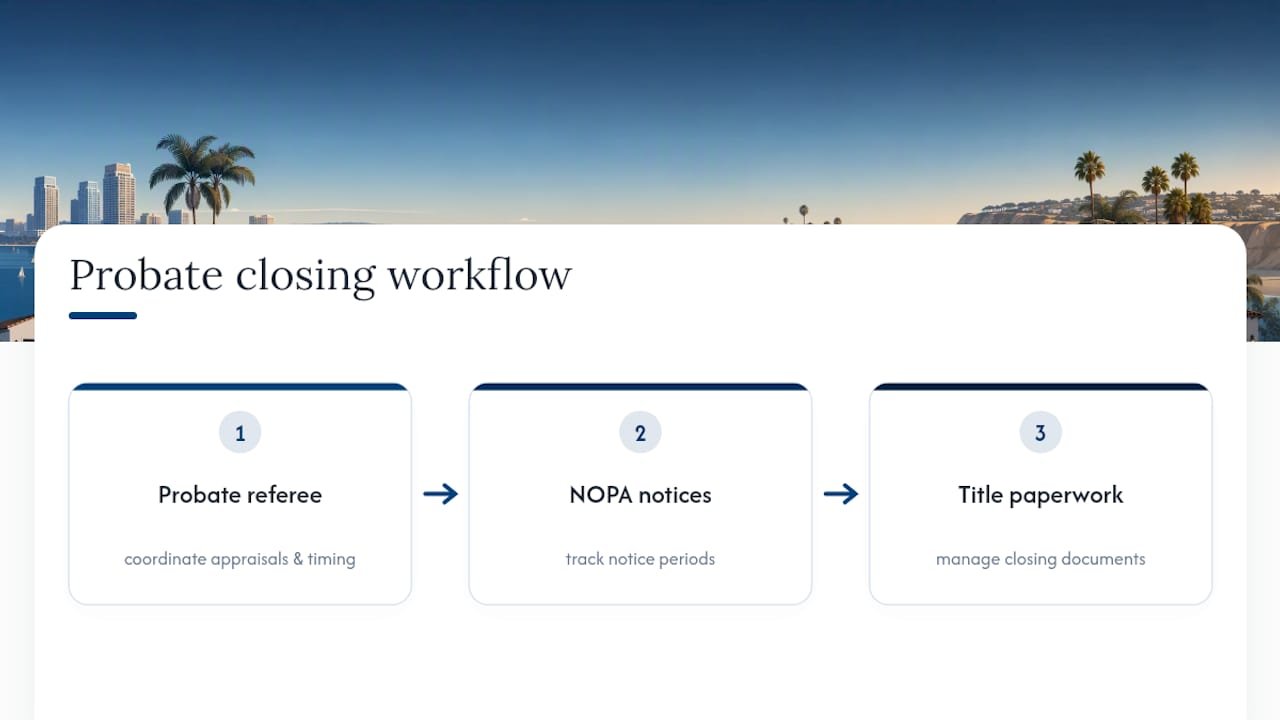
Beyond marketing, an experienced agent also handles logistics: coordinating with the probate referee, tracking NOPA notice periods, and managing paperwork so nothing stalls at the title company.
What Executors Get Wrong Most Often
The most common mistake is starting the marketing conversation before confirming authority. Fix it by verifying your Letters and IAEA status on day one, ordering the referee appraisal immediately, and looping in probate-experienced help before a single sign goes in the yard.
— Ryan Case
Selling Your Probate Home the Right Way in San Diego
A knowledgeable local realtor can provide executors a faster, better-marketed alternative to the bare-minimum listing most probate sales get. The Premier Selling System pairs strategic pricing off the referee appraisal with targeted buyer database outreach, which means your estate isn’t relying on a single open house to hit that 90% threshold.

If the estate needs certainty on a deadline, the Guaranteed Home Sale program removes the uncertainty of waiting on confirmation timing. If the priority is maximum net proceeds within a realistic window, the 6 to 10 week selling approach is built for exactly that. Either way, Ryan Case coordinates the probate paperwork, referee interactions, and marketing timeline so the executor isn’t managing three moving parts alone. Reach out through Ryancaserealtor to talk through where the estate stands today.
This article is general information, not a substitute for advice from a qualified lawyer. Consult a qualified legal professional about your own circumstances before acting on anything here.
Sources
- Probate Court | Superior Court of California
- Estate Sale Terms and Conditions (San Diego County)
- Selling A House In San Diego Probate: Your 2025 Guide & …
FAQ
How Do You Buy a Probate Sale House in California?
You submit a probate purchase agreement with proof of funds and a deposit, typically around 10% of the offer. If the sale requires court confirmation, be ready to attend the hearing since other buyers can overbid your accepted offer in open court.
What Are the Disadvantages of a Probate Sale?
Probate sales move slower than standard transactions, especially when court confirmation and an overbid hearing are required instead of a Notice of Proposed Action. Homes typically sell as-is with limited contingencies, and deposits can become non-refundable once your offer is accepted.
Where Can You Find Estate Sales in San Diego?
The San Diego County Public Administrator’s estate sale page lists county-managed probate properties directly. Most other probate homes appear on the MLS through a probate-experienced agent once the court grants listing approval.
How Do You Find Probate Sellers?
Published legal notices name the executor’s attorney or listing agent for properties heading toward NOPA or confirmation, and those same properties usually reach the MLS. Working with an agent who tracks San Diego Superior Court probate filings can give buyers earlier visibility than searching public notices alone.
What Does Full IAEA Authority Change About the Sale?
Full IAEA authority lets the executor use a Notice of Proposed Action instead of a court confirmation hearing, which can save 3 to 6 months on the overall timeline. Without it, every sale needs a judge’s approval and is subject to overbidding at a public hearing.