Off market listings are private sales you market through your agent’s network without public syndication. MLS listings hit the Multiple Listing Service and syndicate to Zillow, Redfin, and every portal a buyer checks. The rule of thumb: choose MLS when price and speed matter most, choose off-market when privacy or a specific buyer situation outweighs top dollar. Most sellers do better by going wide.
TL;DR:
- Private off-market listings limit exposure to the agent’s network, often resulting in fewer offers and weaker price discovery compared to MLS listings.
- MLS listings generate higher prices and faster sales due to broader buyer pools and increased competition, especially in active markets.
- Sellers valuing privacy or working with a pre-identified buyer might benefit from short private marketing tests, but most will see better results going directly to MLS.
- Transparency and disclosure are crucial; sellers should clarify with agents which off-market pathway they choose and understand the associated trade-offs.
- The gap in sale premiums between private and MLS listings has narrowed, making MLS the default choice for maximizing sale price in most cases.
Table of Contents
- Off Market vs MLS: Key Definitions and How They Compare
- The Real Trade-Offs for Sellers and Buyers
- When Off-Market Actually Makes Sense
- How Buyers Find (and Sellers Run) Off-Market Deals
- What NAR’s Policy Changes Mean for Your Listing
- How an Experienced Agent Actually Evaluates This Decision
- The Honest Take on Off-Market vs MLS
- Ready to Compare Your Own Listing Options?
- Sources
- FAQ
Off Market vs MLS: Key Definitions and How They Compare
The terms get thrown around loosely, so start with what each one actually means.
An off-market property is any home for sale that isn’t syndicated to public portals. A pocket listing (also called a private listing) is the purest version: your agent markets it quietly to their own contacts, and it never touches the MLS at all. An office exclusive is a formal version of that, shared only within the listing brokerage. A delayed marketing exempt listing is different again: it’s already filed in the MLS, so other agents can see it, but the seller has asked to withhold it from public syndication for a period. That distinction matters because “off-market” covers a spectrum, not one single arrangement, and you should ask your agent exactly which version you’re getting before assuming anything.
An MLS listing, by contrast, gets filed with your local Multiple Listing Service, a broker cooperative that shares data across every member brokerage and then pushes it out to public sites. RESO, the organization that sets the technical standards behind nearly 500 MLS systems nationwide, describes this cooperation as the backbone of market transparency.
| Factor | MLS listing | Off-market listing |
|---|---|---|
| Exposure | Broad, syndicated to portals | Limited to agent’s network |
| Buyer pool | Large, competitive | Small, curated |
| Price discovery | Strong (competing offers) | Weaker, fewer comparisons |
| Data availability | Public comps, full history | Often hidden from public records |
The Real Trade-Offs for Sellers and Buyers
Every choice here trades something for something else. Here’s what actually shifts when you pick a lane.
- MLS drives price through competition. A study cited by Zillow covering 2019 through early 2023 found MLS-listed homes sold for a notably higher price than comparable homes marketed privately. More eyes on a listing tends to mean more offers, and more offers tend to mean a higher final number.
- MLS also moves faster for most sellers, simply because a bigger buyer pool finds the right match sooner rather than waiting on word-of-mouth.
- Off-market wins on privacy and control. No public price history, no lockbox parade of strangers, no neighbors watching your sale unfold. That matters to sellers who value discretion over maximizing every dollar.
- The conversion risk is real. BrightMLS research found that only about 13% of homes marketed as office exclusives actually sold that way. Most eventually landed on the MLS anyway, often after burning weeks with no offers.
- Buyers overwhelmingly expect full access. A 2025 Zillow survey found about 90% of prospective buyers believe they should be able to see every home actively on the market, and 43% of sellers who tried a private listing first ended up switching to MLS.
- A narrow off-market premium can exist, but it’s smaller and less reliable than most sellers assume. A 2026 preprint study using zero-day MLS entries as a proxy found a small premium in one metro area, substantially reduced from earlier estimates before broader Clear Cooperation enforcement.
When Off-Market Actually Makes Sense
Neither path is universally right. The decision usually comes down to a handful of concrete factors.
- Price goal: If maximizing sale price is the priority, MLS almost always wins given the pricing data above.
- Timeline: Need certainty on a closing date? MLS produces a bigger, faster-moving buyer pool.
- Privacy needs: Public figures, sensitive family situations, or sellers who don’t want neighbors watching should weigh off-market seriously.
- Property type: Unique or ultra-luxury homes sometimes have a small, identifiable buyer pool an agent can reach directly.
- A pre-existing buyer: If your agent already has a qualified buyer in-network, testing private first costs little.
- Market competitiveness: In a hot market, going public usually creates a bidding dynamic that private marketing can’t replicate.
Pro Tip: If you want to test off-market first, set a hard deadline with your agent, like 10 to 14 days. Agree in writing that if it doesn’t produce a qualified offer by then, you convert to MLS immediately rather than losing more time.
Real examples: a seller relocating quietly for a job change might reasonably try a pocket listing to a known buyer, as shown in cases of rapid house sales and stuck properties resolved. A seller with a standard three-bedroom home in a competitive suburb has almost nothing to gain by skipping MLS. Check the buy-and-sell-simultaneously guide if timing your sale against a purchase is part of the calculation.
How Buyers Find (and Sellers Run) Off-Market Deals
Off-market deals don’t happen by accident. They run through relationships and specific channels on both sides.
Buyers looking for off-market properties typically lean on:
- A well-connected agent with an active buyer network and standing relationships with listing agents.
- Investor and cash-buyer lists that circulate deals before they ever reach a portal.
- Direct outreach: letters, calls, or door knocks in a target neighborhood.
Sellers and agents running a private sale typically use:
- Office exclusives shared only within the listing brokerage.
- Invitation-only previews for a short, curated buyer list.
- Targeted outreach to vetted buyers, often requiring proof of funds or pre-approval before a showing, since the smaller pool means less room for tire-kickers.
Whichever side you’re on, documentation matters. Track every outreach effort, and if you’re the seller signing off on an exempt listing, get the required disclosure in writing before you waive standard exposure.
What NAR’s Policy Changes Mean for Your Listing
The rules here aren’t just industry custom. The National Association of REALTORS® governs this through its Clear Cooperation Policy, which generally requires listing agents to submit a property to the MLS once it’s publicly marketed, and its newer Multiple Listing Options for Sellers, which formally created the delayed marketing and office exclusive pathways.
The key protection built into that newer policy: any seller who chooses delayed marketing or an office exclusive must sign a disclosure acknowledging what they’re giving up. That’s not a formality to skim. It’s your documented proof that you understood the trade-off before agreeing to it.
A few things worth flagging:
- Ask your agent which specific option you’re signing up for, since “off-market” alone doesn’t tell you whether the listing is filed in MLS or not.
- Limiting exposure can raise fair-housing and transparency concerns if it’s used to steer a listing toward a narrow buyer pool rather than genuine privacy needs.
- The pricing gap between public and private marketing has narrowed since Clear Cooperation enforcement tightened up, so don’t assume last decade’s pocket-listing math still applies.
How an Experienced Agent Actually Evaluates This Decision
A seasoned listing agent doesn’t guess. Listings are best evaluated through a comparative market analysis first, then checking the active buyer bench for that specific property type and price point before recommending a path.
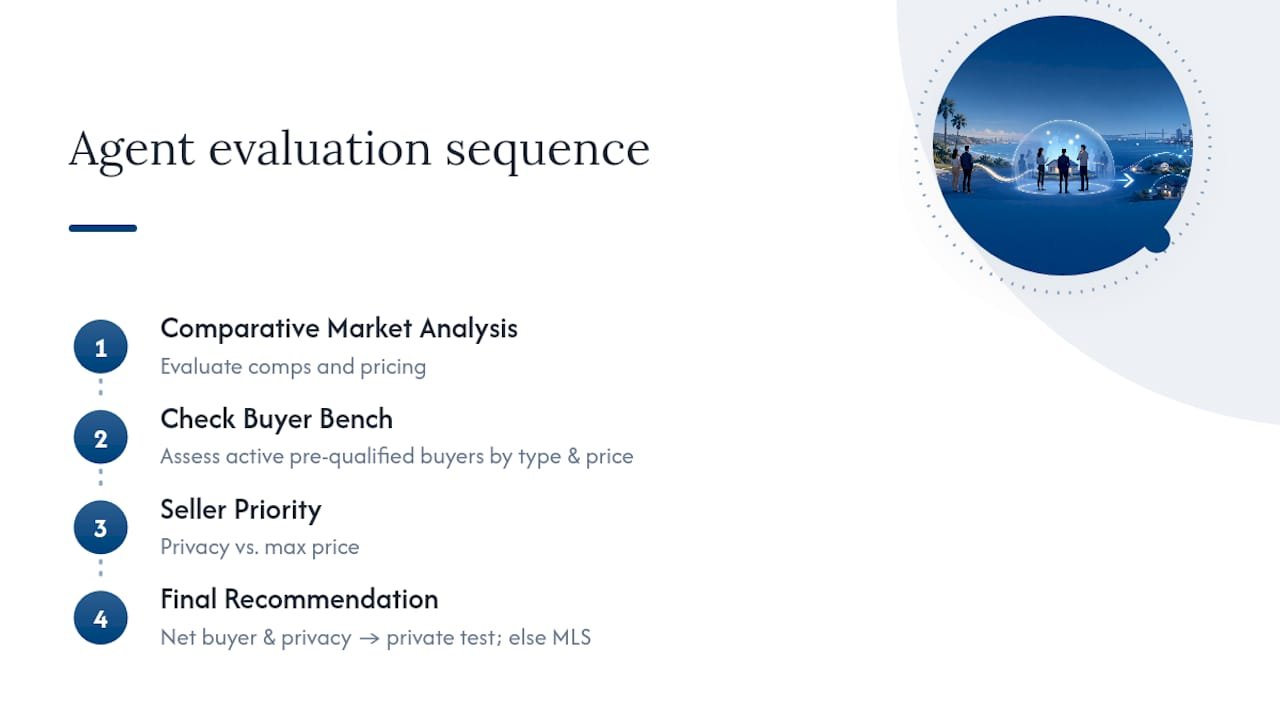
If a genuine pre-qualified buyer already exists in-network and the seller values privacy over maximum price, a short private test can make sense. Otherwise, the Premier Selling System approach defaults to full MLS exposure paired with tools like Zillow Showcase, because the data on buyer pool size and price competition is hard to argue against for most standard listings. Sellers weighing this decision can request a personalized home analysis to see which path actually fits their property and timeline.
The Honest Take on Off-Market vs MLS
Most of the mystique around off-market selling comes from luxury market stories that don’t apply to a typical San Diego home. The data backs this up plainly: MLS exposure correlates with a meaningfully higher sale price in most cases, and the private-sale premium that used to exist has shrunk since Clear Cooperation enforcement tightened.
Where conventional advice falls short is treating “off-market” as one thing. It isn’t. A true pocket listing that never touches the MLS carries far more risk than a delayed-marketing listing that’s already filed and just withheld from portals for a couple of weeks. Sellers who don’t ask which version they’re signing up for are the ones who end up surprised.
Here’s what to prioritize: get the disclosure in writing, set a hard deadline for any private test, and default to MLS unless you have a specific, documented reason not to. Privacy is a legitimate reason. “My agent said it’s more exclusive” is not.
— Ryan Case
Ready to Compare Your Own Listing Options?
Rather than guessing which path fits your situation, get a straight answer based on your specific address, price point, and timeline. Comparative market analyses based on real local inventory help make the off-market versus MLS decision with the actual buyer pool in view, not a hypothetical one.

Several service paths are available depending on what is needed, including options for full-service strategic marketing, different levels of involvement, and programs aimed at providing certainty on a closing date. If a quiet, targeted approach genuinely fits your situation, that gets built into the plan too rather than defaulted away from.
The next step is simple: request a home analysis and find out, with real numbers, whether your home is a candidate for a private test-marketing window or should go straight to full MLS exposure.
Sources
- Multiple Listing Service FAQ | RESO
- What Is a Pocket Listing? | Zillow
- Multiple Listing Options for Sellers | NAR
- Pocket listings premium study (preprint summary) | HousingWire
FAQ
What does “off-market” mean in MLS?
It means a property isn’t syndicated to public portals through the MLS, though the specifics vary. Some off-market homes are filed in the MLS but withheld from public display under delayed marketing rules, while true pocket listings never enter the MLS at all.
Is buying off-market a good idea?
It can work if you have a strong agent relationship and access to a genuine private deal, but the buyer pool and price transparency are both smaller than what MLS offers. Around 90% of buyers surveyed by Zillow say they expect to see every home actively for sale, so off-market deals depend heavily on being plugged into the right network.
Why does my Zillow listing say off-market?
That status usually means the home was withdrawn, sold, or is being marketed under a delayed marketing or office exclusive arrangement rather than being fully syndicated. It can also appear temporarily between a status change and the next data sync.
Why would a property be listed as off-market?
Sellers choose this route for privacy, to test a price quietly, or because they already have a likely buyer in mind. The trade-off is a smaller buyer pool and, based on BrightMLS research, a high chance the home eventually moves to the MLS anyway if it doesn’t sell privately within a short window.