The single most important move in listing description writing is leading with your home’s single best, checkable feature, then following a tight four-part structure: lead line, lifestyle middle, facts block, and a concrete call to action. Every sentence has to be accurate and pass the Fair Housing “ordinary reader” test before it goes live.
TL;DR:
- Listing descriptions should start with a specific, checkable feature, like a recent upgrade or a unique property attribute, to immediately attract buyer attention.
- Incorporate three to five vivid lifestyle moments to help buyers visualize daily life in the home, making the property more memorable.
- Use measurable facts such as dates, measurements, and exact distances to establish credibility and trigger buyer trust during property visits.
- Ensure language complies with Fair Housing rules by avoiding implied preferences or limitations based on race, family status, religion, or other protected categories.
- Keep descriptions around 250 words, front-loading essential details and avoiding filler words or exaggerated adjectives to increase engagement and mobile readability.
Table of Contents
- Why Listing Description Writing Still Matters When Photos Get the Clicks
- How Do You Structure a Listing Description That Converts?
- Which Words Actually Sell a Listing (and Which Ones Waste Space)?
- What Fair Housing Rules Apply to Listing Language?
- How Long Should a Listing Description Be?
- Before and After: Three Listing Rewrites That Actually Work
- What Should You Check Before Publishing Any Listing Remark?
- A Listing Agent’s Take on What Actually Moves Buyers
- Where to Verify Fair Housing Rules and Listing Data
- Sources
- FAQ
Why Listing Description Writing Still Matters When Photos Get the Clicks
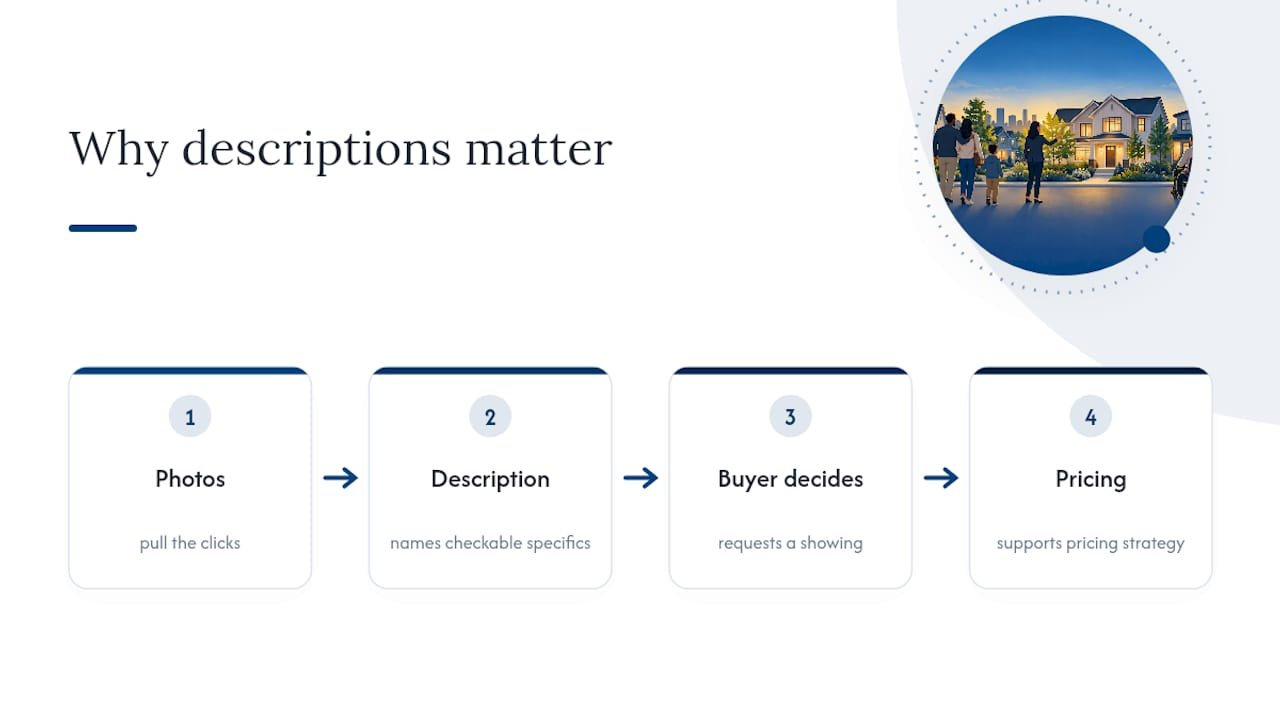
Photos pull the click, but copy closes the showing request. Zillow’s own guidance for agents confirms that while images get the bulk of buyer attention on a listing page, the description still carries real weight once a buyer stops scrolling and starts deciding whether to book a tour.
A description that names checkable specifics, like a renovated kitchen or a walkable coffee shop two blocks over, gives buyers a reason to act instead of just admire. That reason shows up in showing requests, and showing requests are what support your pricing strategy when offers come in. Agents who treat the remarks field as an afterthought are leaving a differentiation tool on the table. The words you choose are one of the few parts of a listing you fully control, unlike square footage or lot lines.
How Do You Structure a Listing Description That Converts?
A practical four-part formula, the one recommended in CloseDaily’s listing description breakdown, keeps you from staring at a blank remarks field wondering where to start.
- Headline or opening phrase. One benefit-focused line naming the standout feature. “Chef’s kitchen meets canyon views” beats “Beautiful home in great location” every time, because it’s specific enough to picture.
- Lead line. Your first full sentence should state the single best, checkable feature of the property. Not “stunning” or “must-see,” but the actual thing: a rebuilt primary suite, a corner lot, a three-car garage.
- Lifestyle middle. Write three to five sentences that create buyer “moments,” small scenes of life in the home. Morning coffee on a private deck. Weeknight dinners that spill onto a patio. This is where you sell the feeling, not just the floor plan.
- Facts block. Two or three sentences of checkable specifics: square footage, year built, recent upgrades with dates, school district if relevant.
- Call to action. End with a concrete showing instruction, ideally with a reason or timing attached, like “Open Saturday 1 to 4, before the next price review.”
That sequence takes maybe fifteen minutes once you’ve done it a few times, and it prevents the generic “won’t last long” filler that buyers scroll right past.
Which Words Actually Sell a Listing (and Which Ones Waste Space)?
Specific, checkable language outperforms vague enthusiasm. Zillow’s data on real estate description writing points to certain keywords, like “barn doors” or “stainless,” that correlate with faster sales in portal analyses. But those words only work when they’re true. A “gourmet kitchen” with a builder-grade range is the kind of claim that erodes trust the moment a buyer walks in.
| Words that pull weight | Filler words to cut |
|---|---|
| “Roof replaced June 2023, transferable warranty” | “Must-see” |
| “Quartz counters, GE Profile appliances” | “Charming” |
| “0.4 miles to Lincoln Elementary” | “Cozy” (often reads as small) |
| “South-facing backyard, no rear neighbors” | “Won’t last” |
| “Owned solar, installed 2022” | “Gorgeous” |
A few rules make this easier to apply on deadline:
- Attach dates to any upgrade claim: “new roof” means nothing; “roof replaced June 2023” does.
- Use measurable distances for amenities: “0.4 miles” beats “close to.”
- Name brands for appliances or systems when they add credibility, like a Sub-Zero fridge or a Trane HVAC system.
- Save adjectives for moments, not features. “Gorgeous” describing a whole house is filler; “gorgeous canyon sunset views from the primary bedroom” is a scene.
What Fair Housing Rules Apply to Listing Language?
The Fair Housing Act prohibits advertising that indicates a preference or limitation based on race, color, religion, sex, handicap, familial status, or national origin, and HUD’s guidance on advertising through digital platforms applies an “ordinary reader” standard. That means regulators look at how the whole ad reads in context, not just whether one flagged word appears.
NAR’s Fair Housing Act guidance reinforces that this applies fully to listing remarks, and recommends checking your own MLS’s prohibited-terms list, since many maintain lists that go further than federal law requires.
Common risky phrases and safer swaps:
- “Perfect for empty nesters” → “Single-level living, low-maintenance layout”
- “Walking distance to churches” → “Near neighborhood parks and dining” (unless the buyer specifically asks about religious institutions)
- “Great for families” → “Four bedrooms, fenced backyard”
- “Master bedroom” → “Primary bedroom” (increasingly standard MLS terminology)
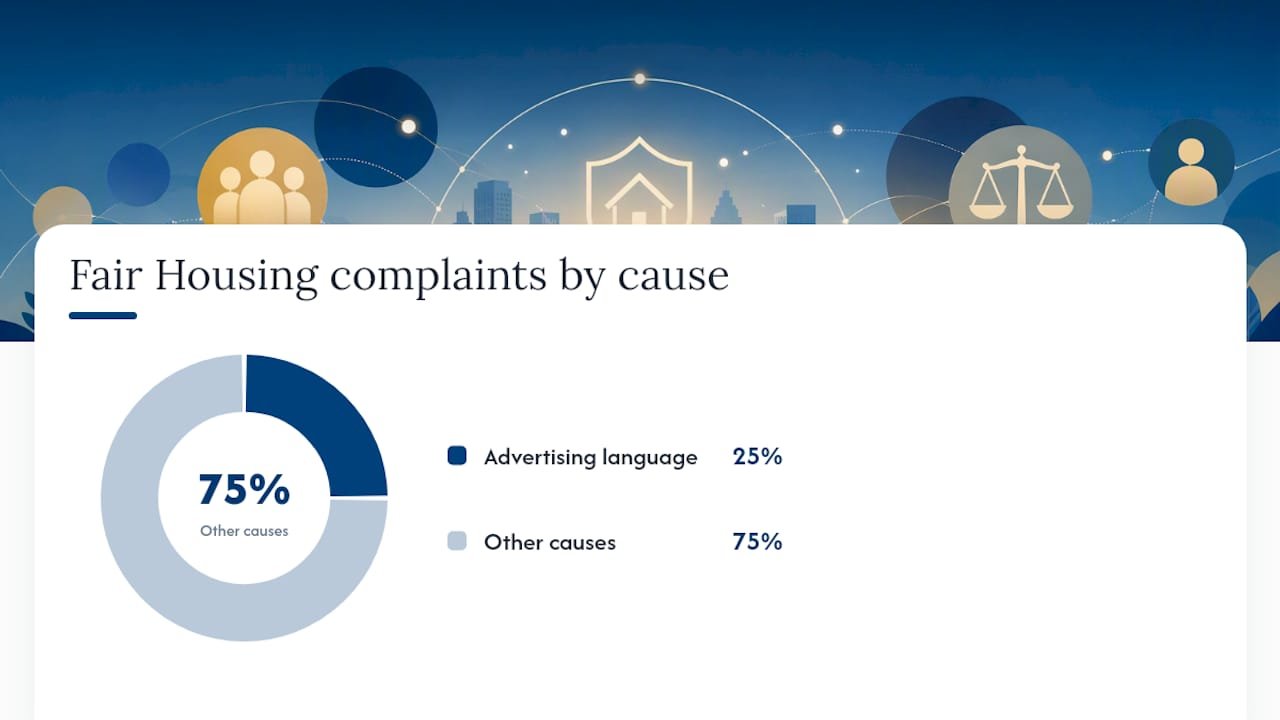
One in four Fair Housing complaints tied to advertising language stems from wording that seemed harmless to the person who wrote it. The safest habit is running every draft through your MLS’s banned-terms list, then reading it aloud, then having a colleague or broker give it a second pass before it goes live.
How Long Should a Listing Description Be?
Zillow recommends roughly 250 words as a practical target for portal listings, long enough to tell a story, short enough to survive mobile viewing without getting cut off.
- Keep your headline and lead line especially tight, since portals often truncate remarks after the first sentence or two on mobile.
- Avoid ALL CAPS and stacked exclamation points. They read as noise, not enthusiasm.
- Spell out abbreviations a buyer might not know. “EIK” means nothing outside certain regional MLSs; “eat-in kitchen” works everywhere.
- Front-load anything essential. If it matters, it belongs in the first two sentences, not paragraph three.
Before and After: Three Listing Rewrites That Actually Work
Seeing the fix matters more than reading the rule. Here are three common weak openings and what replaces them.
- Before: “Beautiful home in a great neighborhood, won’t last long!” After: “Rebuilt kitchen with quartz counters and GE Profile appliances, finished March 2026.” The rewrite trades empty enthusiasm for one checkable fact a buyer can verify at the showing.
- Before: “Cozy starter home, perfect for a young family.” After: “Three-bedroom single-level home with a fenced backyard and updated 2023 HVAC.” This version drops the family-coded language and replaces it with specifics that describe the property, not the buyer.
- Before: “Charming fixer with tons of potential.” After: “1948 bungalow with original hardwood floors, rewired electrical (2021), and a permitted ADU-ready lot.” The second version turns “potential” into something a buyer can actually price out.
A high-rise example: “Corner unit on the 14th floor, floor-to-ceiling windows facing the bay, HOA includes 24-hour concierge and a rooftop pool.” A fixer example: “Structurally sound 1962 ranch, original layout intact, seller has architectural plans available for a primary suite addition.”
Both examples lead with the single best feature and back it with a fact the buyer can confirm, which is the whole point of the exercise.
What Should You Check Before Publishing Any Listing Remark?
Run this before you hit save on the MLS remarks field:
- Does the lead line pass the single-best-feature test? One sentence, one checkable claim.
- Are there at least two buyer “moments” in the lifestyle middle?
- Have you fact-checked every date, measurement, and school reference?
- Does the copy pass a Fair Housing read, including your MLS’s own prohibited-terms list?
- Does the CTA include a concrete showing instruction with timing or a reason?
- Have you read it aloud once, and had a colleague or broker glance at it?
Pro Tip: Write three short variants of the same remark, a premium version, a neutral version, and a value-focused version, and swap in a new one if a listing stalls past seven to ten days. This treats your description like a small A/B test instead of a one-shot draft.
If your broker flags a phrase as a legal gray area, escalate to counsel rather than guessing. It’s not worth the exposure.
A Listing Agent’s Take on What Actually Moves Buyers
I’ve found that the best listing copy does one job well instead of five jobs poorly: it gets a buyer to picture themselves making coffee in that kitchen. Everything else, the adjectives, the exclamation points, is noise competing with that one goal.
Copy doesn’t work in isolation. It has to sit alongside professional photography, floor plan marketing, and portal tools like Zillow Showcase, which Zillow’s own data suggests helps agents win more listings when paired with strong marketing overall. The description is the connective narrative that ties the visuals together, not a replacement for them.
— Ryan Case
Where to Verify Fair Housing Rules and Listing Data
For the legal baseline, go to HUD’s FHEO guidance and NAR’s Fair Housing Act resource. For structure and word-choice data, CloseDaily’s rewrite guide and Zillow’s agent resources are worth bookmarking. Always cross-check against your own MLS’s prohibited-terms list, and loop in local counsel for anything ambiguous.
If you’re weighing whether your current listing copy is pulling its weight, or whether it’s time for a full remarketing pass, Ryan Case’s Premier Selling System pairs writing like this with strategic pricing and targeted buyer outreach across San Diego County.
Sources
- FHEO guidance on advertising through digital platforms (HUD)
- Fair Housing Act (NAR)
- Real Estate Listing Descriptions: The Formula, the Word Lists, and 3 Full Rewrites (CloseDaily)
- Writing better listing descriptions (Zillow for Agents)
FAQ
How Do You Write a Listing Description Step by Step?
Start with a headline naming the standout feature, then a lead sentence stating the single best checkable fact. Follow with three to five lifestyle sentences, a short facts block with dates and measurements, and end with a concrete call to action.
What Is an Example of a Good Listing?
A strong example leads with specifics: “Rebuilt kitchen with quartz counters and GE Profile appliances, finished March 2026,” rather than “Beautiful home, won’t last!” The rewrite gives buyers something they can verify, not just an adjective.
What Is an Example of a Property Description?
A property description combines a factual lead (“Three-bedroom single-level home with a fenced backyard”) with lifestyle detail (“mornings on the covered patio, steps from the neighborhood trail”) and closes with a showing instruction like “Open Saturday 1 to 4.”
Can You Give a Creative Example of a Real Estate Listing?
For a high-rise unit: “Corner unit on the 14th floor, floor-to-ceiling windows facing the bay, HOA includes 24-hour concierge and a rooftop pool.” For a fixer: “Structurally sound 1962 ranch, original layout intact, seller has architectural plans available for a primary suite addition.” Both lead with one verifiable feature instead of a generic pitch.
How Long Should a Listing Description Be?
Zillow recommends around 250 words as a practical target, with the headline and lead line kept especially tight since mobile viewing often truncates longer remarks.
Pingback: 6 Entry Only MLS Steps San Diego Sellers Should Get Right