If your San Diego County home carries a Mello-Roos special tax, you can still sell it at a strong price, but you have a legal duty to act early. California law requires you to make a good-faith effort to get a special tax disclosure notice and hand it to the buyer. The sellers who do this before the listing goes live protect their price and avoid the renegotiations that most often derail escrow.
This guide covers how to confirm your property is in a district, what the notice must contain, how the tax changes the way buyers see your home, and how to price and market around it.
TL;DR
- Mello-Roos is a separate special tax on your county bill, not part of the 1% general property tax. The City of San Diego explains that it appears as its own charge.
- Under Civil Code 1102.6b, you must make a good-faith effort to obtain a disclosure notice and deliver it to the buyer.
- The notice should show the current amount, the maximum tax, the annual increase and the date the tax ends. Get it before you list, not after you accept an offer.
- Buyers judge the total monthly cost of owning your home. Price with the tax in view, and disclose it in the marketing, not only in the contract.
- If you are leaving a low Proposition 13 tax base, check your own next purchase too. Base year transfers are limited.
Table of Contents
- What Mello-Roos is, and how to tell if your home has it
- What you must disclose, and when
- How Mello-Roos changes the way buyers see your home
- Pricing a home that carries a special tax
- A seller’s timeline, step by step
- Proposition 13, Proposition 19 and your next home
- Perspective: why we put the tax up front
- Working with us on a home with a special tax
- FAQ
- Sources
What Mello-Roos is, and how to tell if your home has it
Mello-Roos is a way for cities, counties, school districts and other agencies to finance public improvements. The San Diego County Assessor describes it as a financing method for public works. Those works are typically things like schools, roads, parks and fire stations. The tax is levied on properties inside a Community Facilities District (CFD), often shortened to CFD special tax.
The charge shows up on your county property tax bill as a separate line from the 1% general levy. Homes in newer master-planned communities are the usual suspects, but a district can sit under any parcel, so check rather than assume.
How to check your parcel
- Find your ten-digit secured parcel number in the middle of your property tax bill.
- Enter it in the San Diego County special assessments lookup. It shows assessed value, tax rates and a breakdown of special assessments, including Mello-Roos or CFD charges.
- Read the line items on your actual bill. Any charge with a district name or “CFD” or “1915 Act” in it is a special tax or assessment.
- If the county tool does not help, call the Assessor’s office at (619) 236-3771 or Property Tax Services at (858) 694-2901, the numbers the county lists on that page.
If you live in the City of San Diego, the city also publishes a page for sellers of homes subject to a special tax or special assessment. Other cities and districts run their own, so the levying agency named on your bill is the one to contact.
What you must disclose, and when
California Civil Code section 1102.6b applies to sales of residential property that are subject to the state’s transfer disclosure article. The City of San Diego’s guidance summarizes the duty: sellers of property subject to Mello-Roos taxes or 1913/1915 Act assessments must make a good-faith effort to obtain a disclosure notice and deliver it to the prospective buyer. The city’s seller page lists what the notice should contain:
- The amount of the special tax
- The maximum tax authorized
- The percentage by which the tax can increase
- The date the tax is scheduled to end
You can satisfy the duty with a notice from the levying agency or with a qualified third-party report that is substantially equivalent. The wording matters: the law asks for a good-faith effort, which means doing the work, keeping the paper trail and delivering it on time. Saying you did not know is not a defense.
New homes versus resales
Buyers of brand-new homes receive a public report from the developer. For resales, there is no single standard document, according to the city guidance summarized in our research. You or your agent must request the notice. That is why it is smart to order it the day you decide to sell. Agencies and third-party report providers take time, and you do not want an escrow clock running while you wait.
Where it fits in your disclosure package
The special tax notice travels with the rest of your paperwork: the Transfer Disclosure Statement, the Natural Hazard Disclosure and, if you have one, the HOA documents. Our guides on California seller disclosures (TDS and NHD) and HOA documents California sellers need walk through the rest of that stack. Mello-Roos and HOA dues are different things, and buyers mix them up. The HOA is a private association. The Mello-Roos tax is a government levy collected with your property tax.
A general reminder: disclosure rules carry legal consequences. If your situation is unusual, such as a trust sale, an estate or a partial interest, ask a California real estate attorney about your exact obligations.
How Mello-Roos changes the way buyers see your home
Mello-Roos is rarely the problem. Surprise is the problem.
The tax is a long-term cost that sits on top of the regular tax bill and, in many districts, escalates on a schedule. Buyers are not only paying this year’s number. They are taking on a liability that runs to a set end date. When they learn the amount late, they tend to reopen price. When they learn it up front, they fold it into their offer and move on.
Here is the buyer’s math, in plain terms:
- The lender counts all monthly housing costs, including the special tax, when deciding what loan the buyer qualifies for.
- A higher tax therefore means a smaller loan for the same income.
- A smaller loan means a lower price the buyer can reach, unless they bring more cash.
That is why two otherwise identical homes, one with a special tax and one without, can attract different offers. It is also why a clear notice in the first week of marketing helps you. The buyers who see your home and still schedule a showing have already priced in the tax.
What the local market says
Timing and transparency matter more when the market is selective. The Greater San Diego Association of REALTORS market report for September 2026 shows a split. Detached homes had a median sales price of $1,079,000, up 5.8% from a year earlier, with inventory down 12.9% and an average of 37 days on market. Attached homes had a median of $670,000, down 0.2%, with inventory up 5.8% and 44 days on market.
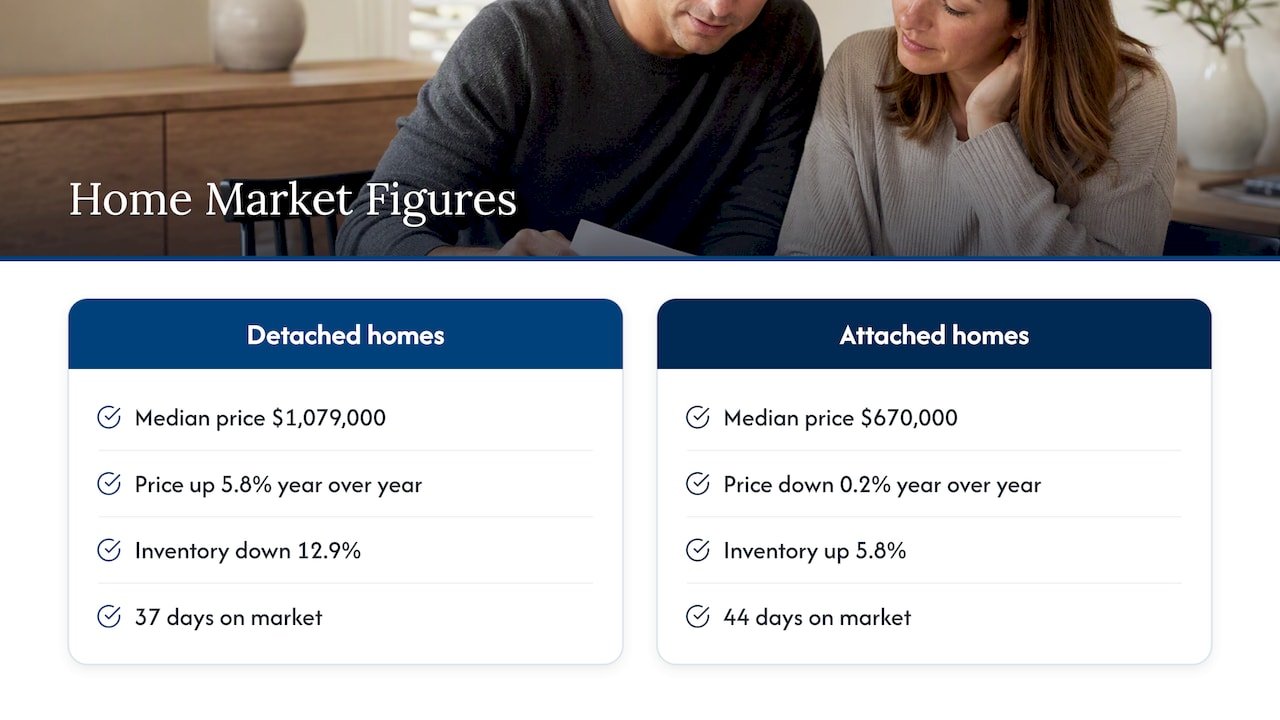
If you are selling a detached home in a tight-supply segment, buyers have fewer choices and you have more leverage, but only if the file is clean. If you are selling a condo or townhome with a district tax, you are competing with growing inventory, and a buyer who feels uncertain can simply move to the next listing.
For a deeper look at supply, see our piece on San Diego housing inventory and what it means for sellers, and our 2026 market forecast.
Pricing a home that carries a special tax
There is no formula that subtracts a fixed amount from your price per dollar of Mello-Roos. Anyone who gives you one is guessing. Buyers respond to the total package: the amount, how long it lasts, how fast it rises and what comparable homes cost.
The approach that works:
- Pull comps with the same burden. Compare to closed sales in the same district, or at least the same community, not to a nearby street with no special tax. Mixed comps will mislead you in both directions.
- Compare total monthly cost. Put the Mello-Roos amount next to each comp’s tax bill so you can see what buyers actually weighed.
- Use closed sales for the final call. Pending sales are useful signals, but they are not final. Our guide to backing pending comps with three to six months of closed sales shows how.
- Be honest about the end date. A tax that ends in a few years is a different product from one that runs for decades. The end date belongs in your pricing logic and in your marketing.
Overpricing is the most expensive mistake here. If you list high and hope the buyer overlooks the tax, the notice will arrive in the contingency period and the price will be renegotiated anyway, usually after you have already lost your best weeks on the market. Our page on data-backed strategic home pricing explains how we set a number that holds through inspection and appraisal.
A seller’s timeline, step by step
Before you list
Confirm the parcel has a district charge. Order the disclosure notice from the levying agency or a qualified third-party provider. Read it yourself: if the maximum tax, the escalator or the end date surprises you, it will surprise buyers too.
Consider also a pre-listing inspection. The point is the same as with the tax notice: find the information before the buyer does, and control how it is presented.
On day one of marketing
Put the special tax in the listing materials. State the amount, the end date and the district name, and attach the notice to the disclosure package that buyers’ agents download. Buyers who find tax data buried in a late document read it as a hidden cost, even when the number is perfectly ordinary.
During escrow
Deliver the notice with your disclosure package and keep proof of delivery. If a buyer asks follow-up questions about the district, answer from the document, not from memory. Questions about bond maturity or the escalator belong with the levying agency.
At closing
Property taxes, including special taxes on the secured bill, are prorated through escrow. Review the settlement figures with your agent so you know what appears on the statement. Our overview of seller closing costs in San Diego covers the other line items you should expect.
Proposition 13, Proposition 19 and your next home
Mello-Roos is separate from your Proposition 13 base, but sellers often mix the two, so it helps to be exact.
Proposition 13 caps the general property tax rate at 1% of assessed value, plus voter-approved debt. The State Board of Equalization’s handbook explains that assessed value resets on a change in ownership or new construction. Your buyer will be taxed on the purchase price, not on your older, lower assessed value. A buyer’s new bill will therefore look different from yours, and a Mello-Roos charge sits on top of it.

If you plan to carry your low tax base to a replacement home, Proposition 19 limits who qualifies. Under the Board of Equalization’s rule on base year value transfers, the benefit is for people over 55, severely disabled homeowners and victims of wildfire or other disaster, and one condition is that the original primary residence is sold within two years of buying the replacement. Our article on Prop 19 timing in San Diego covers that window in more detail. Downsizers in particular should verify eligibility before counting on it.
Capital gains is a different tax
Mello-Roos does not change your federal gain calculation, but sellers often ask about it in the same breath. If the property was your main home, you may be able to exclude up to $250,000 of gain, or $500,000 on a joint return, provided you owned and lived in it for at least two of the last five years, according to the IRS. Talk to a CPA about your own numbers.
Perspective: why we put the tax up front
We have seen the same pattern in sale after sale: price is not what kills a deal, a surprise is. A buyer who understands a special tax in week one treats it as a feature of the neighborhood. A buyer who finds it in week three treats it as something the seller hid, and starts looking for a discount.
So our advice is simple. Order the notice before you list. Read it. Build your price from closed sales that carry a similar burden. Put the tax, the end date and the district in the marketing, and let the right buyers self-select. That keeps your home from sitting while people debate whether a number on a PDF is a problem.
We built our Premier Selling System around pricing and exposure that hold up under scrutiny. A clean disclosure file is part of that, because a strong offer is only worth something if it closes.
— Ryan Case
Working with us on a home with a special tax
If you are selling in San Diego County and want a plan that covers pricing, disclosure timing and marketing, start with our selling services. We offer several tiers, from paperwork-only to full service and the Premier Selling System, so you can choose the level of support that fits your sale. If certainty matters more than a long listing period, look at our guaranteed home sale program. Fees depend on the tier, so ask us for the details that match your home.
FAQ
Do I have to disclose Mello-Roos when I sell my house?
Yes, if the property is subject to a Mello-Roos tax or a 1913/1915 Act assessment. Civil Code 1102.6b requires you to make a good-faith effort to obtain the notice and deliver it to the buyer. Your agent can help you order it, and an attorney can advise on unusual sales.
Can I pay off Mello-Roos before I sell?
Some districts allow a prepayment and some do not, and the terms vary by district. Ask the levying agency named on your bill whether a payoff is available and what it would cost. Compare that figure with what a buyer would reasonably discount your price for the tax before deciding.
Will Mello-Roos lower my sale price?
It can, because it raises the buyer’s monthly cost, but no fixed percentage applies. The effect depends on the amount, how long the tax runs and how comparable homes in the same district sold. Pricing from closed sales with similar burdens is the best protection.
How do I find out if my San Diego County home has Mello-Roos?
Look for a district or CFD line on your property tax bill, or enter your parcel number in the county special assessments lookup. It breaks out special assessments by parcel. If you are still unsure, call the Assessor’s office at (619) 236-3771.
Sources
- Selling Your Home Subject to a Special Tax or Special Assessment, City of San Diego
- CFD Frequently Asked Questions, City of San Diego
- California Civil Code 1102.6b
- Mello-Roos, San Diego County Assessor
- Special Assessments lookup, County of San Diego
- Assessors’ Handbook Section 401, California State Board of Equalization
- Rule 462.540, base year value transfers, Board of Equalization
- Market Activity, Greater San Diego Association of REALTORS
- Topic no. 701, Sale of your home, IRS