If you’re 55 or older, severely and permanently disabled, or you lost your home in a wildfire or other declared disaster, Prop 19 lets you carry your existing Prop 13 assessed value to a new primary residence anywhere in California, including within San Diego County. The move: file the correct claim form with the assessor in the county where your replacement home sits, not your old county, and do it within the deadlines tied to your claim type. Get that piece wrong and you may face delays for the tax break you’re entitled to.
TL;DR:
- Homeowners over 55 or with a permanent disability can transfer their Prop 13 assessed value to a new California home, but must file within specific deadlines at the new county assessor’s office.
- The base-year value transfer in San Diego is fully transferable if the new home costs the same or less, but additional value is added if the price exceeds the original property’s market value.
- Family inheritance rules changed in 2021, requiring the heir to occupy the property as their primary residence to maintain the Prop 19 benefit, with a $1 million cap on the property’s assessed value.
- To prevent delays, claimants should carefully file the correct form at the right county, gather all supporting documents, and file promptly, especially the homeowners’ exemption on the new property.
- The lifetime limit of three age or disability transfers means planning move sequences is essential, and timing moves within the two-year window can avoid reassessment or additional taxes.
Table of Contents
- Who Qualifies for Prop 19 in San Diego County
- How Base-Year Value Transfer Works in San Diego
- Parent-Child and Grandparent-Grandchild Exclusion Changes
- Filing a Prop 19 Claim in San Diego: Forms and Checklist
- Sample Calculations for Common San Diego Scenarios
- Common Filing Mistakes That Delay or Deny Claims
- Limitations San Diego County Homeowners Should Plan Around
- What Prop 19 Means for San Diego Seniors Downsizing
- Disaster Victims and Prop 19 Claims in San Diego County
- Planning Multiple Moves Under Prop 19 in San Diego
- Appealing a Denied or Disputed Prop 19 Claim in San Diego
- Timing a Move Around Prop 19: An Agent’s Take
- Get Hands-On Help Timing Your Prop 19 Move
- Sources
Who Qualifies for Prop 19 in San Diego County
Eligibility hinges on three categories, and San Diego County residents trip up most often on the fine print rather than the headline rule.
Age 55 or older is the most common path. Only one spouse or co-owner needs to hit 55 as of the sale date of the original home. You don’t need to be retired, and you don’t need to have owned the home for any minimum number of years, just be on title and meet the age threshold at the right moment.
Severely and permanently disabled homeowners qualify under a separate claim (BOE-19-D), and the California State Board of Equalization requires documentation from a licensed physician confirming the disability is both severe and permanent, not temporary. A broken hip that heals in six months doesn’t count. A condition that permanently limits mobility or requires a wheelchair-accessible home typically does.
Wildfire and natural disaster victims get their own claim type (BOE-19-V) when a property is substantially damaged, meaning at least 50% of its value, by a Governor-declared disaster. Given San Diego County’s wildfire history in backcountry communities like Alpine, Julian, and Ramona, this category matters more here than in most parts of the state.
Beyond the category itself, you have to prove the original property was your principal residence, usually shown through the homeowners’ exemption filed on that home. A few complications come up repeatedly:
- Multiple owners or co-tenants: only one owner needs to meet the age or disability requirement, but all owners of the original home generally need to be owners of the replacement.
- Property held in a trust: the trust structure itself doesn’t disqualify you, but the assessor will want to see the deed and trust documents proving continuous ownership and occupancy.
- Death or divorce: if ownership changed hands recently, be ready to document exactly when and how, since a gap in the ownership chain can stall a claim.
How Base-Year Value Transfer Works in San Diego
Portability is the mechanism that makes Prop 19 valuable, and the math behind it surprises a lot of homeowners who assume it’s a flat discount.
You have a two-year window to buy or complete new construction on a replacement home, counted from the sale date of your original residence. That window runs both directions: you can buy first and sell within two years, or sell first and buy within two years. Either sequence works, but the clock starts the moment one leg of the transaction closes.
The math that catches people off guard: if your replacement home costs the same as or less than your original home’s market value, your old assessed value transfers over completely, no adjustment. But if the replacement costs more, the difference between the two market values gets added on top of your transferred base. Buy a $200,000 more expensive home, and that $200,000 gap becomes new taxable value stacked onto your old assessment, not the full new purchase price.
Here’s how San Diego County typically applies that formula:
- Equal or lower value replacement: your prior assessed value transfers as is. If your San Diego home was assessed at $400,000 and you move to a home that sells for the same amount or less, you keep paying tax on roughly that $400,000 base.
- Higher value replacement: the county adds the excess market value to your transferred base. Sell your original home for $900,000 and buy a $1,050,000 replacement, and the $150,000 gap gets added to your old assessed value.
- Usage limit for age/disability claims: most San Diego homeowners can use this benefit up to three times over their lifetime under the age or disability category. Disaster-related claims aren’t subject to that same three-use cap.
- Statewide portability: the replacement home doesn’t have to be in San Diego County. You can transfer your base value to a home in Riverside, Sacramento, or anywhere else in California and it still works.
One wrinkle that trips up escrow timelines: your replacement property often gets assessed at full market value the moment you close, because the county needs time to process your claim and apply the adjustment. That means you might see a temporary, higher tax bill or a supplemental assessment before the corrected, lower base value catches up. Budget for that gap. It’s not a sign anything went wrong, it’s just how the timing works between purchase and claim approval.
Parent-Child and Grandparent-Grandchild Exclusion Changes
Prop 19 rewrote the rules for family property transfers starting February 16, 2021, and the change was significant enough that a lot of San Diego families with inherited property are still catching up on what it means for them.
Before Prop 19, a parent could leave a rental property or vacation home to a child, and the child could keep the old, often much lower, assessed value regardless of what they did with the property. That’s gone. Under the current rules, the exclusion only applies if the child or grandchild actually moves into the home and claims it as their primary residence, or if it’s a family farm. Keep it as a rental or a second home, and the county reassesses it at current market value.
There’s also a value cap. If the home’s assessed value plus $1,000,000 is less than the current market value, the excess gets added to the transferred base, similar to how the portability math works for age and disability claims described above. That $1,000,000 figure adjusts periodically, so check the current threshold before assuming your specific number.
Practical steps for San Diego families handling an inheritance:
- File BOE-19-P within the required timeframe, generally within three years of the transfer, or before the property is sold to a third party if that happens sooner.
- Confirm the inheriting family member actually occupies the home and files a homeowners’ exemption on it promptly.
- For estates involving property values anywhere near or above the $1,000,000 combined threshold talk to an estate planning attorney or tax professional before the transfer happens, not after.
Filing a Prop 19 Claim in San Diego: Forms and Checklist
The paperwork itself isn’t complicated, but San Diego homeowners lose weeks, sometimes months, by sending it to the wrong place or missing a supporting document.
Four BOE forms cover almost every Prop 19 scenario:
- BOE-19-B — for homeowners 55 or older transferring their base year value.
- BOE-19-D — for severely and permanently disabled homeowners; requires physician certification.
- BOE-19-P — for parent-child and grandparent-grandchild transfers.
- BOE-19-V — for victims of wildfire or a Governor-declared natural disaster.
You file with the assessor’s office in the county where the replacement property is located, not where your old home was. If you’re moving into San Diego County from elsewhere, that means filing here even if your prior home was in Orange County or Sacramento. If you’re leaving San Diego County, your claim goes to the new county’s assessor instead. This single detail is the most common reason claims stall, and San Diego County’s own property tax savings guidance flags it directly.
San Diego County accepts filings by mail, email, or in person at the Assessor/Recorder/County Clerk office. Before you submit, gather:
- Valid photo ID for all claimants
- Copy of the deed or grant deed for both properties
- Purchase agreement or escrow closing statement for the replacement home
- Evidence of homeowners’ exemption on the original residence
- Physician’s certification, if filing under the disability category
Pro Tip: File your homeowners’ exemption on the replacement property the same week you close escrow. Don’t let a delayed filing cost you money you’re otherwise entitled to.
If your original home is still in escrow when you submit your Prop 19 claim, that’s fine. Just include the pending sale documentation, and expect the county to finalize the claim once both closings are recorded.
Sample Calculations for Common San Diego Scenarios
Numbers make this concrete faster than rules do. These are illustrative examples, not a substitute for your actual assessor notice, but they show the shape of what to expect.
Notice the downsizing row: even though the replacement home costs less than the original sold for, the taxable base doesn’t shrink below the transferred value, it just doesn’t grow. That’s actually the point of downsizing under Prop 19. A retired San Diego homeowner selling a $700,000 house and buying a $500,000 condo keeps paying tax on the old $350,000 base rather than getting reassessed at the new $500,000 purchase price, which is exactly the cash-flow protection the law was designed to deliver.
The “moving up” row shows where people get surprised. Adding $150,000 in market value gap directly onto the old base pushes the tax bill up by roughly $1,650 a year in this example, real money, but still far less than being reassessed on the full $850,000 purchase price, which would run closer to $9,350 annually. Your actual rate depends on your specific tax rate area within San Diego County, so treat these figures as directional and confirm exact numbers with the assessor’s office once you have real purchase figures in hand.
Common Filing Mistakes That Delay or Deny Claims
Most denied or delayed Prop 19 claims in San Diego trace back to a handful of repeat offenders, and nearly all of them are avoidable.
Filing with the wrong county assessor tops the list. If you bought your replacement home in San Diego County, your claim goes to San Diego, full stop, even if your prior home was somewhere else entirely. Filing with the old county means someone eventually has to forward or reject the paperwork, adding weeks to the timeline.
Missing the two-year purchase window is the second most common trap. Homeowners sometimes assume the clock starts when they list their home, not when it actually sells. Track the sale closing date, not the listing date.
Trust and title complications cause more denials than people expect. If the property sits in a trust, or if ownership percentages shifted during a divorce or after a death, the county needs a clean paper trail showing continuous qualifying ownership.
Escrow reserve shortfalls round out the list. Lenders sometimes underestimate the temporary supplemental tax bill that arrives before your Prop 19 adjustment is processed. Keep extra reserve funds available so an unexpected bill doesn’t catch you short.
- Double-check the county before mailing anything.
- Calendar your two-year deadline the day escrow closes on the first property.
- Pull your trust documents and title history before listing.
- Ask your lender directly whether they’ve budgeted for a possible supplemental assessment.
Pro Tip: Call the assessor’s office before you file, not after. A five-minute phone call confirming which forms and documents your specific situation requires can save weeks of back-and-forth correspondence later.
Limitations San Diego County Homeowners Should Plan Around
Prop 19’s benefits come with real boundaries that matter more in a market like San Diego, where home values run well above the state median.
The three-use lifetime cap on age and disability claims means you can’t treat portability as an unlimited moving allowance. If you’ve already used the benefit twice, your third move needs to count, because there’s no fourth.
The value-comparison math also hits harder here than in lower-cost markets. Because San Diego home prices are high in absolute terms, even a modest percentage upgrade in home value can translate into a large dollar gap added to your base. Moving from a $900,000 home to a $1,100,000 home adds $200,000 to your taxable base, a bigger jump than the same percentage increase would cause in a market with lower home prices.
San Diego’s tax rate areas also vary by jurisdiction within the county, meaning two homes with identical assessed values can carry different total tax bills depending on school district bonds, special assessments, and Mello-Roos fees layered on top of the base 1% rate. Prop 19 transfers your assessed value, not your total bill, so always ask about local assessments on the replacement property before assuming your new tax bill matches your old one.
Finally, remember portability only protects your primary residence. A vacation property, rental, or investment condo doesn’t qualify for base-year transfer, regardless of your age or disability status.
What Prop 19 Means for San Diego Seniors Downsizing
For homeowners aged 55 and older in San Diego County, Prop 19 removed the biggest financial obstacle that used to keep people trapped in homes too large for their needs.
Before Prop 19, a senior who bought a home decades ago at a fraction of today’s price faced a brutal choice: stay in a house with too many stairs and too much yard, or sell and get reassessed at full market value on a new place, often tripling or quadrupling the annual tax bill. That penalty kept plenty of San Diego retirees in homes in Clairemont, La Jolla, and Rancho Bernardo that no longer fit their lives, simply because moving cost too much in ongoing taxes.
Now downsizing from a $900,000 home to a $600,000 condo, as the earlier calculation table shows, doesn’t reset your tax base upward. It transfers cleanly, and if the replacement costs less than what you sold for, you’re not penalized for buying smaller. That frees up equity for retirement income without a corresponding tax penalty, which matters enormously for fixed-income households.
The practical effect shows up in decisions we see across the county: seniors moving from single-family homes into age-restricted communities, condos closer to family, or smaller homes in the same neighborhood to cut maintenance costs. The tax math no longer punishes the move, so the decision comes down to lifestyle fit rather than financial fear.
Disaster Victims and Prop 19 Claims in San Diego County
San Diego County’s wildfire exposure, particularly in East County communities and the backcountry, makes the disaster-victim provision of Prop 19 more than a theoretical benefit for a lot of families.
To qualify, your home needs to have sustained damage of at least 50% of its value from a fire or other event the Governor has formally declared a disaster. That threshold matters: partial smoke damage or minor structural repair generally won’t clear the bar, but a home destroyed or substantially leveled by fire typically will.
The claim form is BOE-19-V, and unlike the age or disability categories, disaster-related transfers aren’t limited to three lifetime uses, since nobody should be penalized for facing multiple qualifying disasters. You’ll need documentation of the disaster declaration alongside proof of the damage assessment, usually available through your insurance claim or a county damage inspection report.
One detail specific to disaster claims: the replacement home doesn’t have to closely match the value of the destroyed home the way it does under the standard age/disability rules, though the same value-comparison math applies if you buy something significantly more expensive. If you’re rebuilding on the same lot rather than relocating, different new-construction rules may apply, so confirm with the assessor’s office how your specific rebuild scenario is being classified before assuming standard portability math applies automatically.
Planning Multiple Moves Under Prop 19 in San Diego
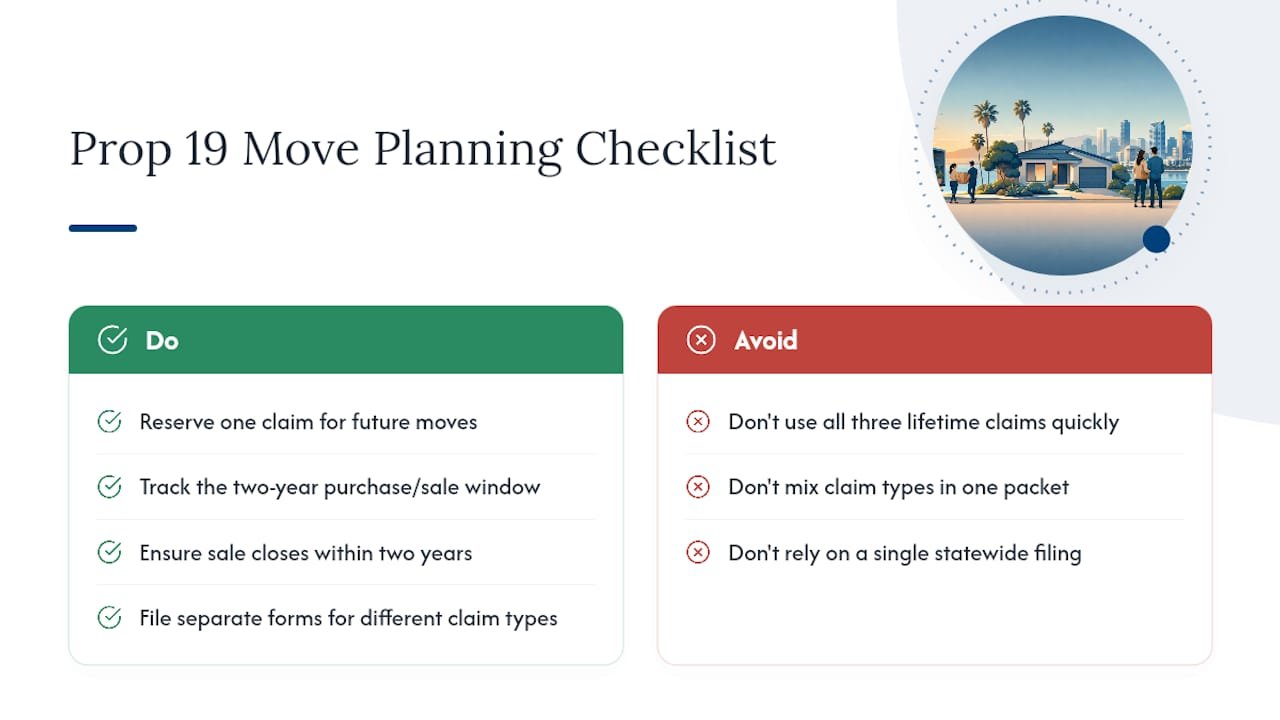
Because age and disability claims cap out at three lifetime uses, sequencing matters if you anticipate more than one move within San Diego County over the coming years.
Think about the order of moves strategically. If you’re planning a transitional move now, say, from a large family home into a smaller single-story property, followed by a possible future move into assisted living or closer to family, that’s two uses of your three. Leave room for the third if there’s any chance you’ll need it.
Timing around the two-year purchase window also matters when you’re coordinating overlapping transactions. If you’re buying before selling, make sure your sale closes within two years of the purchase, and vice versa. San Diego’s competitive housing market can make it tempting to buy first to secure a home before selling, but track that clock carefully so you don’t accidentally forfeit the transfer.
For families managing transfers across generations at the same time, for instance a parent using portability for their own move while also planning an eventual parent-child transfer of a different property, keep the two claim types separate in your paperwork. They’re governed by different forms and different rules, and mixing them in one filing packet tends to slow both down.
If your plans involve properties both inside and outside San Diego County, remember each replacement filing goes to that property’s specific county assessor. There’s no single statewide filing covering multiple future moves in advance. Each move gets its own claim, filed at the right time, in the right place.
Appealing a Denied or Disputed Prop 19 Claim in San Diego
If the San Diego County Assessor denies your claim or you disagree with the assessed value applied, you have a formal path to challenge it, and the timeline matters.
Start by contacting the assessor’s office directly. A denial often stems from a documentation gap rather than an actual ineligibility, and a follow-up call or resubmission with corrected paperwork resolves many disputes without ever reaching a formal appeal.
If the disagreement persists, San Diego County residents can file an assessment appeal with the Assessment Appeals Board, a quasi-judicial body separate from the assessor’s office that reviews valuation disputes. Appeals generally need to be filed within a set window after you receive your assessment notice, so don’t wait to see if the issue resolves itself.
Bring documentation that directly addresses the reason for denial: proof of principal residence, physician certification for disability claims, disaster declaration paperwork, or trust and title records showing continuous qualifying ownership. Vague appeals without new documentation rarely change the outcome.
For high-value disputes, particularly parent-child transfers involving the $1,000,000 combined-value threshold, an experienced property tax attorney can help build the appeal, since these cases often hinge on valuation methodology that benefits from professional interpretation. For simpler eligibility disputes, most San Diego homeowners can navigate the appeals process directly with the assessor’s guidance.
Timing a Move Around Prop 19: An Agent’s Take
Coordinating a Prop 19 transfer well means sequencing the sale and purchase so both fall inside that two-year window without leaving you carrying two mortgages or losing leverage in negotiations. Negotiated closing dates and rent-back arrangements often solve this better than rigid contract dates. Loop in your escrow officer and a tax professional early so nobody’s surprised by a supplemental bill mid-transaction. Getting this timing right is exactly the kind of coordination Ryan Case’s Premier Selling System is built to manage for San Diego sellers navigating a linked sale and purchase.
— Ryan Case
Get Hands-On Help Timing Your Prop 19 Move
Reading the rules is one thing. Actually sequencing a sale and purchase so you land inside the two-year window, without double mortgages or a rushed lowball offer, is a different problem entirely. That’s where working with a San Diego agent who handles this specific timing puzzle regularly pays off.

Ryan Case works with San Diego County homeowners planning Prop 19 moves through a full home value analysis, a timing strategy built around your specific replacement window, and direct coordination with escrow and title so your claim paperwork lines up with your closing dates. When a transfer involves trust documents or complex ownership history, Ryan also connects clients with the tax or legal counsel needed to keep the claim clean. For sellers worried about carrying two mortgages, negotiated rent-back arrangements can buy the breathing room needed to buy before selling, or sell before buying, without breaking your two-year deadline. If you’re ready to see what your current home could sell for and how a coordinated move might work under Prop 19, request a personalized home analysis and start mapping out your timeline today.
Sources
- Proposition 19 – California State Board of Equalization
- Homeowners’ Exemption — San Diego County Assessor
- LAO analysis — Proposition 19 impacts and intergenerational exclusion changes