That baseline rests on a county benchmark price near $998,000 reported by local trackers in mid-2026, combined with the San Diego Regional EDC’s read on the local economy as an inflection point rather than a downturn.
The biggest wildcard isn’t demand. It’s affordability: the median-priced home here still requires a household income well above what most buyers earn, which caps how fast prices can climb even in a good year.
- Baseline: +2% to +5% appreciation, concentrated in late 2026
- Watch closely: mortgage rates, office-to-housing conversions, and local job growth
- Biggest risk: a rate spike or economic shock that stalls buyer qualification
Key Takeaways
| Point | Details |
|---|---|
| Baseline forecast | Expect 2% to 5% county-wide price growth, concentrated in the second half of 2026. |
| Affordability is the real constraint | Median-income households still fall short of what’s needed to comfortably afford the median-priced home. |
| Watch office conversions | Roughly 33% downtown office vacancy could add housing supply if conversions accelerate. |
| Neighborhoods diverge | Inland and North County submarkets offer more upside; coastal areas offer more stability. |
| Work with local expertise | Ryan Case’s Premier Selling System uses strategic pricing and targeted marketing to help sellers price and time listings against these 2026 scenarios. |
Where to Track San Diego’s Market After You Read This
Follow the San Diego Regional EDC for policy and economic signals, California DOF county forecasts for long-term socioeconomic projections, local MLS trackers for neighborhood pricing, and Marcus & Millichap reports for office-market and conversion trends. Sellers planning renovations before listing can also check local remodeling partners for interior updates that affect resale value.
Table of Contents
- What Is the Market Forecast for San Diego in 2026?
- What’s Driving San Diego’s Housing Market in 2026?
- Three Scenarios for the 2026 San Diego Market
- What Should San Diego Buyers and Sellers Do Right Now?
- Frequently Asked Questions
- Sources
What Is the Market Forecast for San Diego in 2026?
Anyone asking for a market forecast San Diego 2026 buyers and sellers can actually use needs three numbers first: the current median price, how fast homes are moving, and where mortgage rates sit. All three point toward a market that’s cooling from its pandemic-era frenzy but nowhere near a crash.
County-wide, the median home price sits close to $998,000 as of mid-2026, according to local benchmark reporting, with several trackers showing modest year-over-year gains rather than the double-digit jumps of 2021 and 2022. That’s a meaningful shift. Buyers who sat out the last few years hoping for a correction are instead watching prices grind upward at a pace closer to historical norms.
Inventory tells the more interesting story. Active listings have been climbing off historic lows, and multiple local trackers now describe a more balanced market where location and presentation matter more than they did when almost anything sold in a weekend. Condos and townhomes are seeing the sharpest inventory increases, while well-priced single-family homes in strong school districts still move quickly.
| Metric | Current Reading (Mid-2026) |
|---|---|
| County median price | ~$998,000 |
| Year-over-year change | Modest positive gain (tracker-dependent) |
| Mortgage rate environment | Near 6%, described as “normalizing” |
| Market balance | Shifting toward buyers in condos; still competitive for well-priced single-family homes |
Norada Real Estate’s market analysis describes this as a normalization year rather than a return to the ultra-low rates of 2020 and 2021.
Pro Tip: If you’re comparing days-on-market figures across websites, check the data window each site uses. A 30-day snapshot and a 90-day rolling average can tell very different stories about the same month.
The takeaway for anyone tracking San Diego market trends 2026 heading into the rest of the year: this is a market of averages hiding real variation underneath. County-wide numbers look calm. Neighborhood-level numbers do not always agree.
What’s Driving San Diego’s Housing Market in 2026?
Three forces are doing most of the work behind this year’s numbers, and none of them are the usual suspects of pure supply and demand.
First, the labor market is going through a structural shift, not just a cyclical slowdown. San Diego Regional EDC leadership called 2026 an “inflection point” driven by productivity gains, slower job formation, and a workforce reshaped by AI adoption across the region’s innovation, defense tech, and life sciences clusters. Fewer new hires doesn’t necessarily mean fewer buyers. It means the buyer pool is shifting toward higher earners in fewer, more specialized roles.
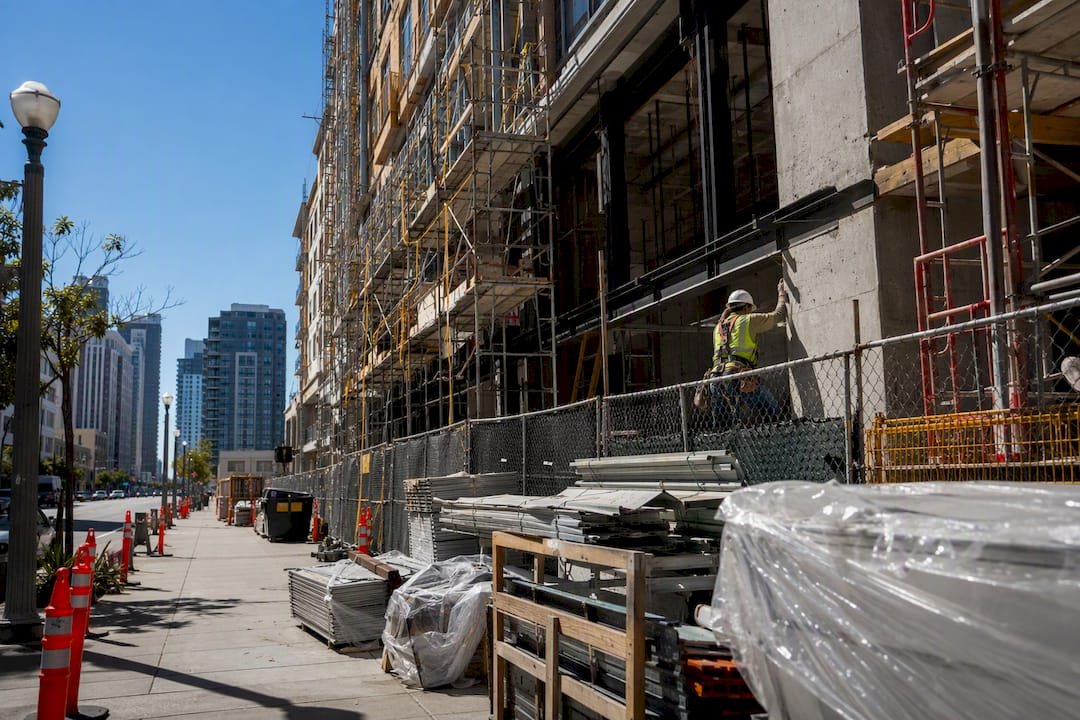
Second, office space is quietly becoming a housing story. Marcus & Millichap’s office-market research found roughly 33% of downtown office space sitting vacant, with tenants fleeing older buildings for newer Class A space. That vacant older stock is exactly the kind of inventory cities eye for residential conversion.
“Structural change, not cyclical movement, is what’s reshaping where San Diego’s jobs and development happen in 2026,” according to the EDC’s own analysis of shifting capital flows toward AI infrastructure and data centers.
Third, construction delivery remains constrained by the usual combination of permitting timelines and zoning limits, which means office conversions and infill projects carry outsized weight in this cycle’s supply story compared with past recoveries.
Pro Tip: If you’re house-hunting near downtown, ask your agent about pending office-to-residential conversion projects nearby. They can affect both future supply and neighborhood character faster than zoning maps suggest.
Three Scenarios for the 2026 San Diego Market
No single number captures where this market is headed, so it helps to think in ranges tied to specific triggers.
-
Baseline (+2% to +5%, most likely): Mortgage rates hold near 6%, job growth stays slow but positive, and price gains concentrate in the second half of the year as buyer confidence firms up. This scenario lines up with Norada’s normalization framing and reflects steady, unspectacular appreciation.
-
Upside (+5% to +8%): Triggered by a faster-than-expected rate drop, stronger job gains in life sciences or defense tech, or quicker-than-planned office-to-housing conversions that draw new buyers downtown without flooding the market.
-
Downside (flat to -3%): Triggered by a renewed rate spike, a broader economic shock, or policy shifts that freeze construction and conversion pipelines mid-project.
Neighborhood performance won’t track evenly across any of these scenarios. Coastal submarkets, from La Jolla to Encinitas, tend to hold value through downturns because scarce inventory limits downside, but they also see the slowest upside gains since they’re already priced near the ceiling of what local incomes support.
North County inland and East County submarkets, by contrast, have more room to run in the upside scenario. They typically carry lower entry prices, larger available lots, and buyer pools more sensitive to rate moves. When rates drop, these areas often see the fastest percentage gains, because a small rate change unlocks a much bigger share of the local buyer pool.
Downtown condos sit in the most uncertain spot on this map. They benefit most directly from office-conversion activity and urban job growth, but they’re also the segment carrying the highest listing inventory right now, which means sellers there need sharper pricing and marketing than the county average would suggest.
Seasonality still applies. Expect the clearest price movement, in either direction, to show up in listings between March and June, with the fall and winter months typically reflecting whatever momentum built earlier in the year rather than setting new trends.
What Should San Diego Buyers and Sellers Do Right Now?
The scenario ranges only matter if they change what you actually do this year. Here’s the short version, split by side of the transaction.
For buyers:
- Get fully underwritten pre-approval, not just pre-qualification. In a market where rate movement drives so much of the upside case, being ready to move fast when rates dip gives you a real edge over buyers still gathering paperwork.
- Target neighborhoods matched to your scenario tolerance. If you want appreciation upside, inland and North County submarkets carry more of it. If you want price stability, coastal areas trade lower volatility for a higher entry cost.
- Build contingency strategy into your offers now, while inventory is more balanced than it was two years ago, rather than waiting until competition tightens again.
For sellers:
- Price to current comparable sales, not last year’s peak. Overpricing in a normalizing market costs you the most active early buyers, then forces a price cut that signals weakness.
- If you’re selling a condo, budget extra time and money for staging and marketing given the segment’s higher inventory and, according to local market observers, slower absorption than single-family homes.
- Ask your agent directly how they plan to handle timing around rate movements and whether their marketing plan changes for a buyer’s versus a seller’s submarket.
If the higher number still works for your budget, you have real negotiating room if rates tick up mid-transaction.*
Pro Tip for sellers: Get a pre-listing inspection before you set your price. In a market where buyers have more options, surprises during escrow cost you leverage you won’t get back.
How One San Diego Listing Performed Under the Premier Selling System
- Situation: A single-family home in a competitive North County submarket, listed using Ryan Case’s Premier Selling System, including strategic pricing and targeted buyer-database outreach.
- Tactics: Zillow Showcase placement, the proprietary “white button” buyer-engagement system, and negotiation focused on multiple-offer leverage.
- Outcome: A measurable sale-price premium and reduced days on market compared with area norms, based on comparable homes sold in the same window.
Sellers weighing their own listing strategy against these results can request a market-ready home assessment to see how their property compares.
Why the Baseline Scenario Fits San Diego Best
The baseline holds up best because affordability, not enthusiasm, is what’s setting the ceiling on prices this year. I watch mortgage rates and office-conversion permits most closely, since either one could push the market toward the upside case fast. Condo sellers need sharper pricing and staging than single-family sellers, given the inventory gap between those two segments right now.
How Ryan Case Helps You Navigate the 2026 Market
Whether you’re timing a sale around this year’s price scenarios or trying to win a home in a tightening submarket, the data only helps if someone translates it into a pricing and marketing plan built for your specific property. That’s where Ryan Case comes in.

The Premier Selling System pairs strategic pricing with targeted exposure through tools like Zillow Showcase and a buyer database built to move faster than the general market. For sellers weighing a condo listing against the segment’s higher inventory, or a single-family home in a submarket poised for upside gains, that combination of pricing strategy and accelerated marketing can be the difference between sitting on the market and closing ahead of it. Buyers get the same local read: financing guidance calibrated to where rates and inventory actually stand this year, not generic advice recycled from a national blog.
If you’re planning a move in San Diego County this year, start with a market-ready home assessment to see where your property or your buying budget fits into the 2026 picture.
Frequently Asked Questions
Will San Diego home prices go up or down in 2026?
Prices are more likely to rise modestly, in the range of 2% to 5%, than to fall, based on current inventory trends and local benchmark reporting. A downside scenario of flat to slightly negative growth would require a rate spike or broader economic shock.
Is 2026 a buyer’s market or a seller’s market in San Diego?
It’s closer to balanced than either extreme, with condos leaning toward buyers given rising inventory and single-family homes in strong locations still favoring sellers.
What mortgage rate should I expect in San Diego in 2026?
Local commentary points to rates settling near 6%, described as a normalization after several years of sharper swings.
Which San Diego neighborhoods will perform best in 2026?
Inland and North County submarkets carry more upside potential if rates drop, while coastal areas tend to hold value more steadily but with slower percentage gains.
How does office vacancy affect San Diego housing in 2026?
High downtown office vacancy, near 33% by one report, creates a pathway for office-to-housing conversions that could ease supply pressure if projects move forward on schedule.
This article is general information, not a substitute for advice from a qualified financial advisor. Consult a qualified financial professional about your own circumstances before acting on anything here.
Sources
- Long-term socio-economic forecasts by county – California DOT / DOF notices
- San Diego 2026 investment forecast — office market report – Marcus & Millichap
- San Diego Housing Market: Trends and Forecast 2026 – Norada Real Estate
- San Diego Real Estate Market Report August 2026 | RITA | Search Listings SD
Pingback: List Now in San Diego's $1.25M–$1.5M Band: Homes Sell in About 78 Days