Take the cash offer when speed and certainty matter most, especially on a distressed or vacant property with a hard moving deadline; take the financed offer when it beats cash by more than a few percentage points and the buyer’s preapproval is solid. Almost a third of home sales close in cash now, and the right call almost always comes down to one exercise: running the actual net proceeds on both offers side by side, not just comparing sticker prices.
TL;DR:
- Cash offers typically close within 7 to 14 days and often omit appraisal and financing contingencies, reducing deal risk and stress.
- Financed offers can exceed cash bids by a meaningful margin, but are subject to appraisal shortfalls and underwriting surprises that may kill the deal.
- Comparing net proceeds involves deducting commissions, repair credits, closing costs, and carrying costs to determine the true financial benefit of each offer.
- A strong preapproval and appraisal-gap commitment make financed offers safer, especially when the buyer demonstrates genuine financial strength.
- Better marketing and pricing strategies can minimize appraisal risk, making financed deals more attractive and competitive with cash offers.
Table of Contents
- Cash vs Financed Offers: A Quick Comparison
- Why Cash Offers Help Sellers: Real Benefits
- The Hidden Cost of Chasing a Cash Offer
- When a Financed Offer Actually Wins
- How to Compare Two Offers Line by Line
- What to Expect on Timing and Common Deal Killers
- How the Premier Selling System Changes the Math
- Negotiating Between Cash and Financed Buyers
- Get a Free Net-Proceeds Estimate Before You Decide
- Sources
Cash vs Financed Offers: A Quick Comparison
The headline number on a financed offer almost always looks better. The number that lands in your bank account often tells a different story once you subtract carrying costs, repair credits, and the risk of a deal falling apart thirty days into escrow.
Cash buyers, particularly investors, tend to bid below market because they’re paying for certainty and speed, not curb appeal. Financed buyers, especially owner-occupants competing for a home they want to live in, will frequently stretch to a higher price, then ask the lender to justify it.
- Closing speed: cash typically closes in 7 to 14 days; financed offers usually take 30 to 45 days.
- Price gap: cash offers run roughly 10% below financed offers on average across all buyer types, though individual non-investor cash buyers often land closer to 3% to 5% under market.
- Contingency risk: cash offers usually skip appraisal and financing contingencies entirely; financed offers carry both.
- Buyer profile: cash buyers are frequently investors or iBuyers; financed buyers are usually retail owner-occupants.
Quick rule of thumb: if you need to be out in three weeks or the house needs work you can’t afford to do, lean cash. If you have breathing room and the financed offer is meaningfully higher, run the numbers before you say yes to either one.
Why Cash Offers Help Sellers: Real Benefits
Speed is the obvious draw, but it’s not the only one. A cash sale removes the two biggest sources of financed-deal anxiety: the appraisal and the underwriter.
There’s no lender pulling the loan file apart, no appraisal that has to come in at contract price, and no thirty-day wait wondering if the buyer’s job situation changed. That certainty has real dollar value, especially when you’re paying two mortgages or juggling a move across the country.
- Faster closings of 7 to 14 days mean less time paying a mortgage, property taxes, and insurance on a house you no longer want.
- No appraisal contingency means the deal doesn’t die because a comp came in low.
- No financing contingency means the buyer’s job change, credit dip, or debt-to-income ratio can’t blow up your escrow.
- Fewer repair demands. Cash buyers, especially investors, often waive inspection negotiations or buy as-is.
- Lower stress on vacant or inherited properties where staging, showings, and repairs aren’t realistic options.
If you’ve inherited a property in another state, or you’re behind on a mortgage and every week of carrying costs eats into your equity, cash is usually the right call regardless of the discount.
Pro Tip: Ask any cash buyer for proof of funds before you take their offer seriously, not after you’ve accepted it. A bank statement or a letter from their fund manager takes five minutes to produce, and a buyer who stalls on that request is telling you something.
The Hidden Cost of Chasing a Cash Offer
Institutional investors and wholesalers frequently offer 15% to 20% below market because they’re pricing in their own resale profit, repair budget, and holding costs. A one-off cash buyer purchasing a primary residence usually offers something closer to market value minus a smaller convenience discount.
The mistake sellers make is treating every cash offer the same way. A cash offer isn’t inherently generous just because it removes contingencies. It’s a trade you’re making, and you should know exactly what you’re trading away before you sign.
- Verify proof of funds with a bank letter or fund statement dated within the last 30 to 60 days, not a generic preapproval screenshot.
- Compare against recent comps, not just the other offers on the table, to see how far below market the bid actually sits.
- Watch for junk fees buried in cash contracts, like inflated title or escrow charges that quietly shrink your proceeds.
- Push back on lowball cash bids when you have multiple interested buyers. Competing cash offers tend to narrow the discount because investors have to compete on price like anyone else.
If a cash buyer won’t provide documentation or won’t budge at all on price despite competing interest, that’s a signal to counter hard or walk toward the financed pool instead.
When a Financed Offer Actually Wins
A financed buyer who’s genuinely qualified and in love with your house will sometimes pay a real premium over any cash bid on the table. That premium exists because owner-occupants are emotionally invested in a specific property in a way an investor never is.
The catch is the appraisal. Lenders won’t loan more than the home appraises for, so if your financed buyer’s offer sits well above recent comps, the appraisal can come in short and force a renegotiation or kill the deal unless the buyer agrees upfront to cover the gap in cash.
Underwriting is the other risk. Financing fall-throughs happen for mundane reasons: a buyer changes jobs mid escrow, a credit card balance spikes, or a lender asks for documentation the buyer can’t produce fast enough. None of that is dramatic. It’s just paperwork friction that cash sidesteps entirely.
- Strong preapproval beats prequalification. A preapproval means a lender has verified income, assets, and credit; prequalification is a guess based on what the buyer told someone over the phone.
- Appraisal-gap commitments matter. A buyer willing to cover a shortfall of $10,000 to $20,000 in cash is a meaningfully safer bet than one who isn’t.
- Larger earnest money signals seriousness. A buyer risking $20,000 in earnest money behaves differently than one risking $2,000.
Accept the financed offer when the premium is large enough to absorb some risk, the buyer’s preapproval looks solid, and you don’t have a hard deadline forcing your hand.
How to Compare Two Offers Line by Line
Comparing headline prices is how sellers talk themselves into the wrong decision. Net proceeds, not sale price, is the number that actually matters, and it takes about ten minutes to calculate properly.
Step 1: Start with the offer price. Write down each offer’s contract price side by side.
Step 2: Subtract commissions. Both cash and financed deals typically carry the same commission structure, so this cancels out, but include it anyway for accuracy.
Step 3: Subtract expected repair credits or seller concessions. Financed buyers often negotiate repairs after inspection; cash buyers frequently skip this step entirely.
Step 4: Subtract seller-paid closing costs, including any concessions negotiated to help a financed buyer’s rate or fees.
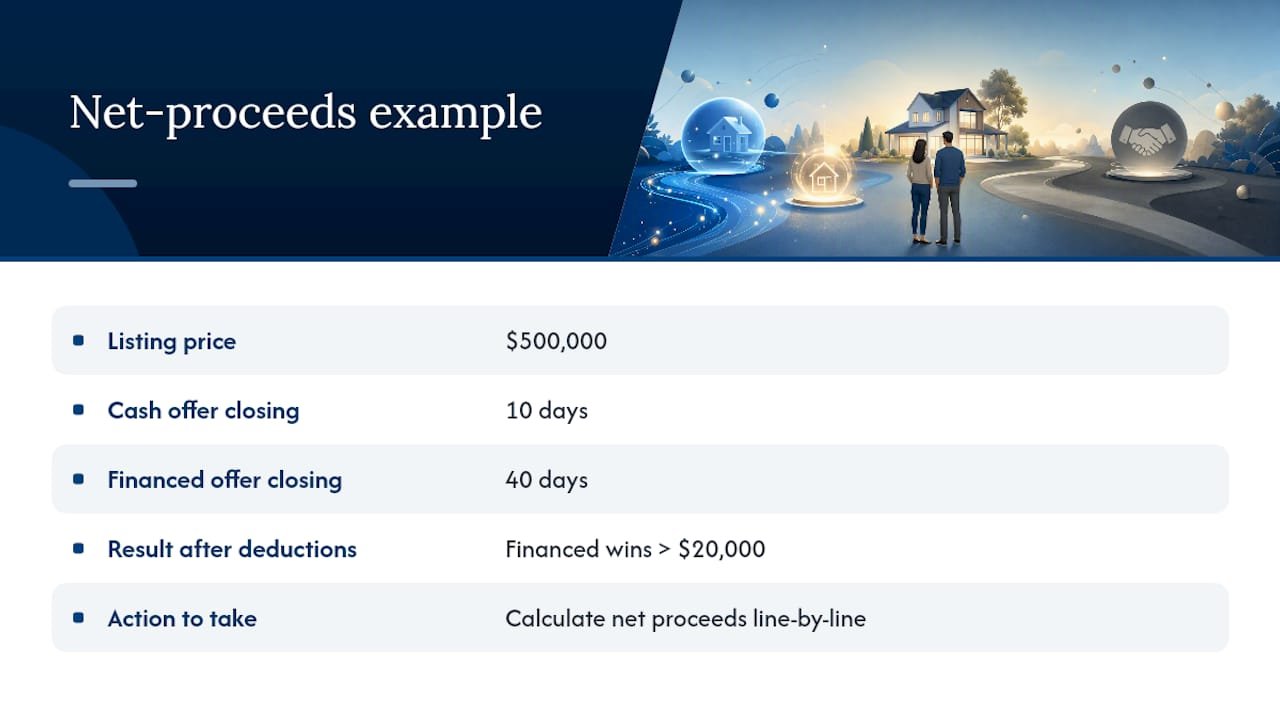
Step 5: Subtract carrying costs for the difference in closing timeline. If the cash deal closes in ten days and the financed deal takes forty, that’s roughly a month of extra mortgage, tax, and insurance payments on the financed side.
Here’s a simplified worked example on a $500,000 listing:
In that example, the financed offer still wins by over $20,000 even after every deduction, which is exactly why you run the math instead of assuming cash automatically comes out ahead, or automatically comes out behind.
Before you commit either direction, check proof of funds on the cash side, and check preapproval strength, earnest money, and appraisal-gap language on the financed side. If the numbers are close, you can often negotiate a shortened escrow or a modest earnest money increase from either buyer to close the gap.
What to Expect on Timing and Common Deal Killers
Set your expectations early so a delay doesn’t feel like a crisis. Cash deals typically close in 7 to 14 days; financed deals typically run 30 to 45 days, sometimes 60 if the lender is backed up or the loan program is more complex, like an FHA or VA loan backed by HUD.
Three things kill financed deals more than anything else:
- Appraisal shortfalls, when the home appraises below contract price and the buyer won’t or can’t cover the gap.
- Underwriting surprises, like a late credit pull revealing new debt the buyer took on during escrow.
- Inspection renegotiation, where repair demands escalate past what either side expected.
You reduce all three by pricing realistically against comps, requesting a pre-underwriting letter instead of a basic preapproval, and asking for appraisal-gap language upfront rather than discovering the risk after the appraiser has already been out.
How the Premier Selling System Changes the Math
Most of the cash versus financed debate assumes you’re stuck choosing between a lower guaranteed number and a higher risky one. Strong marketing and pricing strategy change that trade-off before it ever gets to negotiation.
More qualified financed buyers competing for a property also means stronger preapproval letters and fewer appraisal surprises, since pricing is calibrated against real comps from the start rather than guessed at.
When a home attracts multiple retail buyers instead of a single opportunistic cash bid, the appraisal risk that scares sellers away from financed offers mostly disappears, because the contract price already reflects what the market will actually support.
That’s the real lever: better marketing doesn’t just chase a higher number, it narrows the appraisal gap that makes financed offers feel risky in the first place.
Negotiating Between Cash and Financed Buyers
Every negotiation comes down to the same three variables: net proceeds, certainty, and the seller’s actual moving timeline. A seller with nowhere urgent to be should almost always hold out for the stronger financed number. A seller who needs to close in three weeks should weight certainty far more heavily, even at a discount.
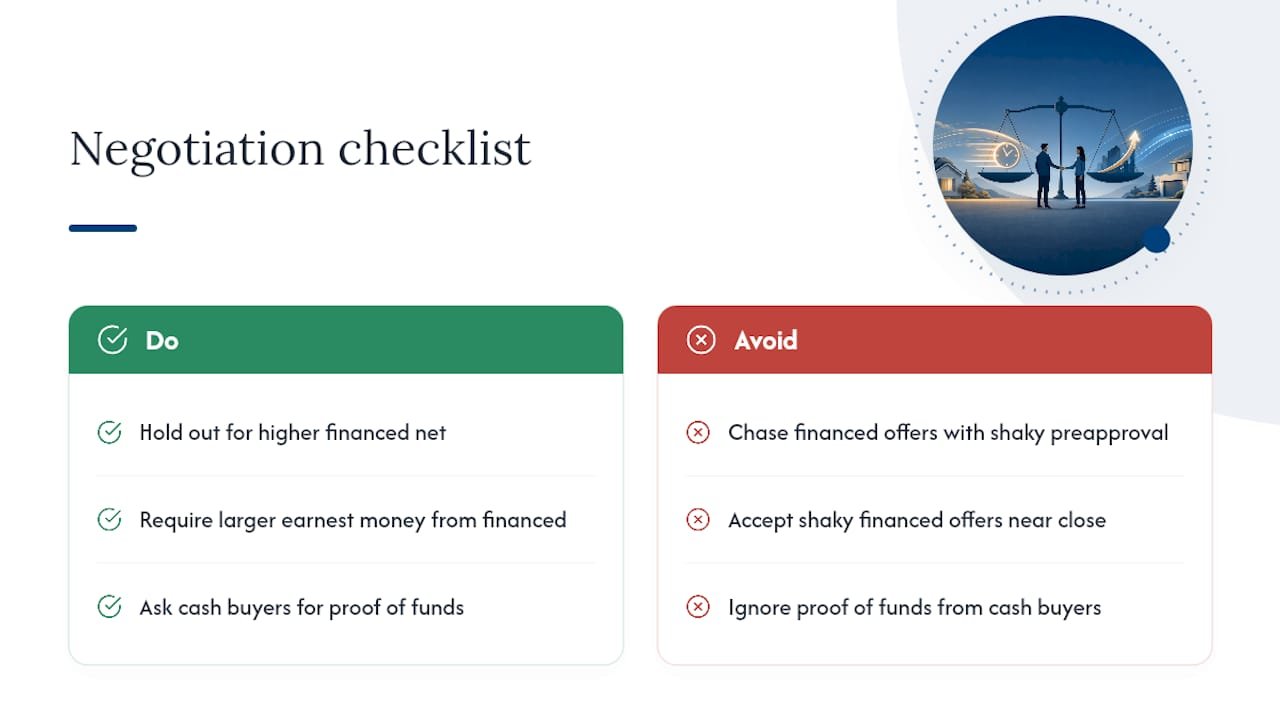
The levers worth pulling are simple. Ask financed buyers for a larger earnest money deposit or an appraisal-gap commitment before you counter their price. Ask cash buyers for proof of funds and a shorter inspection period, since you’re trading them speed for their commitment to close as written.
I’d rather take a cash offer that’s 3% below a financed one with a shaky preapproval than chase a bigger number that has a real chance of falling apart at day 25 of escrow. The math only favors cash by default when the financed alternative is genuinely uncertain.
— Ryan Case
Get a Free Net-Proceeds Estimate Before You Decide
You don’t have to guess which offer actually nets you more. Ryan Case runs a real net-proceeds comparison for San Diego sellers weighing cash against financed offers, factoring in commissions, repair credits, carrying costs, and the closing timeline that fits your move, not just the number at the top of the contract.

Listings marketed through the Premier Selling System sell for 5% to 7% more on average while spending less time on market, which is exactly the kind of leverage that turns a mediocre cash offer or a shaky financed one into a bidding situation you control instead of one you’re stuck reacting to. If you’re weighing a cash bid against a financed offer right now, request a free consultation through Ryancaserealtor and get the actual numbers before you sign anything.