If you have to pick one, pick the floor plan. It answers the question buyers ask first, whether the home works for them, and it is the cheaper and safer asset. A virtual tour is a strong second layer that helps buyers feel a home and screens out the wrong showings. The best listings use both, and they use them in a specific order.
Below, we break down what each one does, where each one falls short, what San Diego MLS rules mean for you, and how to decide where to spend your marketing effort before you list.
TL;DR
- A floor plan shows layout, flow and room proportions. A virtual tour shows finishes, light and atmosphere. They answer different questions.
- Buyers rank floor plans just behind listing photos, yet most listings still skip them, so a floor plan is the easiest edge to gain.
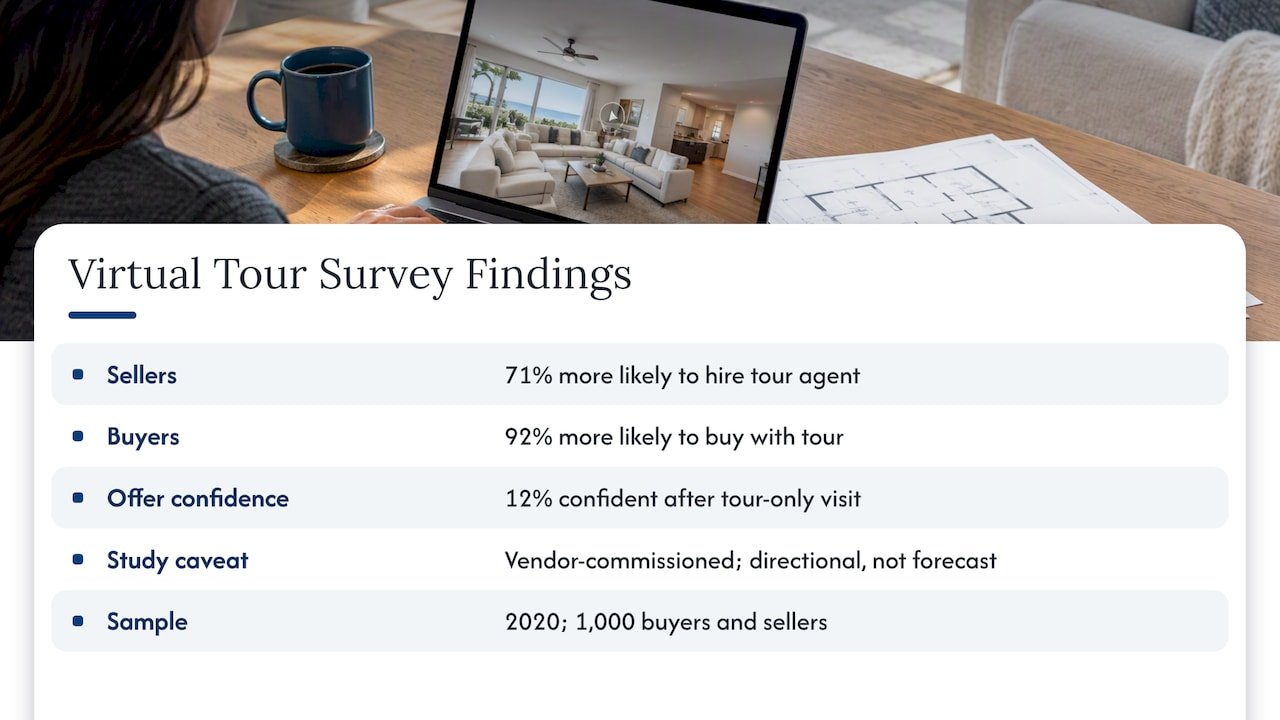
- Virtual tours work best as a pre-screening tool. Only 12% of Americans say they feel very or extremely confident making an offer after a virtual tour alone.
- In San Diego, tours and edited images must follow MLS rules and California law. Never alter what the home actually looks like.
Table of Contents
- What each one actually does for a buyer
- What the data says about floor plans
- What the data says about virtual tours
- Which one should you prioritize?
- Costs, effort and the platform trap
- San Diego MLS rules and California law
- Our perspective on this
- A simple checklist before you list
- Work with us
- FAQ
- Sources
What each one actually does for a buyer
A floor plan is a top-down diagram of the home. It tells a buyer how many steps it takes from the front door to the kitchen, whether the second bedroom is next to the primary suite, and whether the dining area can fit a table for eight. Photos cannot show that, because a photo shows one corner at a time, often through a wide-angle lens.
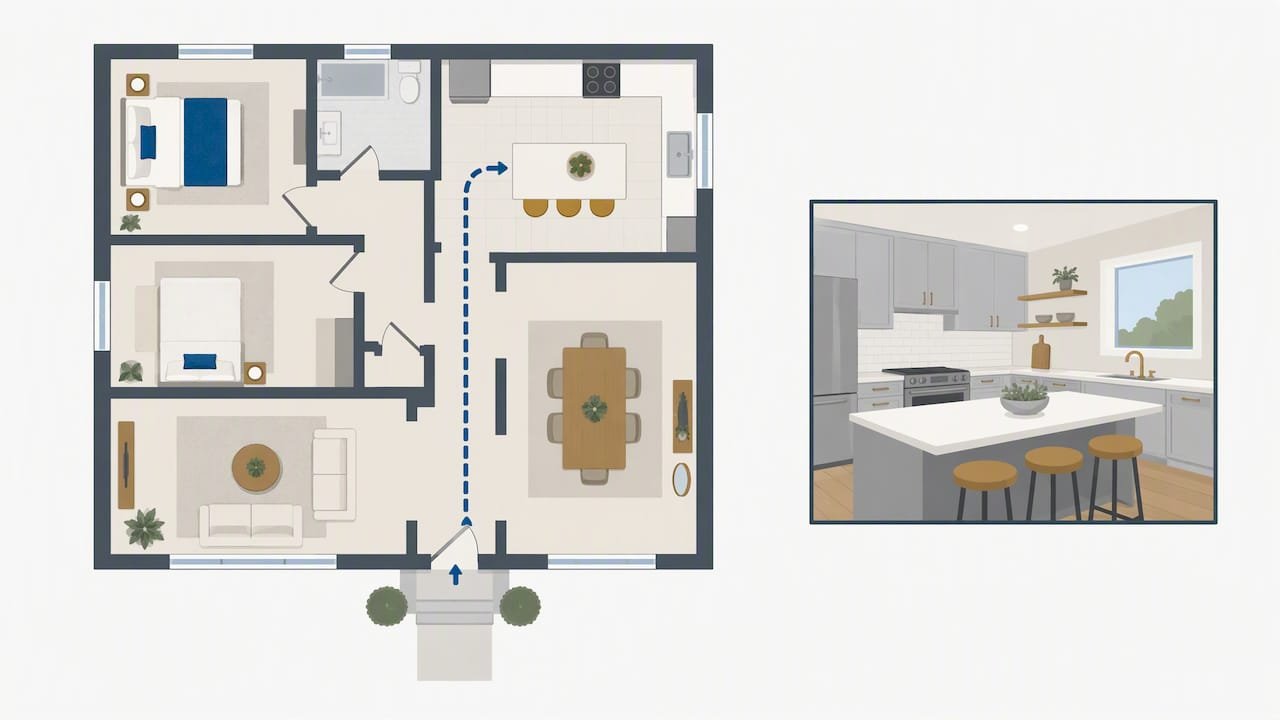
A virtual tour is an immersive capture. It can be a video walkthrough, a 360-degree panorama set, or a 3D model you move through room by room. It tells a buyer what the home feels like: natural light, ceiling height, sightlines to a canyon or a neighbor’s fence, and the condition of the finishes.
The two are not rivals so much as different tools. One is a measuring tape and the other is a visit.
| Floor plan | Virtual tour | |
|---|---|---|
| Main question answered | Does the layout fit my life? | What does it feel like to be inside? |
| Best for | Comparing many homes quickly | Narrowing a short list |
| Weak spot | Says nothing about condition or light | Hard to compare homes side by side |
| Production effort | Short, one visit | Longer, more prep and staging |
| Risk if done badly | Wrong dimensions erode trust | Distorted rooms, platform display problems |
| Works on every portal | Almost always (an image or PDF) | Depends on the platform |
What the data says about floor plans
Buyers want them. According to a compilation of floor plan statistics, floor plans are the second most requested visual asset after listing photos. It reports that 82% of buyers think they should be a required part of online listings, and 86% say they are more likely to view a home that includes one. That page is published by a floor plan capture company, so read the bigger “up to” figures, such as higher saves and shorter time on market, as vendor claims rather than guarantees.
The gap is the opportunity. HomeDiary’s 2025 marketing research notes that buyers still want high-quality photography and floor plans, ideally interactive ones where you click a room and see the photo taken from that spot. Interactive plans do something a static drawing cannot: they connect the 2D diagram to the images. Zillow also offers interactive floor plans that can be captured in the same visit as the photos.
We cover the buyer-quality side in more depth in our guide to floor plan marketing and getting more qualified buyers to show up.
What the data says about virtual tours
The numbers on tours are strong, with a caveat about who is publishing them. A survey commissioned by a 3D capture company found that 71% of sellers say they are more likely to hire an agent who offers 3D tours, and that 92% of buyers say they are more likely to buy a home with an immersive 3D tour available. It is a 2020 study of 1,000 buyers and 1,000 sellers, so treat it as directional, not as a forecast for your house.
The more sober finding comes from Zillow Research: consumers like digital tools as a complement to traditional shopping, not a replacement. Only 12% of Americans feel very or extremely confident making an offer after a virtual tour with no in-person visit.
That tells you how to use a tour. Its job is not to close the sale. Its job is to make sure the people who walk through your door already like the house. Fewer curiosity showings and more serious ones means fewer disruptions for you and cleaner negotiations later. Our post on 3 virtual tour benefits sellers and agents can measure shows which numbers to track.
Which one should you prioritize?
Think of it as a sequence a buyer follows online.
- Photos get the click. Nothing replaces strong images. If your photos are weak, neither a plan nor a tour will rescue the listing. See whether professional listing photos are worth the cost for your home.
- The floor plan earns the save. Once the buyer likes the photos, the plan tells them whether the home fits their furniture, family and routine.
- The tour earns the showing. For buyers who are interested but not sure, the tour removes doubts, or confirms them before anyone drives across town.
So, as a general rule:
- Condo or smaller home with a simple layout: a floor plan plus great photos usually covers it.
- Home with an unusual layout, additions, split levels or an ADU: the floor plan is essential, because confusing layouts are hard to read from photos.
- Larger or higher-priced home, or a home with a view or outdoor space that photos flatten: add a tour.
- Out-of-area or relocating buyers likely: a tour matters more, since they cannot easily visit. San Diego draws many of them, and our guide to selling a house remotely from San Diego covers the California withholding issues that come with owners who live elsewhere.
Costs, effort and the platform trap
We do not publish capture prices here, because they vary by provider, square footage and what you need. Ask for written quotes. What matters is what each one asks of you.
A floor plan needs accurate measurement and one visit. A tour needs a home that is show-ready, because every room is captured, including closets and garages. Mobile capture has also made tours cheaper to produce: NAR’s virtual tour playbook describes how apps now let agents produce professional-looking material without expensive scanner hardware. Easier production, though, means more mediocre tours, so quality and presentation still decide whether it helps.
Then there is distribution. A tour only helps if buyers can see it where they search. Zillow has published guidance on Matterport tours and how they appear on its platform, and the rules have shifted. Before you pay anyone, ask your agent or capture provider to confirm in writing where the finished tour will display. A floor plan, as an image, travels everywhere without drama.
If you are also thinking about how listing content gets discovered more broadly, this walkthrough on adding search channels for referral-based agents is a useful read on the marketing side.
San Diego MLS rules and California law
This is where well-meaning sellers get into trouble. The San Diego MLS photo compliance page requires at least one front exterior photo of the dwelling, with up to 75 photos allowed per listing. The SDMLS rules also say virtual tours must represent the actual property and cannot carry branding, text or advertising. Check the current SDMLS rules and regulations before your agent uploads anything, since they are updated periodically.
Editing is the sharper risk. SDMLS ties its definition of “digitally altered images” to California Business and Professions Code section 10140.8. In practice, that means an image that changes the representation of the property, such as removing a wall, swapping flooring or improving a view, is treated as altered and must follow disclosure requirements. Virtual staging and AI-enhanced images fall into this territory. A floor plan that shows a wall that does not exist, or a tour with digitally cleaned-up finishes, creates the same problem. If you are unsure whether an edit counts, ask your listing agent and your broker before publishing. Accuracy also protects you after closing, because buyers who feel misled by marketing are the ones who raise issues in disclosures. Our overview of California seller disclosures explains that side.
Our perspective on this
We see sellers get stuck on the wrong question. They ask which gadget will sell the house, when the real question is what a buyer needs to know before they decide to show up.
Our view is simple. Start with a clean, accurate floor plan, because it costs the least and shows the layout that photos hide. Pair it with strong photography. Then add a tour when the home’s value lies in how it feels, such as light, flow, a view or outdoor living, or when you expect buyers from outside San Diego.
We also treat marketing as one piece of a pricing and positioning plan, not a substitute for it. Great media on an overpriced home still sits. That is why our Premier Selling System starts with strategic pricing, then layers on targeted marketing tools such as Zillow Showcase and outreach to our buyer database. Floor plans and tours are tools inside that plan. We choose them listing by listing, based on the home, the likely buyer and the price band, rather than selling every home the same package.
— Ryan Case
A simple checklist before you list
Before photos, run through these steps with your agent:
- Decide the likely buyer. A downsizer wants step-free flow and bedroom locations. A family wants bedroom grouping and yard access. Make sure the plan answers those questions at a glance.
- Prepare the home for capture. Declutter surfaces, open blinds, turn on lights and clear closets. A tour exposes everything.
- Verify measurements. Have the plan checked against the actual rooms. Wrong dimensions cost credibility fast.
- Confirm platform display. Ask where the tour and plan will show, including the MLS, Zillow and your agent’s own site.
- Check compliance. Confirm nothing is digitally altered or branded in a way the MLS rules prohibit.
- Plan for showings. Treat the tour as the pre-screen and the open house as the closer. Our guide on open house safety and local rules in San Diego covers that step, and our post on virtual open houses explains how a live online event can fit in.
Work with us
If you are preparing to sell in San Diego County and want a plan for the media, the price and the launch, we can help. Our service tiers run from paperwork-only to the Premier Selling System and guaranteed sale programs. See the options on our main site, or start with how we approach data-backed strategic home pricing.
FAQ
Is a floor plan or a virtual tour more important for selling a house?
For most homes, the floor plan matters more as a first step. Buyers rank it just behind photos, and it works on every portal. A tour is a valuable addition, especially for larger homes or out-of-area buyers, but it should not replace a plan.
Can a virtual tour include a floor plan?
Often yes. Many 3D tour platforms generate a floor plan view from the same capture, and some tools let buyers click a room on the plan and jump to that spot. Ask your provider whether the plan is delivered as a separate image you can upload to the MLS, since that is the version that travels everywhere.
Can I edit or stage photos and tours digitally in San Diego?
You can, but the edits must not misrepresent the property. Under California Business and Professions Code section 10140.8 and SDMLS rules, images that change the representation of the home are treated as digitally altered and carry disclosure requirements. Ask your listing agent before publishing anything edited.
Will a virtual tour make buyers skip an in-person visit?
Unlikely. Zillow’s research found only 12% of Americans feel very or extremely confident making an offer after a virtual tour alone. A tour works better as a screening step that sends more serious buyers to your showing.
Sources
- CubiCasa: Stats and facts about floor plans
- Matterport: Study on buyers and sellers preferring 3D tours
- Zillow Research: Digital tools and home shopping
- HomeDiary PRO: 2025 marketing research
- Zillow: 3D Home interactive floor plans
- NAR: Your virtual tour playbook
- Zillow: What to know about Matterport tours on Zillow
- SDMLS: Listing photo compliance
- SDMLS: Rules and Regulations, April 2026