Virtual tours deliver three practical wins: they attract better-qualified leads, cut wasted showing or booking time, and keep a listing visible around the clock to buyers who can’t show up in person. The size of the payoff depends heavily on the sector and the quality of the tour itself, and the evidence on sale-price impact is more mixed than most marketing pitches admit.
TL;DR:
- Virtual tours mainly improve lead quality and reduce low-intent showings but have limited impact on final sale prices once listing quality is accounted for.
- They are most effective for luxury properties, relocation markets, and sight-unseen bookings, where physical access is impossible or limited.
- Poor-quality tours, such as those with bad lighting or lag, can harm trust, especially on modest or low-traffic listings, making quality investment essential.
- Success measurement should focus on engagement metrics like time-on-page and lead filtering, not just the final sale price.
- A comprehensive listing approach, combining high-quality photos, accurate floor plans, and detailed descriptions, enhances virtual tour effectiveness.
Table of Contents
- The Core Virtual Tour Benefits Worth Knowing
- How Virtual Tour Benefits Play Out by Industry
- What the Data Actually Shows About Virtual Tour ROI
- Where Virtual Tours Fall Short
- Getting Started With a Virtual Tour: A Practical Checklist
- How Ryan Case Builds Virtual Tours Into a Full Listing Approach
- The Overlooked Truth About Virtual Tour Benefits
- How Ryan Case Turns Virtual Tour Exposure Into Offers
- Sources
The Core Virtual Tour Benefits Worth Knowing
Most of what makes virtual tours valuable comes down to who they filter out before you ever pick up the phone. A buyer or renter who spends four minutes clicking through a 3D walkthrough has already ruled out the layout, the light, and the neighborhood feel that photos can’t convey. That’s a warmer lead than someone who just liked a thumbnail.
The main advantages break down like this:
- Immersive engagement: Listings with interactive tours hold attention far longer than static photo galleries, and that extra time on the page tends to correlate with stronger buyer or guest intent.
- Better lead quality: Because viewers self-screen before contacting you, the inquiries that do come in skew more serious. CloudPano’s breakdown of virtual tour advantages points to this filtering effect as one of the format’s biggest practical upsides.
- Remote access, 24/7: Out-of-town buyers, relocating families, and international guests can tour a property or hotel room at 2 a.m. without asking anyone for a favor.
- Time and cost savings: Fewer low-intent showings mean less wear on a seller’s schedule and fewer wasted trips for agents.
- Local search visibility: Embedding a tour link in a Google Business Profile or listing page gives search engines more to index and gives browsers a reason to stay engaged longer.
- Documentation value: In construction and insurance work, a single capture creates a timestamped visual record that can settle disputes before they start.
- Professional differentiation: A clean, well-lit tour signals a level of preparation that a handful of phone photos simply doesn’t.
Pro Tip: A tour is only as strong as what surrounds it. Pair it with sharp photography and a full written description, because industry data shows the quality of the supporting content shapes whether a tour builds trust or undercuts it.
How Virtual Tour Benefits Play Out by Industry
The upside shifts depending on what you’re selling, booking, or documenting.
- Real estate: Remote and relocating buyers get a genuine sense of flow before committing to a flight or a drive, which can trim the number of low-value showings an agent has to schedule.
- Hospitality: Hotels and resorts using embedded tours report substantial engagement increases and booking conversion gains in some cases, according to industry ROI data compiled by THE FUTURE 3D.
- Retail and showrooms: Extended browsing time and clickable product hotspots inside a tour let shoppers explore inventory the way they would in person, minus the drive.
- Leasing and property management: Faster tenant decisions and shorter vacancy windows are common when prospective renters can preview a unit before requesting a viewing.
- Construction and insurance: A 3D capture replaces multiple in-person inspections, reducing rework and giving adjusters a precise record to work from.
What the Data Actually Shows About Virtual Tour ROI
The headline numbers are real, but they need context. Listings with virtual tours often sell faster than comparable ones without, according to multiple industry analyses, and some analyses show sale-price premiums in certain cases, along with a notable increase in qualified leads compared to photos alone, according to THE FUTURE 3D’s review of virtual tour ROI data.
Here’s the catch. A Harvard Business School analysis of 75,000 home sales found that once you control for photo quality and how thorough the listing description is, the direct effect of a 3D tour on final sale price often becomes statistically insignificant. In plain terms: a great tour rarely rescues a listing with weak photos and a thin description, and a lot of the price lift people credit to virtual tours may actually belong to the overall listing quality that tends to travel alongside them.
Tours pay off most where buyers physically cannot walk through the door themselves: luxury properties, relocation-heavy markets, and hospitality bookings made sight-unseen. That’s where the time-on-market and conversion gains show up most reliably.
The right way to measure success isn’t the sale price alone. Track time-on-page, the ratio of showings to offers, and how many inbound leads mention the tour specifically. Those numbers tell you whether the tour is doing its job, independent of everything else in the listing.
Where Virtual Tours Fall Short
Not every listing needs one, and a bad tour can do more harm than no tour at all.
- Cost versus return: A high-end capture on a modest, low-traffic property rarely earns back its price the way it would on a luxury or relocation-market listing.
- Quality variance: Poor lighting, stitching errors, or laggy load times erode buyer trust faster than a plain photo gallery would.
- Accessibility gaps: Older devices, weak rural internet, and unfamiliarity with click-and-drag navigation still shut some viewers out.
- Privacy considerations: Capturing occupied spaces means being deliberate about what’s visible: personal documents, faces, or valuables should be cleared before shooting.
Pro Tip: If your capture budget is tight, spend it on lighting and a tripod before you spend it on software. A steady, well-lit 360° tour built on a basic platform beats a shaky, dim one built on the priciest tool available.
Getting Started With a Virtual Tour: A Practical Checklist
Getting this right is less about the software and more about sequencing.
- Define the goal first. Lead generation, direct bookings, and insurance documentation each call for different capture approaches and different distribution plans.
- Pick the right format. A 360° walkthrough suits quick, low-cost navigation; a 3D digital twin (the kind Matterport builds) adds floor-plan accuracy and spatial data, which matters more for real estate marketing where buyers want precise dimensions.
- Invest in capture quality. Clean staging, strong lighting, and an accurate floor plan do more for perceived value than any software feature.
- Distribute deliberately. Embed the tour on the listing page, link it from your Business Profile, and push it through email and social rather than letting it sit unshared.
- Set a measurement window. Give it 30 to 60 days and track the metrics below before judging whether it worked.
| Metric | What it tells you |
|---|---|
| Time-on-page | Whether viewers are actually exploring or bouncing |
| Qualified lead volume | Whether the tour is filtering serious buyers from browsers |
| Showing-to-offer ratio | Whether pre-screened viewers convert better in person |
| Days on market | A lagging but useful check on overall listing performance |
How Ryan Case Builds Virtual Tours Into a Full Listing Approach
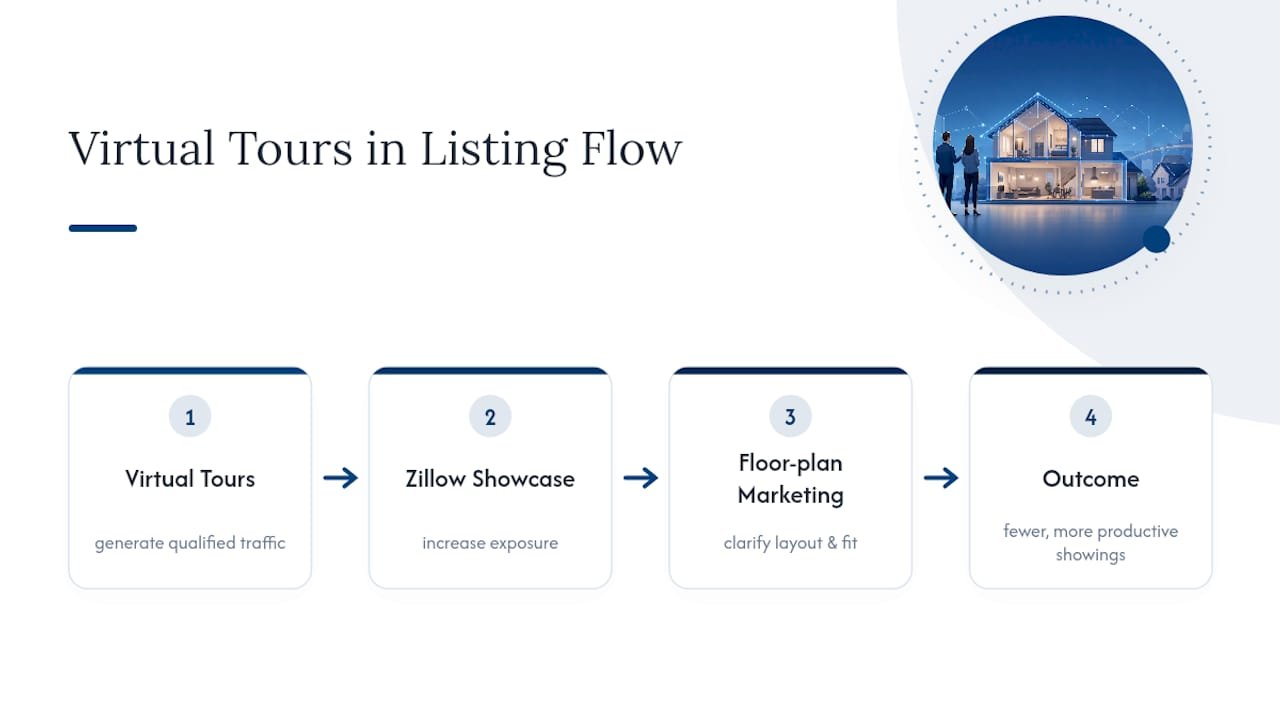
Within the Premier Selling System, virtual tours work alongside Zillow Showcase placement and detailed floor-plan marketing, not as a standalone add-on, aiming to bring more qualified buyer traffic to fewer, more productive showings.
The Overlooked Truth About Virtual Tour Benefits
Most sellers get pitched virtual tours as a magic bullet for price, and that’s the wrong frame. The Harvard research is blunt about it: strip out photo quality and description depth, and the tour’s own effect on final sale price often shrinks to statistical noise. That doesn’t mean tours are worthless. It means their real value shows up in fewer wasted showings, better-qualified buyers, and a faster path to an offer, not in a guaranteed bump on the closing statement.
The mistake I see most often is treating the tour as the whole strategy instead of one piece of it. A stunning 3D walkthrough attached to blurry photos and a two-line description is still a weak listing. The sellers who get the most out of this technology are the ones who fund the entire presentation. Sharp photography, a real floor plan, an honest description, and the tour layered on top. Sequence matters here: fix the fundamentals first, then use a tour to extend their reach to buyers who’d never otherwise walk through the door.
— Ryan Case
How Ryan Case Turns Virtual Tour Exposure Into Offers
A do-it-yourself listing gets you a tour link and hope. Some sellers use a system that includes placement and professional floor-plan marketing so the presentation is supported by multiple marketing elements.

Some sellers get their home positioned in front of a targeted buyer database, showings streamlined so only serious prospects walk through the door, and every marketing element, tour included, tracked against real engagement data rather than guesswork. If you’re weighing how to get your San Diego home ready for market, start with a personalized home analysis to see what a full listing strategy looks like for your property.
Sources
- Are Virtual Tours Still Worth It in Real Estate? Evidence from 75,000 Home Sales | Working Knowledge
- Virtual Tour ROI: The Hard Numbers Behind 3D Scanning | THE FUTURE 3D
- What are the Advantages and Disadvantages of Virtual Tours? | CloudPano