Most U.S. listing agreements usually fall into shorter, common, or longer terms depending on market speed and listing type. The right choice depends on how fast homes are moving in your area and how clearly the contract spells out start dates, expiration, and cancellation terms. Match the term to local market speed before you sign anything.
TL;DR:
- Shorter listing terms of 30 to 60 days work best in hot markets where homes sell quickly and demand remains high.
- Longer contracts of 90 to 180 days suit slower markets, luxury properties, and homes with smaller buyer pools that take more time to sell.
- Contract language must specify explicit start and end dates with fixed timestamps to prevent indefinite control or disputes over expiration.
- Tying the contract to a detailed marketing plan and review milestones ensures performance, regardless of the listed duration.
- Negotiating clear cancellation, renewal, and exit clauses before signing helps protect sellers from being locked into unfavorable or overly extended agreements.
Table of Contents
- Typical listing agreement durations and when each fits
- How listing agreement types shape your contract term
- How to choose and negotiate the right listing term
- The contract language that actually controls your timeline
- Matching a marketing plan to the listing timeline
- What a mismatched term can cost you legally
- Why the length of the contract changes everyone’s incentives
- How hot and cold markets change the ideal listing term
- The number of months matters less than what backs it
- Getting the term and the marketing plan right from the start
- Sources
- FAQ
Typical listing agreement durations and when each fits
A short term suits sellers wanting a trial run or expecting a quick sale in a fast-moving neighborhood. It leaves little room for a slow start, but it also limits how long you’re committed if the relationship doesn’t work.
A medium-length term gives an agent enough time to launch a campaign, gather feedback, and adjust pricing. Longer terms tend to appear with luxury, unusual, or rural properties with smaller buyer pools and longer sales cycles.
- Short terms fit hot markets or trials with new agents.
- Medium terms suit most homes.
- Longer terms fit luxury, rural, or niche properties.
National housing data gives sellers a useful benchmark for picking a term. The median days on market tracked by Realtor.com and archived at the St. Louis Fed shows how long homes typically sit before going under contract, and that figure shifts by season and metro area. A term shorter than local market times pressures faster action, while a much longer term may lock you into a less effective agreement.
How listing agreement types shape your contract term
The type of listing agreement you sign affects how much leverage you have over the term and what happens if the home doesn’t sell.
- Exclusive right to sell: the most common type, where one brokerage earns a commission regardless of who finds the buyer, typically paired with a 90 day to one year term.
- Exclusive agency: similar exclusivity, except the seller keeps the right to sell the home directly and avoid paying commission on that sale.
- Limited-service: the agent provides specific tasks, such as MLS entry, for a flat fee, often on shorter terms since the scope is narrower.
- Non-exclusive: multiple agents can market the home, but only the one who produces a buyer gets paid.
According to NAR’s consumer guide to listing agreements, these contracts define representation, services, and compensation, and they typically specify start and expiration dates rather than leaving the timeline open-ended. Before agreeing to any term, confirm that the promised marketing activities, photography, showings, and open houses match the length of time you’re committing to.
How to choose and negotiate the right listing term
Start with two numbers: your local median days on market and your personal deadline, whether that’s a job relocation, a closing on a new purchase, or a lease expiration. Then build the contract term around those numbers instead of accepting whatever an agent proposes by default.
- Check recent comparable sales and local days on market data to estimate how long marketing will realistically take.
- Set a specific start date and a fixed expiration date and time, not just a number of days.
- Request marketing milestones tied to the term, such as professional photos within a week and a paid promotion schedule.
- Confirm the cancellation and release process in writing before you sign.
Watch for red flags in the paperwork. A clause that keeps the listing active “until sold” with no fixed end date gives the agent indefinite control. Auto-renewal language that extends the contract without your written consent removes your ability to walk away on schedule. Vague effective or expiration wording, or a contract with no marketing commitments attached to the term, both suggest the length was chosen to protect the agent rather than to fit your sale.
Pro Tip: Ask for the expiration date and time to be written in the contract itself, not left to an assumed “30 days from signing” calculation.
The contract language that actually controls your timeline
The words on the page matter more than the number of months. A listing agreement should state an explicit effective date and expiration date and time, such as “This agreement begins March 1, 2026, and expires at 11:59 PM on May 30, 2026,” rather than a vague reference to a duration.
- Renewal and extension clauses should require your written signature, not happen automatically.
- Protection period, or holdover, clauses typically let the agent collect commission if a buyer they introduced during the listing closes shortly after expiration, so ask for a defined window and a specific list of qualifying leads rather than an open-ended promise.
- Early termination language should spell out how you can exit, whether that requires written notice, a waiting period, or reimbursement of specific marketing expenses.
If you want to understand exactly how a release works before you sign, Ryan Case Realtor’s guide to canceling a listing agreement breaks down termination rights and potential fees in plain terms.
Matching a marketing plan to the listing timeline
A listing term only works if it’s built around an actual marketing plan rather than a default number pulled from habit. The Premier Selling System schedules a launch window, a cadence of paid promotion, and open houses within the first weeks of a listing, then uses early showing feedback to adjust pricing or exposure before the term runs out.
- Ask for a written marketing calendar that maps to the contract’s start and expiration dates.
- Request a defined review point, such as 30 days in, to assess showing activity against the plan.
- Confirm what happens to buyer leads generated during the listing if the term expires without a sale.
Sellers who tie the length of the contract to a specific plan, rather than accepting an open-ended term, tend to have a clearer sense of what “working” looks like at each stage.
What a mismatched term can cost you legally
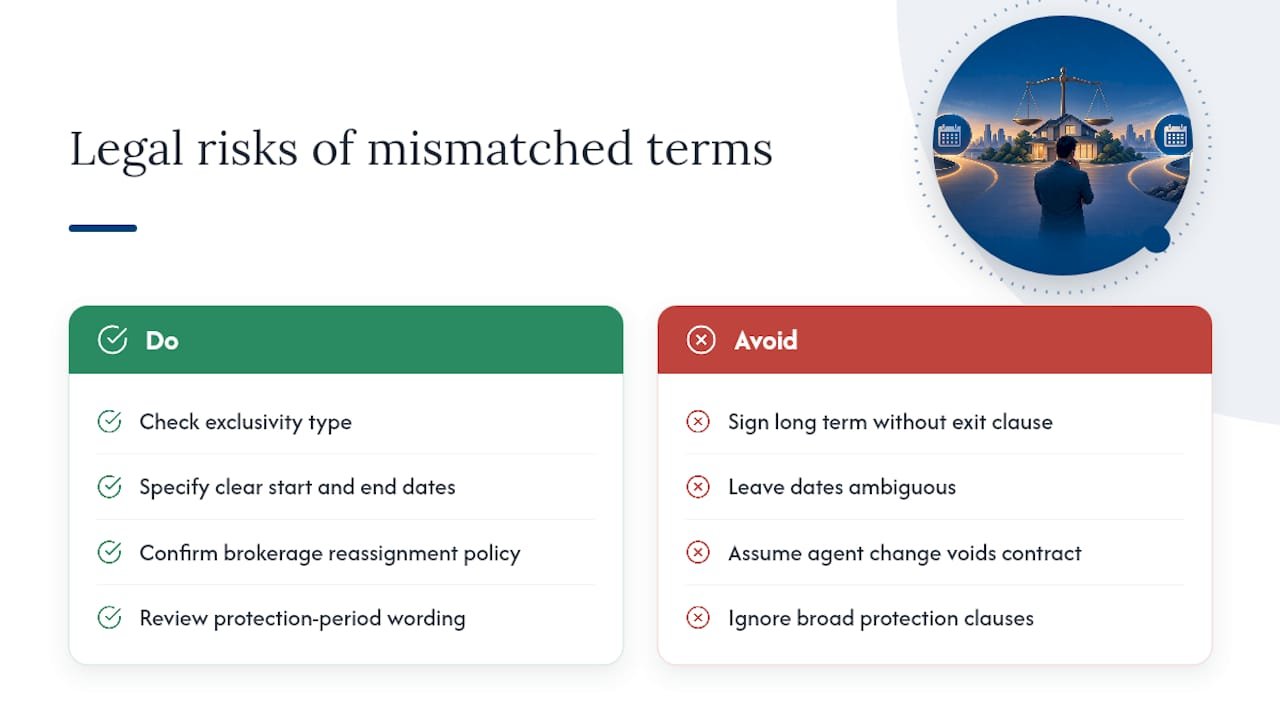
A listing agreement is a binding contract, and getting the length wrong creates real consequences, not just inconvenience. If a term runs longer than you expected and you sell the home yourself or through another agent before it expires, you may still owe commission depending on the exclusivity type you signed. An exclusive right to sell agreement obligates you to pay the listed brokerage regardless of who finds the buyer, so a long term without a clear exit clause can trap you financially.
Ambiguous dates create their own risk. State regulatory guidance around the country consistently emphasizes clear effective and expiration timestamps precisely because a phrase like “90 days” without a specified start date leads to disputes over when the contract actually ends. Sellers who sign with a brokerage, rather than an individual agent, should also confirm reassignment and release policies since the agreement is legally with the firm, and staff changes at the brokerage don’t automatically void your obligations.
Protection period clauses add another layer. If they’re written too broadly, an agent could claim commission on a sale that closes months after expiration, based on a buyer who saw the home during the listing. Reviewing this language before signing, rather than after a dispute arises, is the only reliable way to avoid it.
Why the length of the contract changes everyone’s incentives
The term you sign shapes how hard your agent works and how patient you can afford to be. A very short term, paired with no marketing budget or plan, can push an agent to prioritize a quick sale at a lower price just to close before the contract lapses. A very long term with no milestones can have the opposite effect, letting a listing sit without fresh marketing because there’s no urgency to perform.
The healthiest arrangement ties duration to specific commitments rather than trusting time alone to motivate results. A seller who negotiates a marketing calendar, a pricing review checkpoint, and a defined exit option gets an agent whose incentives are tied to performance within the term, not just to running out the clock. Short terms can work well when they’re paired with intensive, paid marketing and a committed showing schedule from day one. Longer terms make more sense when a seller needs time to prepare the home, expects a slower sales cycle, or wants flexibility around a contingent purchase elsewhere.
Either way, the length itself isn’t what drives performance. What matters is whether the contract holds the agent to specific activity during that window.
How hot and cold markets change the ideal listing term
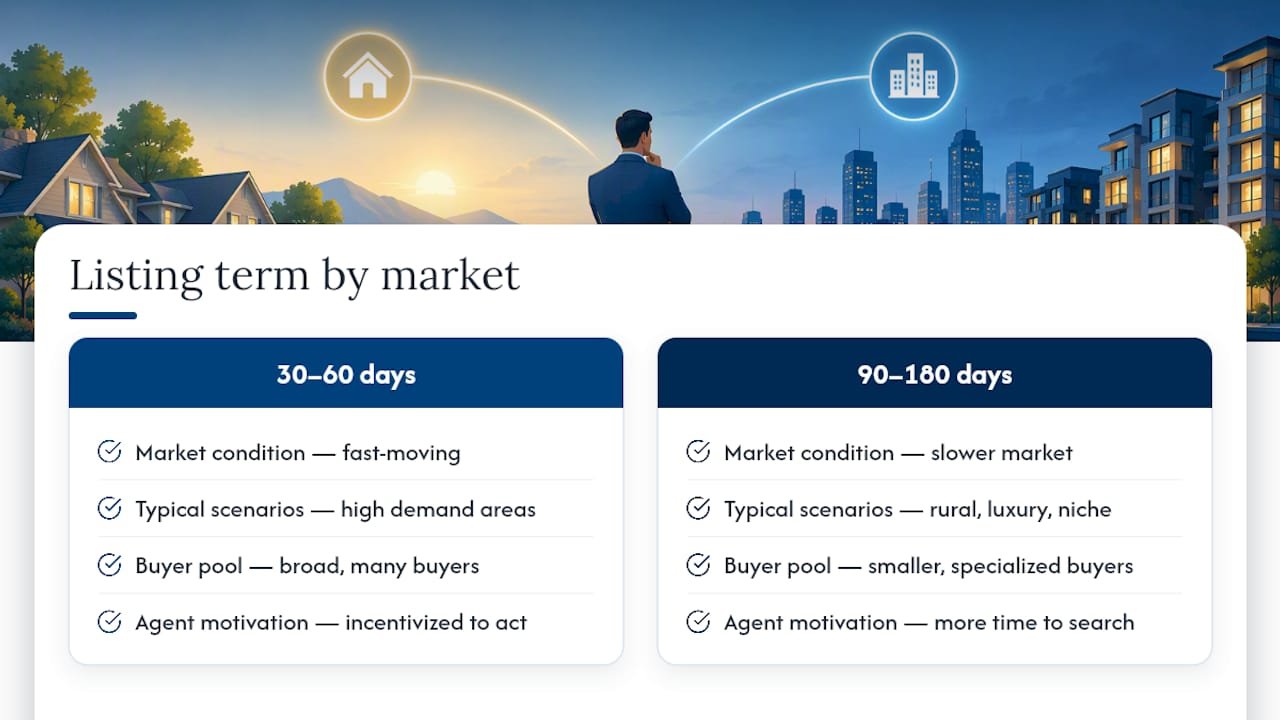
In a fast-moving market where homes are receiving offers quickly, a shorter term, often 30 to 60 days, gives sellers leverage. There’s less need to lock in a long commitment when demand is strong, and a short term keeps the agent motivated to perform quickly rather than coast on favorable conditions.
In a slower market, a longer term, typically 90 to 180 days or more, gives a listing enough time to reach the right buyer without the pressure of an looming expiration forcing a premature price cut. Rural properties, luxury homes, and niche listings often need longer terms regardless of the overall market temperature, since their buyer pool is naturally smaller.
The safest approach in any market is checking recent local data before committing to either extreme. A RealtiFy guide on renewing or changing agents after a listing expires walks through what options remain if the term runs out without a sale, which is worth understanding before you pick a length in the first place. Whatever the market condition, pairing the term with a price reduction checkpoint, rather than letting a stale listing sit unchanged for months, tends to produce a better outcome than the length of the contract alone.
The number of months matters less than what backs it
Most advice on listing agreement length treats the number itself as the decision, when the more useful question is what happens during that window. A 90 day term with no marketing plan is weaker than a 60 day term with a defined launch strategy and a pricing review built in. Sellers who fixate on getting the “right” number of months often skip the harder conversation about what the agent is actually committing to do with that time.
The conventional wisdom to “just pick 90 days, that’s standard” ignores how much local market speed varies. A term that’s comfortable in a slow suburban market can be needlessly restrictive in a competitive urban one, and vice versa. What the research actually supports is anchoring the term to your area’s median days on market, then negotiating milestones and an exit clause around that number rather than accepting a default.
If there’s one thing sellers underestimate, it’s how much leverage they have to negotiate cancellation terms before signing, not after they’re unhappy. Ask for the exit language in writing first. The length of the contract should protect you as much as it protects the agent.
— Ryan Case
Getting the term and the marketing plan right from the start
Choosing the right listing length is only half the equation. The other half is having an agent who commits to a marketing plan that justifies whatever term you agree to. A well-structured selling system pairs a defined launch and marketing cadence with strategic pricing and access to a buyer database, so the length of a contract lines up with an actual plan rather than a guess.

Sellers who want more certainty around timing can also look at the Guaranteed Home Sale program, which changes how the term and commitments are structured, or the fast-sale option for San Diego sellers built for a shorter, managed timeline.
| Service | Best fit for |
|---|---|
| Premier Selling System | Sellers who want strategic pricing and a full marketing plan tied to the term |
| Full Service Listing | Sellers who want standard representation without a specialized program |
| Guaranteed Sale Program | Sellers who want more certainty around the sale timeline |
- Request a personalized home analysis before settling on a term length.
- Compare service tiers on the Ryan Case Realtor site to see which one matches your timeline.
Consider starting with a home analysis to see which term and service tier fits your situation.
Sources
- Consumer guide: listing agreements — NAR
- Housing Inventory: Median days on market month-over-month in the United States | ALFRED
FAQ
What is the 3-3-3 rule in real estate?
The 3-3-3 rule is an informal phrase used in prospecting and marketing conversations, not a legal or regulatory standard tied to listing agreements. Definitions vary depending on who uses it, so sellers should ask an agent to explain exactly what they mean before assuming it applies to a contract term.
Does a listing agreement have to have an end date?
Yes, a listing agreement should always include a specific expiration date and time rather than an open-ended term. State regulatory guidance emphasizes explicit effective and expiration dates because vague language creates disputes over when the contract actually ends.
How long are most realtor agreements?
Most listing agreements fall into medium-length terms, with shorter or longer ones used depending on market speed and property type.
How long is too long to list a house for sale?
There’s no fixed cutoff, but a term that runs well beyond your area’s typical median days on market without built-in checkpoints, like a pricing review or marketing milestone, can leave you locked into an underperforming listing longer than necessary. Pairing any term, long or short, with a clear cancellation clause protects you either way.