An appraisal gap and a price drop are two different answers to the same problem: the buyer’s lender thinks the home is worth less than the contract price. With a gap, the buyer pays the difference in cash and the price stays put. With a price drop, you lower the contract price to the appraised value. Which one is better for you depends on how strong the buyer’s finances are, how good the appraisal is, and how many other buyers are waiting behind this one.
Below we walk through the math, the other options between those two extremes, and how we advise San Diego sellers when an appraisal lands under the contract.
TL;DR
- An appraisal gap is the difference between the agreed price and the appraised value. Your buyer’s lender will lend against the lower number, so someone has to cover the difference.
- A gap only works if the buyer has real cash. A price drop works even if they do not, but you give up the money dollar for dollar.
- Check the appraisal for factual errors first. A formal Reconsideration of Value (ROV) costs nothing and sometimes closes the gap without anyone paying.
- A middle path, a split or a credit, often beats both extremes. Run your net proceeds on each before you answer.
- A low appraisal is often a signal about pricing. Fixing the price strategy before you list is cheaper than fixing it at the appraisal.
Table of Contents
- What each term means
- How often low appraisals happen, and why it matters
- The math: gap, price drop and split
- When the gap wins
- When a price drop wins
- Four steps before you concede anything
- The options between gap and drop
- How the cash-gap choice reflects on your buyer
- Our perspective
- Help if your appraisal is already low
- Common mistakes sellers make
- FAQ
- Sources
What each term means
The appraisal gap is the difference between the contract price and the appraised value. If you agree to sell for $800,000 and the appraiser says $770,000, the gap is $30,000. Lenders base the loan on the lower of the price and the appraisal, so the buyer cannot borrow against the extra $30,000. The Consumer Financial Protection Bureau warns that paying more than the appraised value is very risky for buyers, which is why many of them push back.
A price drop has two meanings, and readers often mix them up:
- A contract price reduction. After a low appraisal, you agree to lower the price in the signed contract. This is the meaning we use in this article.
- A list price reduction. You cut the asking price on an active listing because it is not drawing offers. That is a marketing decision, covered in our data-backed timing playbook for price reductions.
The two are linked. A home priced too high on day one is more likely to meet a buyer who stretches, then an appraiser who disagrees.
How often low appraisals happen, and why it matters
Low appraisals are the exception, not the rule, but they carry weight. Fannie Mae researchers found that when an appraisal comes in under contract, price renegotiation becomes far more likely, rising from 8% to 51% in their study. They describe two forces. Some buyers simply cannot cover the shortfall in cash. Others treat the appraisal as fresh news that the home is worth less, even when they could afford to pay.
That second point is important for sellers. Even a buyer with cash in the bank may ask for a reduction, because the appraisal gives them a neutral third-party number to point to.
Market direction matters too. Freddie Mac’s chief appraiser has said that when a market is softening, appraisers should weigh downward trends and may reconcile value toward the lower end of the range. If prices are cooling in your neighborhood, expect more tension between a hopeful contract price and a cautious appraisal.
The math: gap, price drop and split
Numbers make the choice clearer. Take an $800,000 contract, a $770,000 appraisal and a buyer putting 20% down on a conventional loan. These figures are an illustration, not a quote, and your buyer’s loan terms will differ.
| Scenario | Final price | Loan (80% of the lower value) | Buyer cash needed | Your price vs. contract |
|---|---|---|---|---|
| Original contract, no fix | $800,000 | $616,000 | $184,000 | Unchanged, but the loan falls short |
| Buyer covers the full gap | $800,000 | $616,000 | $184,000 | $0 lost |
| Full price drop | $770,000 | $616,000 | $154,000 | $30,000 lost |
| Split the gap | $785,000 | $616,000 | $169,000 | $15,000 lost |
The buyer originally planned on $160,000 down (20% of $800,000). If they cover the whole gap, they bring $24,000 more than planned. Their lender still lends $616,000, which is 80% of the appraised value.
Three things stand out:
- The lender’s loan does not change in any scenario. Only the buyer’s cash and your price move.
- A gap costs you nothing, but it costs the buyer $24,000 of extra cash. If they do not have it, the deal stalls.
- A price drop costs you the full $30,000. It is certain and quick, which is its appeal and its drawback.
The mortgage lender, not the agent, decides whether the loan can go through at a given price, so the buyer’s lender should confirm the new numbers before anyone signs an amendment.
When the gap wins
Covering the gap in cash is the best outcome for you. It makes the most sense when:
- The buyer has shown strong liquid funds, beyond the down payment and closing costs.
- The buyer wrote an appraisal gap clause into the original offer. In that case the cash was promised, and holding them to it is reasonable.
- Comparable sales are thin or dated, so you have a good argument that the appraiser lacked data.
- The home is unique, with a view, lot or renovation that a model-based number may miss.
Be careful about asking an unprepared buyer to find $24,000 on short notice. If they are a first-time buyer stretching to qualify, pushing hard may end in a cancellation, and you restart your marketing time. Our guide for the other side of the table, appraisal gap options for home buyers, explains how buyers think about this money.
When a price drop wins
Accepting a lower contract price is not defeat when:
- The appraisal is well supported and recent comparable sales really do sit near the lower value. Another buyer’s appraiser would likely say the same, so holding out only delays the correction.
- The buyer’s cash is already committed to down payment, closing costs and reserves.
- You have a hard date, such as a purchase of your own that closes in a few weeks.
- The home has already sat on the market, and relisting would likely cost more than the reduction.
A useful rule: if you would rather accept the lower price than take the home back to market, a price drop is the right call. If you would happily relist at the original price because buyers are lining up, hold your ground a little longer.
Four steps before you concede anything
1. Read the appraisal for factual errors
Check the square footage, bedroom and bathroom count, lot size, condition rating and the comparables. Missed upgrades, a wrong garage count or comps from a different type of neighborhood are the usual culprits.
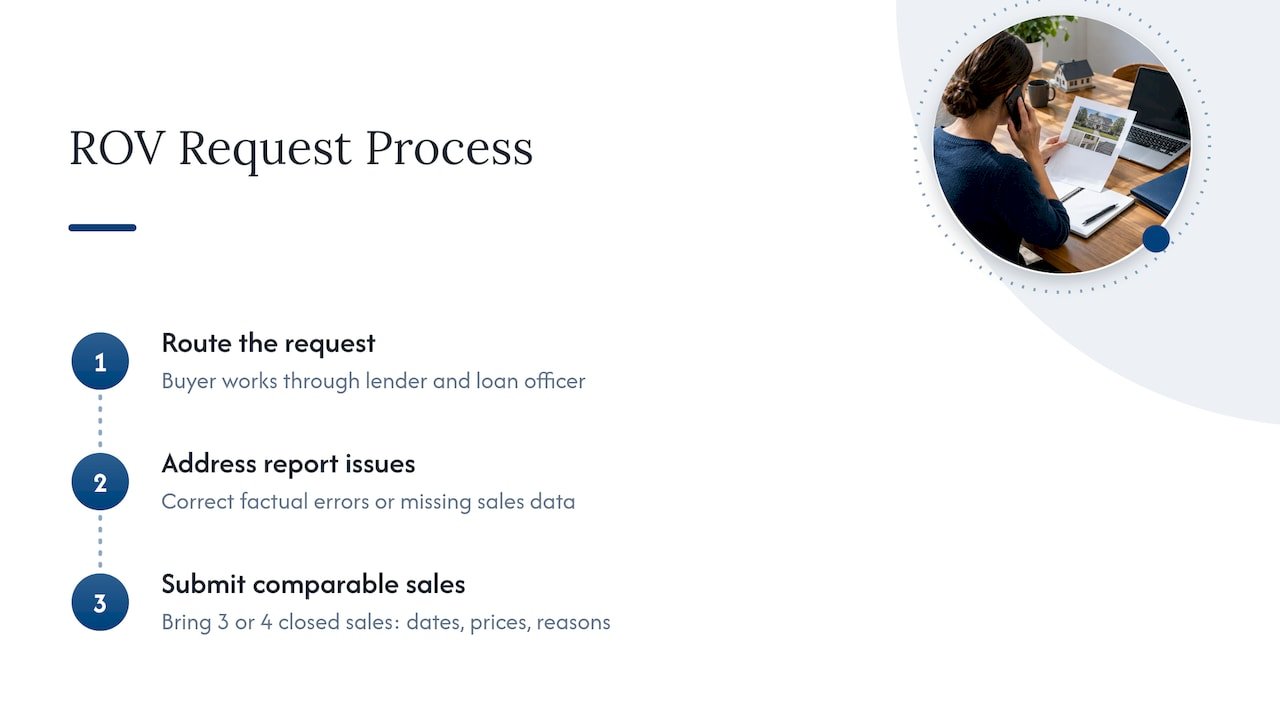
2. Ask the buyer to request a Reconsideration of Value
The buyer’s lender handles an ROV, so the request goes through the buyer and their loan officer, not through you. The CFPB says ROV is an important consumer right and that the appraisal should not be treated as final until factual errors or missing sales data have been addressed through the lender’s process.
An ROV needs evidence. The interagency guidance on reconsiderations of value describes the process as based on concrete facts, such as comparable sales the appraiser missed or property errors. Saying the number feels low is not enough. Bring three or four closed sales, with dates, prices and reasons they are better comparisons.
3. Look at your timeline
Federal rules require lenders to provide a copy of the appraisal promptly upon completion or at least three business days before closing, whichever comes first. The buyer may waive the three-day period, but the waiver must be obtained at least three business days before closing. So the buyer should already have the report in hand when you start negotiating. Ask your agent to confirm that and to check your contract’s appraisal contingency deadline.
4. Compare your net on every option
Price is not the only number. A credit towards closing costs, a repair, or a different closing date may be worth more to you or the buyer than it costs. For more on this trade-off, see our piece on when a $10,000 credit beats a price cut.
The options between gap and drop
Most deals that survive a low appraisal end up somewhere in the middle. According to the CFPB, buyers generally have four main choices: ask the seller to lower the price, challenge the report through an ROV, put in more cash, or walk away if the contract has an appraisal contingency. Each can be blended.
- Split the difference. Each side takes half. It is quick, feels fair, and keeps both parties invested.
- Partial gap, partial credit. The buyer covers part in cash, and you give a seller credit for closing costs. The price on paper stays higher, which can help with future comps, though the lender must approve credits.
- Reduce price, extend the rent-back or close date. Give the buyer something besides money.
- Wait for a second appraisal. Only worthwhile if you have a clear factual basis, since a second opinion costs the buyer time and money.
- Cancel and relist. The last resort. You lose the time and any momentum you built, and the failed appraisal may follow the home in showings. Our guide to saving the sale after a low appraisal walks through these paths with sample scripts.
The local detail we see is that comparables vary block by block in San Diego County. A coastal home in one neighborhood and a similar-sized home a few miles inland can sit at very different price per square foot, and an appraiser working from comps in the wrong pocket will produce the wrong number. That is the most common reason an ROV succeeds here.
How the cash-gap choice reflects on your buyer
If you are comparing financed offers against all-cash ones, the appraisal question looks different. A cash buyer has no lender and no loan appraisal, so there is no gap to cover. Our article on when financing beats a faster cash close goes through the trade. And if a cash buyer appears, confirm their funds first with our four-step check to verify cash buyer funds.
For a wider view of how buyers and sellers bargain when the appraisal falls short, this guide on appraisal gap coverage, caps and ROV lays out how coverage limits are set and reserved. It is written for a different region, but the mechanics of gap clauses are the same.
Our perspective
We rarely see a low appraisal as bad luck. More often it is a pricing problem that showed up late. When a home is priced from a gut feeling or from an online estimate, the first real test comes from the buyer’s lender, at the point when you have the least room to respond.

So we do the work early. We build the price from recent closed sales and active competition, and we show the numbers to the seller before listing. Our data-backed approach to strategic home pricing is designed so that an appraiser looking at the same sales would see the same story. If the appraisal still lands low, we pull the comps and check the report line by line before conceding a dollar. We decide on a price drop only after an ROV has been tried or ruled out, and only after we have compared the net to a gap split and a credit.
We also push to have the offer terms work for us from the start: a strong, qualified buyer, a clear appraisal contingency timeline, and a counter that asks for gap coverage where the buyer can really afford it. Our seller counteroffer strategy explains how.
— Ryan Case
Help if your appraisal is already low
If you are under contract and the number came in short, we can review the report with you, pull the comps, and lay out your net under each option. Sellers who want certainty on price and timing can also look at our guaranteed home sale program, and you can see all our service tiers on the Ryan Case home page.
Common mistakes sellers make
- Dropping the price immediately. The first reaction is often to accept the buyer’s request without checking the report for errors.
- Demanding the full gap from a buyer who cannot pay it. You may force a cancellation.
- Ignoring the appraiser’s data. If three comparables agree with the low value, it is evidence about the market, not just one opinion.
- Trusting an online estimate over the appraisal. Automated values are a starting point, not a verdict. See Zestimate vs. appraisal for how they differ.
- Missing contract deadlines. An appraisal contingency has a clock. Let it lapse without a written agreement and your leverage changes.
FAQ
Is an appraisal gap the same as a price reduction?
No. In an appraisal gap, the price stays the same and the buyer pays the difference in cash. In a price reduction, the contract price falls to or toward the appraised value. The gap protects your sale price but needs a buyer with extra cash.
Who pays when an appraisal comes in low?
Whoever agrees to in the negotiation. The lender will only lend against the lower value, so the shortfall is covered by the buyer’s cash, a lower price from you, a split, or the deal ends if the contract has an appraisal contingency.
Can a buyer back out after a low appraisal?
If the contract has an appraisal contingency and the buyer acts within its deadline, yes. Without that contingency, or after it has been removed, they may risk their deposit. Check your own contract’s dates and wording with your agent.
Can we challenge a low appraisal?
The buyer can ask the lender for a Reconsideration of Value. It requires factual evidence such as missed comparable sales or errors in the property details, and the lender decides whether to act on it.
What is the three-day appraisal rule?
Under federal rules, the lender must give the buyer a copy of the appraisal promptly after it is done, and no later than three business days before closing. The buyer can waive the waiting period in writing.
Sources
- CFPB: My appraisal is less than the sale price. What does that mean for me?
- Fannie Mae: When Appraisers Go Low, Contracts Go Lower
- Freddie Mac: Q&A with the Single-Family Chief Appraiser
- CFPB: Mortgage borrowers can challenge inaccurate appraisals through the ROV process
- Interagency guidance on reconsiderations of value
- eCFR: 12 CFR 1002.14, Rules on providing appraisals and other valuations