Online home valuations are a solid starting point but not a number you should list, lend against, or negotiate with. On-market tools tend to land within a few percentage points of sale price, while off-market estimates drift much further. Treat any single figure as the middle of a range, run two or three tools side by side, and bring in a comparative market analysis or appraisal before any decision that involves real money.
TL;DR:
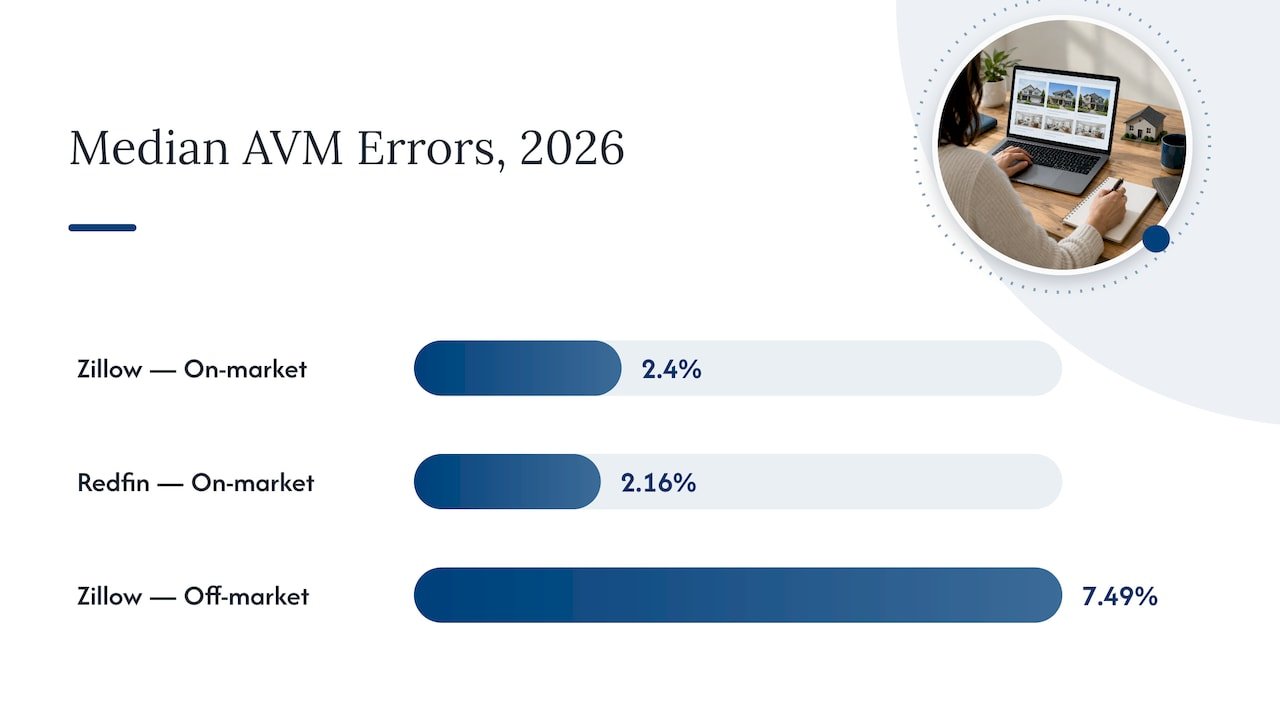
- Zillow’s 2026 median error was about 2.4% for listed homes and 7.49% for homes not listed; Redfin reported 2.16% for listed homes.
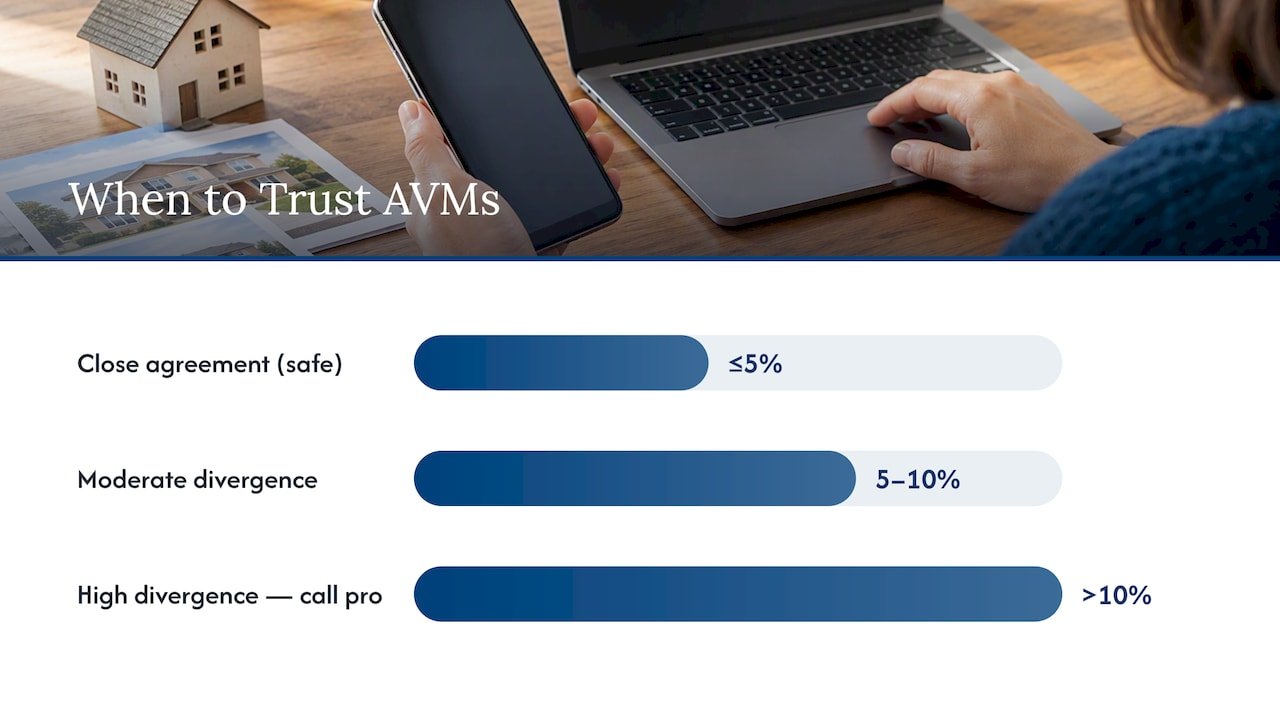
- If two or three estimates fall within about 5% of one another, use their spread as an early planning range, not a final asking price.
- When tools differ by more than 10%, or your home has unusual features or few nearby comparables, get a professional valuation.
- A lender, title company, or buyer requiring a value for financing needs an appraisal, because an automated estimate will not satisfy underwriting.
- Models cannot see renovations, unpermitted work, interior condition, or road noise, so provide permits, receipts, and current photos when requesting a comparative market analysis.
Table of Contents
- What “accuracy” actually means for an online estimate
- How automated valuation models work and where they struggle
- What the published accuracy numbers actually show
- When to trust an online estimate, and when to call in a professional
- How we use online estimates inside the Premier Selling System
- What this means for sellers
- FAQ
- Sources
What “accuracy” actually means for an online estimate
When a valuation tool claims to be accurate, it is reporting a statistical pattern across thousands of homes, not a promise about yours. The most common measure is median error, the midpoint of all the percentage gaps between estimated and actual sale price. Statisticians prefer the median over the average because a handful of wildly wrong estimates (a teardown, a mansion, a home with an illegal addition) can skew an average without reflecting the typical case.
A few terms show up repeatedly in accuracy reports:
- MdAPE (median absolute percentage error): the median of the error sizes, ignoring whether the estimate was too high or too low.
- MAE (mean absolute error): the average error size, more sensitive to extreme misses than the median.
- Within-5%/within-10% bands: the share of estimates that landed inside 5% or 10% of the actual sale price.
- Forecast Standard Deviation (FSD): a confidence score tied to an expected error range.
Freddie Mac’s model-governance research describes FSD as a way to link a confidence score to an expected proportional error, with roughly 68% of actual sales falling within plus or minus one FSD of the AVM estimate.
FSD is the number vendors rarely show you, even though it is the clearest measure of how much to trust a given estimate.
How automated valuation models work and where they struggle
An automated valuation model, or AVM, builds its number from whatever data it can find: county tax records, past sales in the area, public listing details, and sometimes photos pulled from prior MLS listings. When a home is actively listed, the model also picks up agent-written descriptions, days on market, and any price changes, which is a big reason on-market estimates tend to outperform off-market ones.
Under the hood, these models typically rely on one of a few approaches:
- Regression models, which tend to stay stable in smaller or data-thin markets.
- Machine learning models, which can capture more complex patterns but risk overfitting where sales data is sparse, according to a regression analysis overview from G2.
- Hybrid models, which blend both to balance stability and nuance.
None of these methods can see inside your home. A model has no way of knowing that you gutted the kitchen last year, added a bathroom without pulling a permit, or that the house next door backs onto a busy road. Condos with unusual HOA fees, rural homes with few comparable sales, and properties with non-permitted work are the classic blind spots.
Pro Tip: Run your address through two or three valuation tools and note where they disagree most. That gap usually points to the exact feature of your home the models can’t see.
What the published accuracy numbers actually show
Zillow’s 2026 published figures put the Zestimate’s median error at roughly 2.4% for on-market homes and about 7.49% for off-market homes, according to a 2026 benchmarking analysis. Redfin’s on-market estimate performs similarly, with a reported median error near 2.16% in the same 2026 comparison.
Realtor.com’s RealEstimate tool and Redfin’s model use comparable data sources and land in a similar range for on-market homes, though exact figures shift by region and update cycle.
Fannie Mae’s own research on valuation accuracy found that AVM estimates fall within a narrow range of actual contract prices less often than professional appraisals do, and that the gap between AVMs and appraisals varies by property type and local market conditions, per Fannie Mae’s research on AVMs versus appraisals. Academic benchmarking against municipal assessment data has also found that AVMs perform best in dense, homogeneous neighborhoods with lots of recent comparable sales, and worst in mixed-use or heterogeneous areas, according to a New York City benchmarking study.
Here is what those percentage errors mean in dollars across a few common price points:
Error rates are not evenly distributed. A handful of properties, usually unique homes or ones in thin markets, drive most of the large misses, while the typical homelands much closer to the estimate than the worst case suggests.
When to trust an online estimate, and when to call in a professional
Online tools earn your trust when several of them agree. When they diverge, that disagreement is useful information in itself.
- If two or three valuation tools land within about 5% of each other, you likely have a workable range for early planning.
- If the estimates differ by more than 10%, or your home has an unusual layout, a recent renovation, or no close comparables nearby, skip straight to a human opinion.
- If a lender, title company, or buyer needs a number for financing, you need an appraisal; an AVM alone will not satisfy underwriting.
Watch for red flags that tend to push AVMs off course: very few recent sales in your ZIP code, a condo with HOA-specific issues, missing or outdated interior photos, or a local market that has swung sharply in the past few months. Bankrate’s consumer guidance makes a similar point, noting that online home value tools give a quick rough idea but cannot replace an in-person appraisal or a comparative market analysis, especially once interiors or recent upgrades are unaccounted for.
Pro Tip: Before you request a CMA, gather permits, renovation receipts, and recent interior photos. That paperwork is exactly what AVMs can’t see and what a CMA will factor in.
If you are weighing a faster, lower-cost alternative to a full appraisal, a broker price opinion is worth understanding too. BDC New England’s guide to BPOs versus appraisals breaks down when each makes sense for owners and sellers who need a number quickly.
How we use online estimates inside the Premier Selling System
We treat an AVM as a starting input, never the final word. When handling a new listing, we compare the online estimate against a full comparative market analysis, a walk-through of the property’s condition, and recent closed sales that match the home’s specific features, not just its ZIP code.
Our Premier Selling System is built around that gap between what an algorithm sees and what a buyer actually experiences. We pair accurate pricing with targeted exposure, including Zillow Showcase listings and direct access to our buyer database, so the final asking price reflects both the data and real demand.
A few things we ask every seller to do before we price a listing:
- Pull together permits and receipts for any renovation work, even small jobs.
- Add current interior photos rather than relying on whatever a public listing shows from years ago.
- Request a full CMA with recent, truly comparable sales rather than a single algorithm-generated number.
What this means for sellers
Run two or three online estimates, convert the reported error rate into a dollar range for your price point, and treat that range as your planning number. If the tools cluster closely, you have a reasonable starting point for conversations with buyers or agents. If they scatter, or if a loan, closing, or legal matter depends on the number being right, stop trusting the algorithm and get a CMA or appraisal instead. An AVM is a tool for narrowing a question, not for answering it.
— Ryan Case
This article is general information, not a substitute for advice from a qualified financial advisor. Consult a qualified financial professional about your own circumstances before acting on anything here.
FAQ
How close is Zillow’s Zestimate to the actual sale price?
For homes actively listed for sale, Zillow’s 2026 figures put the median error around 2.4%, with about 68% of estimates landing within 5% of the final sale price.
Which online property valuation tool is most accurate?
No single tool is consistently the most accurate everywhere, since performance depends heavily on local sales volume and data quality.
Do appraisals usually match the asking price?
Appraisals are generally closer to contract price than automated estimates, though they do not always match the asking price exactly. Fannie Mae’s research on AVMs versus appraisals found that appraisals fall within a narrow range of contract price more consistently than algorithm-based estimates.
Do Zestimates tend to run high or low?
Zillow’s published accuracy data does not point to a consistent bias toward high or low estimates across the board; errors run in both directions depending on the property and market. What is consistent is that off-market homes carry a wider error band than on-market homes, simply because the model has less current information to work with.
How do I know if my home needs a professional valuation instead of an online estimate?
If multiple online tools disagree by more than about 10%, or your home has unique features, recent renovations, or few comparable sales nearby, a CMA or appraisal will give you a far more reliable number. The same applies anytime a lender, buyer, or legal process requires a defensible value rather than an estimate.
Sources
- Metrics matter: Forecast standard deviation and AVM confidence
- How accurate is Zestimate in 2026? We ran the numbers
- Fannie Mae research: Influence of contract prices and AVM vs appraisals
- Bankrate: Online home value estimator overview