Pending comps can support a pricing decision and signal where a market is heading, but they cannot replace closed sales as primary appraisal evidence. Appraisers still anchor value to recorded, lender-verified transactions. When you have active pendings, the smart move is to document them, weight them conservatively against closed data, and use them to explain market direction rather than to set your number outright.
TL;DR:
- Pending comps are useful in rapidly changing markets, small neighborhoods, or seasonal shifts but should not override verified closed sales for valuation.
- Appraisers rely primarily on closed sales from the past three to six months, supporting adjustments with pending or active listings rather than replacing them.
- Seller concessions, unresolved contingencies, or financing issues can inflate pending prices and should trigger discounting their weight or exclusion.
- Effective pricing when considering pendings involves conservative weighting, detailed documentation, and clear communication about demand signals to buyers and appraisers.
- Overstating pending activity risks overpricing and potential appraisal gaps, so reliance on verified closed sales remains essential in appraisal and valuation processes.
Table of Contents
- What sold, pending, and active comps represent
- When pending comps matter most
- How to price a listing when pending comps are in play
- How appraisers document time adjustments
- Red flags that should make you discount a pending comp
- Practitioner notes on pricing when pendings are active
- Balancing an aggressive price against appraisal risk
- How we help you price with confidence when pendings complicate the picture
- FAQ
- Sources
What sold, pending, and active comps represent
A sold comp is a closed transaction recorded at the county level, with a final price confirmed by a lender and title company. A pending comp is a property under contract where a price has been agreed but the sale hasn’t closed, so the figure is not yet public record. An active listing is simply an asking price with no accepted offer behind it.
Closed sales carry the most weight because they’re verified, finalized, and tied to a funded loan. Fannie Mae’s guidance on comparable sales requires appraisers to analyze closed sales as primary evidence, with contract sales and listings treated as supporting data rather than substitutes.
Pendings are useful for a different reason: they reflect what buyers are agreeing to pay right now, before that information becomes public.
- Sold comps: verified price, recorded, usable as primary appraisal evidence.
- Pending comps: agreed price, not yet public, useful as a leading indicator.
- Active listings: asking price only, no buyer commitment behind the number.
What pendings hide matters just as much as what they reveal: seller concessions, buydowns, and contingencies rarely show up until closing, so a pending price can overstate true market value if you take it at face value.
When pending comps matter most
Pending comps carry the most weight in specific, identifiable conditions rather than as a general pricing tool.
- Rapidly shifting markets. When prices are climbing or falling quickly, closed sales reflect contracts signed weeks or months earlier. Pendings close that gap and show what buyers are agreeing to pay today.
- Low-volume neighborhoods or small condo projects. In areas with few recent closings, such as a new condo building with only a handful of completed sales, pendings may be among the only recent data points available.
- Seasonal transitions. The jump into spring buying season or the slowdown after the winter holidays can shift pricing faster than closed data can catch up, making recent contract activity a more current signal.
Outside these scenarios, closed comps from the trailing three to six months remain the more reliable foundation, and pendings should supplement that picture rather than override it.
How to price a listing when pending comps are in play
Pricing with pendings in the mix works best as a structured process, not a gut call.
- Pull every closed comp from the trailing three to six months, then layer in active listings and any pendings you can identify nearby, using detailed tools on how to pull real estate comps for investment properties.
- Use list-to-pending ratios and the property’s last list price as a proxy when the actual contract price isn’t public yet.
- Weight pendings conservatively: treat them as directional evidence, not confirmed value, and lean on closed sales for the final number.
- Document the dates each comp went pending, any visible concessions, and the reasoning behind any time adjustment you apply.
- Write a short summary for the seller and, later, the appraiser explaining why recent pending activity supports your pricing.
Pro Tip: Keep a running log of every pending comp you track from the day it appears, the eventual close date and price often tell you how accurate your early read actually was.
When you talk to a seller about pricing that leans on pending activity, say it plainly: “Three homes near yours went pending in the last three weeks above the last closed sale. That tells us demand is moving up, but we’ll price carefully because the appraisal will still lean on what’s actually closed.” That framing sets expectations before an offer ever comes in.
How appraisers document time adjustments
Fannie Mae expects appraisers to do more than list closed sales. Guidance on adjustments to comparable sales directs appraisers to analyze contract sales and current listings for market trends between a comparable’s contract date and the appraisal’s effective date, and to support any time adjustment with real evidence rather than a flat guess.
- Closed sales remain the primary basis, with a minimum of three closed comparables typically required.
- Time adjustments must be backed by evidence such as home price indices, paired sales analysis, or other statistical methods.
- Pending and active listings can be cited to show a trend, but they support the adjustment rather than replacing the closed-sale foundation.
NAR’s Pending Home Sales Index tracks exactly this kind of signal: recent data reported a 0.3% month-over-month increase and a 4.7% year-over-year decrease, underscoring that pending activity moves differently by region and by month, which is precisely why appraisers are asked to document rather than assume a trend.
If you want an appraiser to take a pending-driven time adjustment seriously, hand over the contract dates, the comp addresses, and a brief note on what shifted in the market between contract and closing. A documented argument lands better than a verbal claim.
Red flags that should make you discount a pending comp
Not every pending is a clean signal. Some hide terms that inflate the apparent price.
- Seller-paid concessions or rate buydowns that make the nominal contract price look higher than the true market-equivalent value.
- Contingencies still attached, such as a pending home sale or an unresolved inspection, that could unwind the deal entirely.
- Financing contingencies that haven’t cleared, meaning the buyer’s loan approval isn’t final.
- Days on market that suggest the property sat before accepting a below-market offer dressed up with incentives.
Before leaning on a pending comp, request a contract summary if you can get one, confirm whether contingencies have been removed, and check the property’s price and marketing history. When concessions are confirmed or contingencies remain open, discount that comp’s weight significantly or set it aside until it closes and the terms become public record.
Practitioner notes on pricing when pendings are active
My approach when pendings are moving in a seller’s favor is to set a strategic list price range, stage the marketing rollout, and push the listing straight to our buyer database before it hits the open market broadly. That sequencing often surfaces offers before the comp picture even fully updates.
When an appraisal comes in under contract, the documentation you built before the offer, not after, is what gives you room to negotiate or appeal.
Having pending comps, contract dates, and concession details organized in advance turns a stressful renegotiation into a shorter conversation with more leverage.
Balancing an aggressive price against appraisal risk
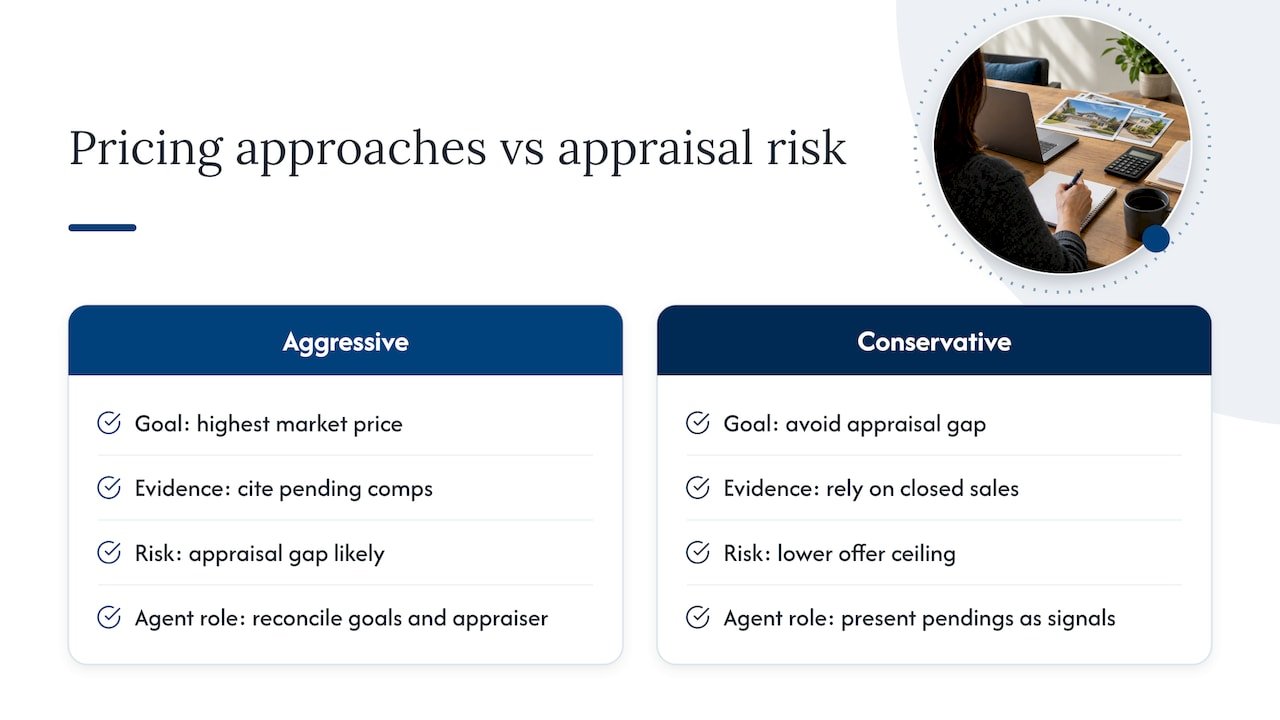
Some sellers want the highest number the market will bear, backed by every pending they can point to. Others would rather price conservatively and avoid an appraisal gap altogether. Neither instinct is wrong, but an agent’s job is reconciling the seller’s financial goal with what an appraiser will actually support.
The honest path is presenting pending comps as what they are, which is a signal, not a settled fact, and being accurate about contract terms when that data reaches an appraiser. Overstating a pending’s strength to justify a stretch price tends to backfire at the one moment it matters most.
— Ryan Case
How we help you price with confidence when pendings complicate the picture
We build a seller’s pricing strategy around real-time market signals, not just the last closed sale, pairing strategic pricing with targeted marketing and direct access to a buyer database. For San Diego homeowners trying to figure out how pending activity should factor into a list price, we put together a documented comp package that holds up with buyers, their agents, and appraisers alike.

- A personalized seller analysis that weighs closed, pending, and active comps for your specific property.
- A documented package of pending-sale indicators and time-adjustment reasoning ready to hand to an appraiser.
- Direct outreach to our buyer database before your listing goes wide.
If you’re weighing how to price with pending comps in the mix, request a seller analysis and we’ll walk through the comp picture together.
FAQ
How far out do appraisers go for comps?
Appraisers typically pull closed sales from the trailing three to six months, though they can extend further back in slow markets where recent closings are scarce. Fannie Mae’s guidance calls for a minimum of three closed comparables most similar to the subject property.
Which is better, pending or contingent?
A pending sale generally means contingencies have been removed or are close to clearing, while a contingent listing still has conditions, like a buyer’s financing or home sale, that need to be satisfied. Pending status signals a deal closer to the finish line, though neither is confirmed until closing.
What is the hardest month to sell a house?
Market timing shifts by region and year, and pending home sales data shows activity moves month to month rather than following one fixed pattern nationwide. NAR’s pending sales reporting is one way to check how contract activity is trending in a given month.
What not to tell an appraiser?
Avoid overstating comparable sales, guessing at adjustment figures, or pressuring an appraiser toward a target number. Stick to factual, documented information such as contract dates, closed comps, and verified concessions, and let that evidence speak for itself.