If you’re selling a home inside a California homeowners association, you must provide the buyer with the 10 categories of disclosure documents listed in Civil Code §4525. Your HOA has 10 days to produce them once you make a written request and can only charge its actual cost under §4530. Starting January 1, 2026, the packet must also include the latest exterior elevated elements inspection report under SB 410.
TL;DR:
- The HOA must respond to a written request for disclosure documents within 10 days, providing an itemized bill based on actual production costs.
- Buyers often find recent reserve study summaries, current budgets, insurance declarations, and recent board minutes missing, causing escrow delays.
- Requesting the resale packet early, immediately after accepting an offer, helps avoid last-minute delays and gives time to dispute unreasonable fees.
- The latest exterior elevated elements inspection report is now required and must be included in the packet starting January 1, 2026.
- Sellers should verify that all critical financial and litigation disclosures are current and complete before submitting documents to prevent escrow hold-ups.
Table of Contents
- What the statutory disclosure checklist requires under Civil Code §4525
- Who orders the packet, who pays, and how fast the HOA has to respond
- The documents buyers and sellers most often find missing
- If the HOA delays or overcharges, here’s how to push back
- A practical seller timeline to avoid escrow delays
- How we build HOA verification into a listing
- How we help you manage HOA paperwork without the back and forth
- FAQ
- Sources
What the statutory disclosure checklist requires under Civil Code §4525
Civil Code §4525 spells out exactly what has to land in a buyer’s hands before you sign a purchase contract or close escrow, and skipping any category can delay your sale or create liability later. The list falls into a few practical groups.
Your governing documents come first: the CC&Rs, articles of incorporation, bylaws, and current operating rules. Buyers and their lenders want to see recorded copies, not drafts, and they’ll check for recent amendments that might restrict rentals, pets, or renovations.
Financial records make up the next group, and they tend to matter most to lenders. These include the current operating budget, a summary of the reserve study, and the most recent reviewed or audited financial statement. The percent funded figure in that reserve study is often the single detail that determines whether a lender treats the HOA as financially healthy.
A statement of the specific assessments and fees tied to your unit also has to be included: current regular dues, any special assessments, and notes of delinquencies or fines attached to the property. Buyers need this number to be exact, not estimated, because it affects their closing costs and monthly budget.
Rounding out the packet are:
- Notices of any pending or settled litigation involving the association
- Construction defect disclosures, when applicable
- A summary of the association’s insurance coverage
- Board meeting minutes from the last several months, available on request
- The latest exterior elevated elements inspection report, now required under SB 410
That last item is new. DRE guidance on common interest developments confirms these categories are what buyers and their agents should expect to receive, and treats any missing item as a material fact worth flagging before contingencies are removed.
Who orders the packet, who pays, and how fast the HOA has to respond
Requesting the packet is straightforward, but the rules around timing and cost are specific enough that sellers get overcharged when nobody checks them. Here’s the sequence that keeps you protected.
- Submit a written request to the HOA or its management company, naming yourself or your authorized agent as the recipient.
- Confirm the association provides a written estimate of fees before it starts processing anything, as required under §4530.
- Track the 10-day clock. California Civil Code §4530 requires delivery within 10 days of a valid written request, and electronic delivery is allowed at no extra charge.
- Review the itemized billing form. Under §4528, every charge has to appear on a standardized form, in type no smaller than 10 points, so bundled or vague fees are easy to spot and challenge.
Third-party management companies frequently quote resale packet fees well above an association’s actual cost of production, which is the only basis §4530 allows for billing, according to practical reviews of California resale packets. If you already have copies of governing documents or recent minutes, you can supply them yourself at no cost, which should lower what the HOA charges for the rest.
The documents buyers and sellers most often find missing
Even when a resale packet looks complete, specific financial and risk-related items get left out more often than not, and those gaps are exactly what trigger late-stage escrow questions.
- The current fiscal year’s approved budget, as opposed to an outdated or draft version
- The reserve study summary and percent funded figure
- Current insurance declarations pages
- Any pending litigation disclosure, even minor claims
- The exact dollar amount of assessments tied to the specific unit, not a general dues schedule
- Recent board minutes, when they were requested
Audits of resale packets across multiple California communities found these same categories missing repeatedly, and noted that the omissions are what most often push buyers to delay removing contingencies.
Before you forward anything to a buyer, check the date on every document, confirm whether you’re looking at a signed original or an unsigned summary, and make sure any inspection report is labeled as the most recent one rather than a prior cycle’s report.
Pro Tip: Request the reserve study summary and the insurance declarations page by name, since generic requests for “financial records” often come back incomplete.
If something is missing, follow up in writing immediately, name the specific section number you’re requesting, and set a firm deadline tied to your escrow contingency dates rather than leaving it open-ended.
If the HOA delays or overcharges, here’s how to push back
A slow or inflated HOA response doesn’t have to stall your closing, but you need to respond the right way from the first request.
- Put every request in writing, including the date sent and the method of delivery, and save the HOA’s response with its own timestamp.
- Insist on the written cost estimate required under §4530 before the association begins processing your request, and refuse to pay a bundled fee that doesn’t break out each document separately.
- Compare the itemized bill against the standardized form required by §4528. If fees aren’t itemized that way, you have statutory grounds to dispute them in writing.
- If the HOA blows past the 10-day deadline or won’t itemize charges, use that written record to extend or preserve your contingency period with the buyer and escrow.
- For willful noncompliance, California law allows penalties and attorney’s fees under the Davis-Stirling Act, so a certified letter referencing the statute often resolves the issue before it reaches that point.
Most delays get fixed once an association realizes you’re tracking dates and fees against the actual statute rather than just accepting whatever the management company quotes. When they don’t, that’s the point to loop in your escrow officer or an attorney rather than let the closing date slip.
A practical seller timeline to avoid escrow delays
The biggest cause of last-minute escrow stress isn’t missing paperwork, it’s ordering it too late. A simple sequence prevents most of it.
- Request the resale packet the day you accept an offer, not when escrow asks for it. The 10-day response window starts from your written request, so earlier is always better.
- Have your agent or escrow officer confirm who is authorized to receive the documents, since management companies sometimes require the request to come from a specific party.
- Gather and hand over any governing documents or minutes you already have, since those come at no cost and shrink the HOA’s final bill.
- Set an internal follow-up deadline two business days before your buyer’s contingency removal date, so you have time to dispute fees or chase missing items before it becomes a deadline problem.
Document timing like this connects directly to how a home sale contingency actually plays out, since a buyer can’t remove an HOA-related contingency until every required document is in hand.
How we build HOA verification into a listing
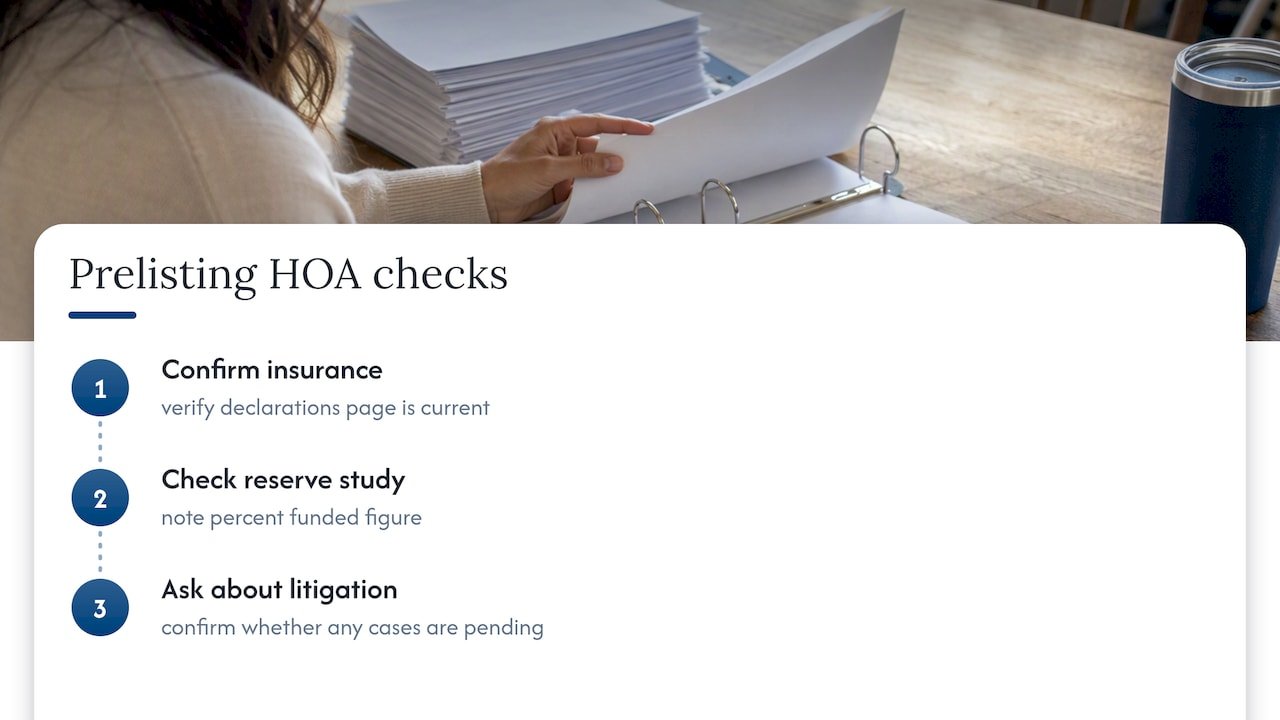
We treat HOA disclosure verification as a prelisting task, not something to solve after an offer comes in. Before a property with an HOA goes live, we confirm the insurance declarations page is current, check the reserve study’s percent funded figure, and ask directly whether any litigation is pending, because these are exactly the items that stall escrow when they surface late.
That groundwork matters more in some markets where condos and planned communities carry HOA dues tied to amenities, shared structures, or coastal exposure that bring exterior inspection requirements into play.
— Ryan Case
How we help you manage HOA paperwork without the back and forth
Ordering a resale packet, tracking a 10-day deadline, and disputing an inflated fee is doable on your own, but it’s one more task competing with your attention during a sale. As part of our Premier Selling System, we coordinate disclosure packet requests, flag missing items before they reach your buyer, and keep escrow moving on schedule.

If you’re weighing your timeline against an HOA’s paperwork process, our guide to selling without a deep discount walks through how we keep closings on track, and our Guaranteed Home Sale program gives you a certainty option if timing is your biggest concern. Reach out and we’ll map out what your HOA packet will involve before you list.
FAQ
Who can order the necessary HOA documents for a transaction?
You, as the seller, can request the packet directly, and you may authorize your real estate agent or escrow officer to submit the written request on your behalf. The HOA or its management company must respond within 10 days of a valid written request under Civil Code §4530.
Do I need to tell my HOA I’m selling?
You aren’t required to announce your sale before requesting disclosure documents, but submitting a written request for the resale packet effectively puts the association on notice. Most associations need that request in writing anyway to start the 10-day clock required by statute.
Who pays for the HOA resale certificate?
As the seller, you’re generally responsible for the cost of the resale packet, though the HOA can only charge its actual cost of production under §4530, with fees itemized on the standardized billing form required by §4528. If you already have copies of governing documents or recent minutes, you can provide those yourself at no charge, which lowers the total bill.
What are HOA disclosure documents?
They’re the set of 10 categories of records required under Civil Code §4525, covering governing documents, financial statements, assessment amounts, litigation notices, insurance summaries, and board minutes. As of January 1, 2026, the packet also must include the most recent exterior elevated elements inspection report under SB 410.
Sources
- California Code, CIV 4525
- DRE updates — Documents for the Buyer (Civil Code Section 4525)
- California HOA disclosure packet guide — HOA Notes