Price at or slightly below fair market value when you want competition and a fast, clean sale. Choose an aggressive price only if speed matters more than the last few percentage points, and hold aspirational pricing for a slow, low-inventory market where you have no timeline pressure. The decision hinges on three numbers: recent comparable sales, current days on market (DOM), absorption rate, and how many competing listings sit in your price band. Get those right, and the rest of this guide shows you exactly how to apply them.
TL;DR:
- Setting a price slightly below recent comparable sales can attract rapid multiple offers in high-inventory or urgent-sale markets.
- Using a comprehensive CMA based on 10 to 15 recent, adjusted comps within 90 days strengthens your price support and negotiation leverage.
- Listing just below round-number thresholds increases listing visibility, as most buyers filter searches by price brackets, not exact dollar amounts.
- Making an initial sharp price reduction combined with marketing updates can reset buyer perception and prevent prolonged DOM.
- Evaluating offers based on net proceeds, after subtracting concessions and costs, guides the best financial outcome over the highest headline price.
Table of Contents
- What Is Strategic Home Pricing and Why Does It Matter?
- Building a Defensible Price: CMA Data and Calculations
- How Does Price Affect Listing Visibility and Search Results?
- When Should You Reduce Your Home’s Price?
- How Do You Evaluate Offers Beyond the Sale Price?
- Real Results: How the Premier Selling System Connects Pricing to Marketing
- Legal and Ethical Considerations in Home Pricing
- Adjusting Price Strategy for Unique Homes and Conditions
- How Can You Test Your Price Before Going Live?
- Pricing is the strategy that drives the sale
- How Ryan Case Can Help You Price and Sell With Confidence
- Sources
- FAQ
What Is Strategic Home Pricing and Why Does It Matter?
Strategic home pricing means choosing a list price based on data and buyer psychology rather than what you feel your house is worth or what you’d like to walk away with. It’s the difference between a number that generates competition and a number that sits ignored for 90 days while you chase the market down. Real estate professionals generally group pricing into three lanes, and picking the wrong one is the single most common reason homes underperform.
- Aggressive (below-market) pricing lists a home slightly under recent comparable sales, sometimes 2 to 5 percent below the data-supported value. It works best in markets with tight inventory or when a seller needs a fast, certain close. The signal that this approach is working shows up fast: multiple showings in the first weekend and offers arriving within days.
- Market-value pricing sets the price at what the data actually supports, using a tight band around recent, adjusted comparable sales. This is the default for most sellers and most markets, and it tends to produce steady showings and an offer within two to four weeks in a balanced market.
- Aspirational (above-market) pricing bets that a buyer will pay a premium for the home’s unique features, view, or timing. It rarely works unless inventory is extremely low or the seller has zero urgency, and top sellers who separate emotion from data consistently outperform sellers who chase an aspirational number.
The buyer response pattern differs sharply across these three lanes. Aggressive pricing often triggers multiple offers and can push the final sale price above the original ask, because buyers compete rather than negotiate down. Market-value pricing draws serious, qualified buyers who’ve already done their own comp research and expect a fair back-and-forth. Aspirational pricing draws fewer showings overall, and the ones who do walk through the door often anchor on the “too high” perception even after a later price cut. That perception problem outlasts the actual price change, which is exactly why so many aspirational listings end up chasing the market down in increments instead of landing where they should have started.
Building a Defensible Price: CMA Data and Calculations
A comparative market analysis (CMA) is only as good as the data feeding it, and a thin CMA is how sellers end up defending a number they can’t actually support. A rigorous CMA pulls 10 to 15 recent comps within the past 90 days where the local market has enough sales volume to support that sample size, then adjusts each one for differences in square footage, condition, lot size, and upgrades before normalizing everything to a dollar-per-square-foot figure.
Here’s the sequence that produces a number you can actually defend to a buyer’s agent or an appraiser:
- Pull comps sold in the last 90 days within a half-mile to one-mile radius, prioritizing homes with similar square footage, bed and bath count, and lot size.
- Weight the most recent sales more heavily. A comp from three weeks ago tells you more about today’s market than one from ten weeks ago, especially in a market where rates or inventory are shifting.
- Adjust each comp for condition, upgrades, and any concessions the seller offered (rate buydowns, closing cost credits), since a $10,000 concession effectively lowers that comp’s real sale price.
- Normalize to price per square foot so homes of different sizes can be compared on equal footing.
- Build a price band, not a single number. A defensible CMA presents a price range backed by the adjusted comp average, rather than one number pulled from thin air.
- Check the absorption rate for your specific price bracket and neighborhood before finalizing where in that band you land.
Pro Tip: Ask your agent to show you the raw comps and the adjustment math, not just a finished number. If they can’t walk you through why $890,000 beats $875,000, that number won’t survive a skeptical buyer’s agent either.
Absorption rate, or months of housing inventory, is the metric most sellers never see but should demand. Lower inventory typically favors sellers and supports pricing at the higher end of your band, while higher inventory favors buyers and argues for pricing at or below the low end of your range, regardless of how the comps look in isolation.
How Does Price Affect Listing Visibility and Search Results?
Buyers filter home searches by price bracket, and most portals and MLS systems use round-number thresholds like $800,000, $850,000, and $900,000 as search cutoffs. A home priced at $851,000 gets filtered out of every search capped at $850,000, even though it’s functionally identical to a home listed one dollar under that line. That single dollar can cost you dozens of buyer eyes in the first week.
This is where charm pricing earns its keep. Listing a home at $849,900 instead of $851,000 keeps it inside a search bracket that a huge share of buyers use as their upper limit, without materially changing what you’ll net at closing. It’s a rounding tactic, not a pricing strategy substitute, and it works because buyer search behavior is mechanical even when buyer decision-making isn’t.
Visibility inside the right bracket only pays off if the listing itself converts lookers into showings. That outcome comes down to presentation:
- Professional photography consistently outperforms smartphone photos in click-through rate and time-on-listing, and it’s one of the cheapest levers a seller controls.
- A clear, accurate floor plan helps buyers self-select before they ever request a showing, which improves the quality of foot traffic.
- Enhanced marketing placements like Zillow Showcase can lift buyer engagement on a listing that’s already priced to compete.
- Descriptive, keyword-rich listing copy (school district, recent renovations, walkability) helps a listing surface in more filtered searches, not just price-based ones.
None of this replaces getting the number right. It’s the difference between a well-priced home that 40 buyers see and the same home that 200 buyers see, because companies now supplement a single list price with comparisons, framing, and presentation cues that shape how buyers perceive value before they ever see the number.
When Should You Reduce Your Home’s Price?
The first two to three weeks on market are diagnostic, not decorative. Showings-to-offer ratio, buyer agent feedback, and how your DOM compares to the neighborhood’s typical absorption rate all tell you whether the price is working before you touch the number.
- Track showings in week one. Fewer than five showings in the first seven to ten days in an active market is a red flag that the price, not the marketing, is the problem.
- Listen to specific feedback, not vague feedback. “Too expensive compared to the house on Elm Street” is actionable. “Just not the right fit” usually isn’t about price at all.
- Make your first cut meaningful, not timid. Sellers who price correctly on day one net more than sellers who make small, repeated reductions, because each incremental cut signals desperation and invites lowball offers instead of resetting buyer perception.
- Pair the reduction with a relaunch, not a quiet edit. New photos, a refreshed listing description, and a push back into “just reduced” search alerts do more than the price change alone. Combining a price cut with a marketing refresh resets buyer perception instead of just lowering the number on an already-stale listing.
- Time the reduction around your local absorption rate, since a market with six-plus months of inventory calls for a faster, larger correction than a tight four-month market.
A detailed breakdown of exact timing and percentage guidance lives in Ryan Case’s price reduction playbook, which walks through week-by-week benchmarks for when a cut is overdue.
How Do You Evaluate Offers Beyond the Sale Price?
The highest offer on paper isn’t always the highest offer in your bank account. Net proceeds, not headline price, is the number that should drive your decision, and it requires subtracting financing contingencies, requested credits, closing cost concessions, and the buyer’s actual ability to close on time.
A cash offer $15,000 below your top bid might net you more once you factor in a financed buyer’s appraisal contingency, a longer close, and a repair credit request. Run every offer through the same net-proceeds math: sale price, minus seller concessions, minus estimated closing costs, minus any credits tied to inspection or appraisal issues.
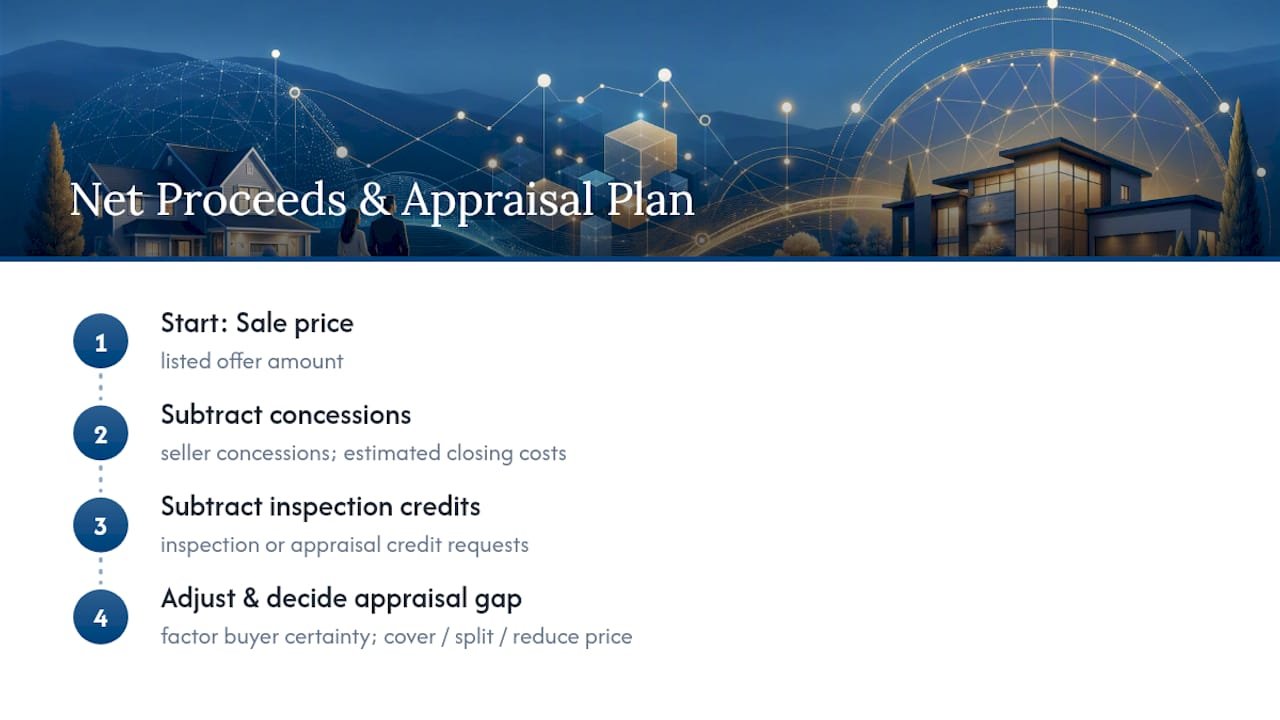
Appraisal gaps deserve their own plan before they happen, not after. If your strategic price sits above recent comps for a legitimate reason (upgrades, lot size, view), decide in advance whether you’ll ask the buyer to cover a shortfall, split the gap, or reduce price to the appraised value if it comes in low.
Pricing strategy itself shapes your negotiating position. A market-value or slightly-aggressive price that draws multiple offers puts you in control of terms, timeline, and contingency waivers. A single-offer situation on an aspirationally priced home flips that leverage to the buyer, who knows you’ve already sat on the market too long.
Real Results: How the Premier Selling System Connects Pricing to Marketing
Pricing a home well only pays off when the marketing behind it actually reaches the right buyers. That’s the core logic behind Ryan Case’s Premier Selling System, which pairs data-driven pricing analytics with a targeted buyer database and paid placement tools like Zillow Showcase, rather than treating the list price as a number that stands alone.
The system’s stated goal is straightforward: use pricing analytics and DOM tracking to set a defensible number, then push that listing directly into a database of active local buyers instead of waiting for organic traffic to find it on its own.
Ryan Case reports average days-on-market figures and sale-price premiums tied to this approach on the Premier Selling System’s own pages, and sellers evaluating any agent should ask for the same kind of evidence. That means requesting the actual comps used, the DOM history for recent listings in your area, and the absorption rate for your specific price bracket, not just a verbal assurance that “the market is strong right now.”
If an agent can’t produce that data during the listing interview, treat it as a warning sign about how the number was set in the first place.
Legal and Ethical Considerations in Home Pricing
Pricing a home is not just a math exercise. Fair housing law prohibits any pricing decision, marketing choice, or buyer-screening practice that discriminates based on race, religion, national origin, family status, disability, or other protected classes, and that obligation applies to sellers and agents alike. Steering pricing or negotiation terms based on who is likely to buy in a given neighborhood is illegal, not just unethical.
Disclosure obligations also intersect with pricing more than most sellers realize. Pricing a home aggressively to generate multiple offers doesn’t reduce your duty to disclose known material defects, and doing so can expose you to post-sale litigation regardless of how the bidding war played out. A high final sale price won’t protect you from a lawsuit if a buyer later proves you knew about a foundation issue or water intrusion and priced the home without disclosing it.
There’s also a subtler ethical line around intentionally underpricing a home purely to manufacture a bidding frenzy with no intention of accepting a reasonable early offer. Some jurisdictions and MLS rules require sellers and agents to consider offers in good faith once a listing is active, and using price as bait without a legitimate strategy behind it can create disputes with buyers who feel misled. Strategic pricing should create real competition based on real value, not a false scarcity built on a number nobody intended to honor.
Adjusting Price Strategy for Unique Homes and Conditions
Standard CMA math breaks down when a home doesn’t have close comps, and that’s more common than most sellers expect. A home with an ADU, a pool on a lot where most neighbors don’t have one, solar panels, or a significant renovation needs adjustments that go beyond a simple price-per-square-foot comparison.

The fix is widening your comp radius or timeframe before inventing a premium out of thin air. If there are no directly comparable sales within a mile or 90 days, pull comps from a slightly larger radius or a slightly longer window, then adjust explicitly for the unique feature rather than guessing at its value. A pool typically adds less resale value than it cost to install; solar panels vary widely in perceived value depending on whether they’re owned or leased.
Condition cuts the other way. A home needing a new roof, updated electrical, or cosmetic work throughout should be priced against comps in similar condition, not against fully renovated neighbors, and sellers should decide upfront whether to price low to reflect the work needed or invest in fixes before listing. Neither choice is wrong, but pricing as if the work is already done when it isn’t invites a renegotiation after inspection, which usually costs more than pricing honestly from day one.
How Can You Test Your Price Before Going Live?
The smartest sellers get feedback on price before the listing ever goes public, because a wrong number in the MLS leaves a visible history that follows the listing even after a correction. Pre-market previews, sometimes called agent previews or seller’s previews, invite a handful of local agents to walk the home and give unfiltered feedback on price positioning before the official launch.
That feedback is more honest than post-listing buyer feedback, because agents aren’t trying to negotiate anything. They’ll tell you flatly if a number feels 5 percent too high relative to what’s currently active in the neighborhood.
A soft or “coming soon” listing period serves a similar purpose. It generates early interest and gauges showing request volume at a given price point before the home officially hits full public search, giving you a chance to adjust before the DOM clock starts running in the public record. Some sellers also invite a small pool of past buyer leads or database contacts for an informal walkthrough, treating their reactions as a data point rather than a sales pitch.
The common thread across all these methods is the same: gather real signal from people with market knowledge before committing to a number in a system that timestamps every change you make.
Pricing is the strategy that drives the sale
The biggest mistake sellers make isn’t picking the wrong pricing lane. It’s letting emotion override the data checkpoints that would have told them which lane to pick. Comps, absorption rate, and DOM aren’t optional inputs, they’re the whole decision.
Three things to do today: pull your neighborhood’s absorption rate before you settle on a number, ask any agent you’re interviewing to show you the raw comps and adjustments behind their suggested price, and decide now what you’ll do if the first two weeks don’t produce the showings you expect. Sellers who make that decision in advance rarely make the panic cuts that hurt final sale price.
— Ryan Case
How Ryan Case Can Help You Price and Sell With Confidence
If you’re weighing whether to price aggressive for speed, at market value for balance, or hold out for a premium, that decision gets a lot easier with real local data in front of you instead of a guess. Some selling systems are designed to pair a defensible, comp-driven price with access to a local buyer database and enhanced marketing placements like Zillow Showcase, so the number chosen actually gets seen by buyers more likely to pay it.

Sellers who need certainty on timeline can look at the Guaranteed Home Sale program, while sellers focused on speed without a deep discount have a dedicated path through Ryan Case’s quick-sale option. For sellers who want to see exactly how presentation affects achievable price, professional listing photos are one of the highest-leverage, lowest-cost investments available before you ever set a number. If your home has staging needs beyond photos, a resource like Flawlessly Functional’s styling guidance can help you prioritize what actually moves buyer perception.
The next step is simple: request a free home analysis directly through Ryancaserealtor and get the comps, DOM data, and absorption numbers for your specific neighborhood before you commit to a price.
Sources
- Beyond list price: alternatives to expressing price and value — BCG
- How to Price Your Home to Sell: A Data-Driven Guide for Sellers in 2026 – AgentsGather
- How to Price a Real Estate Listing – CloseDaily
- Pricing strategy in real estate — Jo Mangum
FAQ
What Is the 3-3-3 Rule for Buying a House?
The 3-3-3 rule is a budgeting guideline for buyers, not sellers: spend no more than three times your annual income on a home, keep your monthly payment under three weeks of take-home pay, and hold three months of expenses in savings after closing. It shapes how many buyers qualify for homes in your price bracket, which is part of why absorption rate and buyer pool size matter so much when you set your number.
What Is the Hardest Month to Sell a House?
Late fall through midwinter, particularly November through January, tends to be the slowest window in most markets because buyer traffic drops around holidays and colder weather. That seasonal dip typically means longer DOM and lower absorption, so a seller listing in that window should lean toward market-value or slightly aggressive pricing rather than an aspirational number.
What Are the 5 C’s of Pricing?
There’s no single, universally agreed-upon “5 C’s of pricing” framework in real estate, and definitions vary across sources. The more reliable approach for home sellers is the comp-driven CMA method covered above: recent comps, condition adjustments, cost-per-square-foot normalization, current absorption rate, and competing active listings.
How Do You Increase Home Value by $50,000?
There’s no guaranteed formula for a specific dollar increase, since it depends heavily on your local market and starting condition, but the highest-leverage moves are typically strategic renovations (kitchens, primary bathrooms), professional staging, and addressing deferred maintenance before listing. A resource like One Day Doors & Closets’ home value guide breaks down which upgrades tend to return the most relative to their cost.
Does Ryan Case Offer a Free Pricing Analysis?
Yes, sellers can request a personalized home analysis directly through Ryancaserealtor, which includes comps, DOM trends, and absorption data specific to their neighborhood. Pricing for the Premier Selling System and other service tiers is available on request through the site.
Pingback: Seller vs. Buyer Warranty: Who Pays and What Transfers at Closing