An escalation clause automatically raises your offer above a competing bid, up to a ceiling you set in advance, using fixed increments you also set in advance. It can be the difference between losing a house you love and winning it, but it also hands the seller your top number before negotiations even start. That tradeoff, competitiveness against exposure, is everything you need to weigh before adding one to your offer. The mechanics, the math, the appraisal risk, and the drafting details that make it legally solid all follow below.
TL;DR:
- Escalation clauses automatically increase your offer up to a set ceiling when higher competing bids appear, but reveal your maximum price upfront.
- The clause triggers only with proof of a higher offer, escalating in fixed increments until the ceiling is reached or you win, requiring your signature to finalize increases.
- Using an escalation clause is best in competitive markets with limited inventory and when you can comfortably cover potential appraisal gaps and have sufficient cash reserves.
- Proper drafting emphasizes clear, specific terms for base, increment, and ceiling, along with requiring proof of competing offers to prevent disputes.
- Sellers may reject escalation clauses in favor of simpler, final offers, and the clause’s downside includes weakening negotiation leverage and risking overpayment or financing issues if the appraisal falls short.
Table of Contents
- How Does an Escalation Clause Work?
- A Real Example of Escalation Math
- Weighing the Pros and Cons Before You Escalate
- Financing and Appraisal Risks You Need to Plan For
- When an Escalation Clause Makes Sense (and When It Doesn’t)
- Drafting Language That Actually Holds Up
- How Sellers Actually View an Escalated Offer
- What I Tell Buyers Before They Add an Escalator
- Get Help Structuring an Offer That Actually Wins
- Sources
- FAQ
How Does an Escalation Clause Work?
Every escalation clause runs on three numbers: the base offer (what you’d pay with no competition), the increment (how much you’ll beat a rival bid by), and the ceiling (the absolute maximum you’ll pay, no matter what). Set those three, and the clause does the rest automatically.
Here’s the trigger mechanism. Once you submit your offer, the clause sits dormant unless the seller receives a documented competing offer higher than yours. When that happens, your price escalates by the set increment above the rival bid, and it keeps climbing (in those same increments) each time a new higher bid appears, until it either wins or hits your ceiling. A properly drafted clause requires the seller to show proof of that competing offer, sometimes even a redacted copy of the actual contract, before your price moves at all. That proof requirement is what separates a real escalation trigger from a seller simply claiming another buyer showed up.
- No competing offer surfaces: your base price stands, and the clause never activates.
- One competing offer surfaces: you escalate to beat it by your increment, capped at your ceiling.
- Multiple competing offers surface: the clause keeps ratcheting upward until a bid exceeds the ceiling or you win.
A Real Example of Escalation Math
Say you offer a base price of $500,000 with a $2,000 increment and a $530,000 ceiling.
- A rival bids $510,000. Your offer escalates to $512,000.
- Another buyer counters at $520,000. You escalate again, this time to $522,000.
- A third offer comes in at $535,000, which is above your $530,000 ceiling. Your clause stops climbing at $530,000, and you lose the bidding war unless you choose to manually raise your offer outside the clause.
Sellers typically treat the escalated number as a counter-offer, meaning you’ll need to sign off on the final price before it becomes binding. Nothing locks automatically without your signature on that revised figure.
Weighing the Pros and Cons Before You Escalate
An escalation clause keeps you in the running without having to guess your competitor’s exact number, and it caps your risk at a price you’ve already decided you can live with. The tradeoff, according to a North Carolina Real Estate Commission bulletin, is that you’re handing the seller your ceiling in writing. Once they see your top number, your negotiating leverage largely disappears, and some sellers will simply counter you at that exact ceiling.
Pros:
- Keeps your offer competitive without constant manual re-bidding
- Automates the back-and-forth so you’re not guessing blindly
- Caps your maximum spend at a number you’ve already approved
Cons:
- Reveals your absolute ceiling to the seller and their agent
- Raises the risk of overpaying relative to the home’s appraised value
- Creates appraisal-gap exposure if the escalated price outruns the appraisal
- Some sellers reject escalation clauses outright
Pro Tip: Pair your escalation clause with a slightly larger earnest money deposit or proof of extra liquid funds. It signals seriousness to the seller without changing your actual ceiling, and it can offset the trust you lose by showing your top number.
Mitigate the downside by pairing your clause with appraisal-gap coverage, a larger down payment cushion, or a carefully worded appraisal contingency instead of dropping it entirely.
Financing and Appraisal Risks You Need to Plan For
Lenders base your loan on whichever number is lower: the purchase price or the appraised value. If your escalation clause pushes your price past what the home actually appraises for, you’re on the hook for the difference in cash, unless you’ve planned ahead.
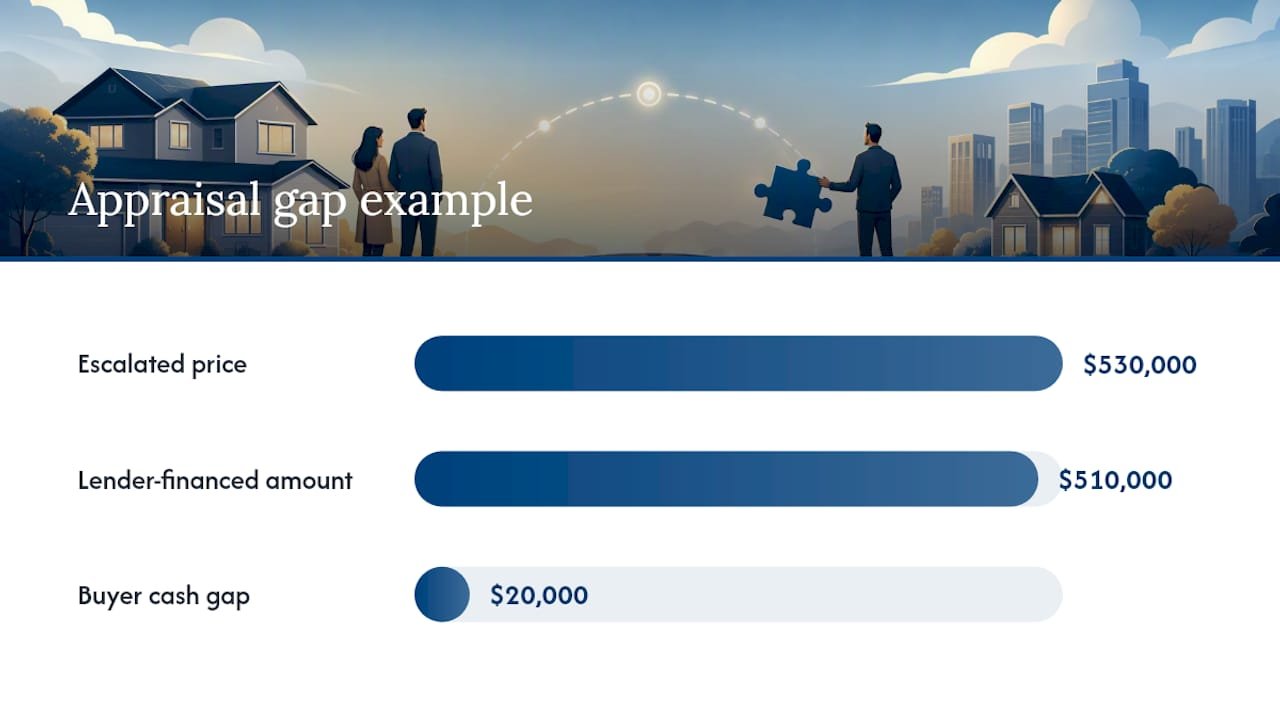
This is the appraisal gap problem, and it catches more buyers off guard than any other part of the escalation process. Say your escalated price lands at $530,000 but the appraisal comes back at $510,000. Your lender still only finances against $510,000, leaving you to cover that $20,000 difference out of pocket or renegotiate with the seller.
Two common responses: add appraisal-gap coverage language that commits you to a set amount above appraised value, or increase your down payment so the loan-to-value math still works even if the appraisal comes in low. A Georgia-focused breakdown of appraisal-gap clauses walks through exactly how buyers cap this exposure contractually rather than leaving it open-ended.
Talk to your lender before you write the offer, not after. They can tell you how much cash cushion you’d realistically need if the appraisal lands below your escalated number.
When an Escalation Clause Makes Sense (and When It Doesn’t)
An escalator fits best in a hot, multiple-offer market where you already know your absolute max and have the cash reserves to cover a potential appraisal gap.
- Use one when inventory is tight, bidding wars are common, and you have a firm number you won’t cross.
- Skip it when inventory is plentiful and competition is thin, since there’s nothing to escalate against.
- Skip it when the listing agent explicitly requests highest-and-best offers instead, which many sellers now prefer.
- Skip it if you can’t comfortably cover an appraisal gap without derailing your budget.
Some sellers and their agents will refuse escalation clauses altogether, asking every buyer to submit one final number instead. Ask your agent early whether the listing agent has a stated preference. Reading the room on highest-and-best offer requests before you draft your offer can save you from submitting a clause the seller won’t even consider.
Drafting Language That Actually Holds Up
A clause is only as good as its wording. Courts and real estate attorneys look for definiteness: clear numbers, no ambiguity, and no room for a seller to manipulate the process.
- State the exact base price, the exact increment, and the exact ceiling. No ranges, no vague language.
- Require the seller to provide written proof of a competing offer before the escalation triggers.
- Specify whether that proof must include a redacted copy of the actual competing contract.
- Confirm how disputes over “what counts as a competing offer” get resolved.
Vague terms invite disputes and weaken enforceability. Contract law generally favors definite, specific terms over open-ended promises, which is why Cornell’s Legal Information Institute notes that some states restrict who’s allowed to draft custom contract language at all. Real estate agents in those states typically rely on standardized addenda approved by their state association rather than writing custom clauses themselves.
Get an attorney or your agent’s approved standardized form to review the exact language before you submit. A one-word ambiguity here can turn into a expensive dispute later, and it’s far cheaper to fix on paper than in court.
How Sellers Actually View an Escalated Offer
Sellers don’t automatically love escalation clauses, even when the final number is high. A cleaner offer, fewer contingencies, verified financing, a fast close, often beats a numerically bigger one loaded with escalation paperwork and appraisal uncertainty.
- Escalators add administrative complexity and a real chance the deal stalls over appraisal disputes.
- Sellers may worry the “winning” price won’t survive underwriting.
- Strengthen your escalated offer with a strong pre-approval letter, solid proof of funds, and as few contingencies as you can responsibly drop.
What I Tell Buyers Before They Add an Escalator
I recommend an escalation clause when a buyer already knows their real ceiling and the market is genuinely competitive, not just anxious. If a listing has three showings and no offers yet, an escalator solves a problem that doesn’t exist.
What I watch on the seller side: agents who ask for highest-and-best almost always ignore escalation language entirely, so submitting one there wastes your leverage. Coordinate with your agent and your lender before you write the number down. That conversation catches problems a clause alone never will.
— Ryan Case
Get Help Structuring an Offer That Actually Wins
Escalation clauses look simple on paper, but the numbers only work if your ceiling, your financing, and your appraisal-gap coverage are all lined up before you submit. That’s where a second set of eyes pays off. Some real estate agents work with buyers to pressure-test the base price, increment, and ceiling against comparable sales to avoid guessing at a number that either overshoots the budget or undershoots the competition.

Beyond escalation strategy, Ryan Case also helps buyers prepare highest-and-best offers when a seller won’t accept an escalator at all, and works through appraisal-gap planning so a low valuation doesn’t blow up your closing. If you’re heading into a competitive San Diego listing and want your offer structured correctly the first time, Ryancaserealtor to talk through your specific numbers before you write the offer.
Sources
- Escalation clauses in real estate: Enforceability and risks – LegalClarity
- The pitfalls of using escalation clauses – NCREC bulletin
- Should My Offer Include an Escalation Clause? | Freddie Mac
FAQ
Is there a downside to an escalation clause?
Yes. It reveals your maximum price to the seller, which weakens your negotiating position and can expose you to an appraisal gap if the escalated price outpaces the home’s appraised value.
What is an escalation clause example?
A buyer offers $500,000 with a $2,000 increment and a $530,000 ceiling, then automatically escalates to $512,000 if a rival bids $510,000, continuing until the ceiling or a win.
Can an escalation clause backfire?
It can. If competing bids exceed your ceiling, you lose the home, and if the appraisal comes in below your escalated price, you may need extra cash to cover the gap at closing.
Why don’t sellers like escalation clauses?
Some sellers prefer clean, high-and-final offers with fewer contingencies over escalation paperwork, since escalators can add administrative complexity and appraisal or financing uncertainty to the deal.