A “highest and best” request asks every interested buyer to submit their strongest price and terms by a firm deadline. To win, lead with underwriting certainty, clean terms, and a clear proof-of-funds story — not just the biggest number.
When a seller calls for highest and best offers, the playing field resets. Every buyer gets one shot. The three moves that matter most right now:
- Confirm your financing status. A fully underwritten preapproval or a bank proof of funds letter is the single most credible document you can attach. A standard prequalification letter will not cut it in a competitive field.
- Decide which contingencies you can honestly waive or tighten. Inspection, appraisal, and financing contingencies each carry risk if removed — but keeping all three in a hot market often means losing.
- Assemble a clean, verifiable packet. Underwritten preapproval letter, bank or brokerage statement showing proof of funds, earnest money amount (typically 1–3% of the purchase price), and a short, polite cover note addressed to the seller.
Quick-action checklist before you submit:
- Underwritten mortgage preapproval or loan condition letter from your lender
- Bank or brokerage statement dated within 30 days showing liquid assets
- Earnest money amount confirmed and ready to wire on acceptance
- Signed buyer agency agreement (required in most states since August 2024 NAR rule changes)
- Cover note: two to four sentences, professional tone, no emotional pressure
Pro Tip: Call your lender before the deadline, not after. Ask specifically: “Is my file fully underwritten or just prequalified?” The answer changes everything about how the listing agent reads your offer.
Key Takeaways
Winning a highest-and-best round comes down to three things: financing certainty, clean terms, and a credible, complete offer packet delivered before the deadline.
| Point | Details |
|---|---|
| Underwriting beats prequalification | A fully underwritten preapproval signals to sellers that your loan is nearly certain to close. |
| Net proceeds, not gross price | Sellers compare offers after subtracting credits and concessions — a clean lower offer can beat a padded higher one. |
| Contingency decisions carry real risk | Waiving appraisal or inspection contingencies without cash reserves or a pre-inspection can cost you your earnest money. |
| Escalation clauses need a hard cap | State your increment and maximum price clearly; vague escalation language raises fraud concerns and may be rejected. |
| Ryan Case | Works with San Diego buyers and sellers to build credible offer packets and generate competitive multiple-offer situations. |
Table of Contents
- What does “highest and best” actually mean?
- Why sellers use highest-and-best and what they actually prioritize
- How a highest-and-best round runs from start to finish
- How to prepare your offer packet before the deadline
- Which offer elements actually matter to a seller?
- Tactical options and the honest pros and cons of each
- How to write and deliver your highest-and-best offer
- What happens after you submit
- Risks of aggressive offers and how to limit your exposure
- How Ryan Case approaches highest-and-best situations
- Negotiation etiquette during the highest-and-best round
- A direct take on when to go all-in and when to step back
- Ryan Case: competitive offer strategy for San Diego buyers
- Sources
What does “highest and best” actually mean?
A highest-and-best request is a deadline-driven call for buyers’ strongest offers on both price and terms. As Rocket Mortgage explains, it is a formal process used when multiple offers exist — the seller wants to surface every buyer’s ceiling without running a prolonged back-and-forth negotiation. It may still leave a narrow window for minor adjustments after the deadline, but buyers should treat it as their one real shot.
How it differs from “best and final”
Realtor.com notes that “highest and best” and “best and final” are often used interchangeably, but the intent behind each phrase can differ. “Best and final” typically signals the seller wants to close the negotiation entirely — no further rounds, no counter-offers. “Highest and best” sometimes leaves a sliver of room for the seller to counter the top offer. In practice, treat both as your ceiling submission.
Two quick scenarios where this distinction matters:
- Price wins: A seller with no timeline pressure and three near-identical offers will almost always take the highest net number. If your financing is solid and the gap between offers is meaningful, price is the tiebreaker.
- Terms win: A seller who needs to close in 21 days, is already under contract on a new home, and has received one cash offer and two financed offers at similar prices will likely choose the cash buyer or the buyer with the fewest contingencies — even at a slightly lower price.
Key things to watch for in the listing agent’s language:
- “Submit your highest and best by [date/time]” with no other instruction: treat it as a clean one-round process.
- “The seller will review all offers and may counter” signals some flexibility remains.
- MLS remarks mentioning “pre-inspections welcome” or “seller prefers a 30-day close” tell you exactly what to optimize.
Pro Tip: Ask your agent to call the listing agent before the deadline. One two-minute conversation can reveal whether the seller cares most about price, speed, or certainty — and that shapes every term you write.
Why sellers use highest-and-best and what they actually prioritize
Sellers call for highest and best because it compresses negotiation time and forces buyers to show their hand simultaneously. But the NAR consumer guide on navigating multiple offers makes clear that sellers should weigh price, financing certainty, contingencies, and timeline together — not just the headline number.
Here is how most sellers actually rank their priorities:
- Net proceeds after credits and concessions. The gross offer price minus any repair credits, closing cost assistance, or seller-paid fees. A $750,000 offer with $15,000 in credits nets less than a $740,000 clean offer.
- Financing certainty. Cash is king, but a fully underwritten conventional loan from a local lender is a strong second. A prequalification letter from an online lender the listing agent has never heard of sits near the bottom.
- Contingency footprint. Fewer contingencies mean fewer exit ramps for the buyer — which means fewer ways the deal falls apart. Sellers in competitive markets often prefer a buyer who waives the appraisal contingency over one who offers $10,000 more but keeps it.
- Timeline alignment. If the seller needs 45 days to close, a buyer pushing for 21 days creates friction. Flexibility on possession, or offering a rent-back period, can be worth thousands in goodwill.
- Earnest money. A larger deposit signals commitment. A buyer offering earnest money at a moderate rate signals strong commitment.
The seller’s tradeoff is always between maximizing dollars and minimizing the risk of a failed closing. Inman, citing NAR data, reports that roughly 5% of contracts were terminated and about 14% had delayed settlements in a recent period. A seller who has already watched one deal fall apart will weight financing certainty heavily the second time around.
On disclosure: listing agents can tell buyers whether competing offers exist, but they can only share specific terms of other offers with the seller’s explicit permission. Agents who misrepresent competing offers violate their ethical obligations under NAR’s Code of Ethics.
How a highest-and-best round runs from start to finish
The listing agent sets a deadline — typically 24–72 hours after the request goes out — and notifies all buyers or their agents. Offers arrive by email, through a transaction portal like Dotloop or DocuSign, or occasionally by fax (yes, still). The listing agent then presents every offer to the seller, usually with a side-by-side comparison sheet.
What the listing agent must do, legally and ethically:
- Present all offers promptly, even after a seller has verbally indicated interest in one
- Follow the seller’s written instructions on whether to disclose the existence of competing offers
- Avoid misrepresenting any offer’s terms to other buyers
- Per Florida Realtors guidance, agents must handle multiple offers in a way that protects the seller’s interests without creating legal exposure
After the seller reviews, they typically respond within 24–48 hours. Delays happen when the seller is traveling, consulting an attorney, or genuinely torn between two offers. Silence for more than 48 hours usually means the seller is negotiating with another buyer or waiting on additional information.
Questions your agent should ask the listing agent before submitting:
- Is there a specific deadline, and will it be extended?
- How many offers are currently on the table?
- Does the seller have a preferred closing date or possession timeline?
- Is the seller open to a rent-back arrangement?
- Will the seller disclose whether competing offers include escalation clauses?
How to prepare your offer packet before the deadline
Preparation before the deadline is where most buyers lose ground. The offer packet is your credibility on paper — and a disorganized submission signals a disorganized buyer.
Documents to gather:
- Fully underwritten preapproval letter or loan condition letter (not a prequalification)
- Bank or brokerage statement dated within 30 days, showing liquid assets sufficient to cover the down payment and closing costs
- Signed buyer agency agreement (required in most states post-August 2024)
- Recent pay stubs and asset documentation if your lender recommends including them
- Proof of earnest money availability (sometimes a separate bank statement page)
How to accelerate your underwriting:
Ask your lender directly: “Can you run my file through full underwriting before I submit an offer?” Many lenders offer this as a “credit-approved” or “fully underwritten” preapproval. It means the underwriter has already reviewed your income, assets, and credit — the only remaining condition is the property appraisal. That distinction matters enormously to a listing agent who has seen financed deals collapse at the last minute.
On inspections: keeping an inspection contingency is the safer choice, especially on older homes or properties with deferred maintenance. If you want to stay competitive without fully waiving it, consider a shorter inspection period (5–7 days instead of 10–17) or a pre-inspection before submitting if the seller allows it. A pre-listing inspection report, when the seller provides one, gives you enough information to make an informed decision about waiving.

Pro Tip: Ask your buyer’s agent to call the listing agent and confirm the preferred delivery method. Some agents want everything in one PDF. Others use Dotloop or Authentisign. Submitting in the wrong format can delay your offer reaching the seller.
Which offer elements actually matter to a seller?
Price gets the headline, but EffectiveAgents makes the case that normalizing offers to net proceeds and financing certainty is the most defensible way to compare them. Subtract credits, repair allowances, and timing costs from each offer’s gross price — what’s left is what the seller actually pockets.
The six dimensions sellers (and their agents) compare:
| Offer element | What sellers want | Red flags |
|---|---|---|
| Offered price | Highest net after credits | Large credits or concessions buried in the offer |
| Financing certainty | Underwritten preapproval or cash | Prequalification only; unknown lender |
| Contingencies | Fewer, shorter, or waived | All three contingencies at full length |
| Earnest money | 2–3%+ of purchase price | Minimum statutory deposit |
| Closing timeline | Matches seller’s preferred date | Buyer-driven timeline with no flexibility |
| Escalation / appraisal gap | Documented, capped, verifiable | Vague escalation language; no cap stated |
On escalation clauses: an escalation clause says you’ll beat any competing offer by a set increment, up to a stated cap. Example: “Buyer will pay $5,000 above the highest verified competing offer, up to a maximum of $785,000.” The mechanics matter. Per Realtor.com’s guidance on winning highest-and-best situations, buyers using escalation clauses are typically entitled to see written proof of the competing offer that triggers the escalation. Fabricating or misrepresenting competing bids creates fraud risk for everyone involved.
On appraisal gap coverage: if you offer $750,000 on a home that appraises at $730,000, you have a $20,000 gap. An appraisal gap clause commits you to covering some or all of that difference in cash. It’s a powerful signal to sellers — but only if you actually have the cash to back it.
The highest price on paper is frequently not the best offer for the seller. Financing strength, contingencies, and terms determine whether a deal actually closes. A seller who has watched a high-priced offer fall apart at the appraisal will remember that lesson the next time they review offers.
Warning: offers that look strong but carry fragile financing, unverifiable proof of funds, or vague escalation language often collapse before closing. A listing agent who has seen this pattern will flag those offers to the seller.
Tactical options and the honest pros and cons of each
Every tactic in a highest-and-best round involves a tradeoff. Here is a plain-language breakdown:
| Tactic | Pros | Cons / Risks |
|---|---|---|
| Escalation clause | Competitive without overbidding blind | Requires verified competing offer; can reveal your ceiling |
| Appraisal gap guarantee | Removes seller’s biggest financing fear | Requires cash reserves; can’t be bluffed |
| Waive appraisal contingency | Strong signal to seller | Buyer absorbs full gap if property appraises low |
| Waive inspection contingency | Reduces seller’s risk perception | Buyer takes on unknown repair costs |
| All-cash offer | Maximum certainty for seller | Requires full liquidity; opportunity cost of capital |
| Larger earnest money | Signals commitment | At risk if buyer defaults without a contingency exit |
| Flexible closing / rent-back | Differentiates on terms, not price | Requires coordination with buyer’s own move timeline |
Sellers and agents often prefer offers that reduce failure points — cash, high down payment, appraisal gap guarantees — even when those offers are nominally lower on paper, as EffectiveAgents notes.
When each tactic fits:
- Use an escalation clause when you don’t know the competing offer range and want to stay competitive without committing to a ceiling price upfront.
- Use appraisal gap language when the market is running hot and comparable sales are lagging behind active prices.
- Waive the inspection contingency only on newer construction or properties where you’ve done a pre-inspection and feel confident in the condition.
- Offer a rent-back when the seller has mentioned needing time to find their next home — it costs you almost nothing and can be the deciding factor.
Lender check before waiving contingencies: confirm with your loan officer that your loan program allows an appraisal waiver (some conventional loans qualify for Fannie Mae’s appraisal waiver program). FHA and VA loans have mandatory appraisal requirements that cannot be waived. Know your program before you commit.
Financing is the single biggest silent failure point in competitive deals. Inman’s reporting underscores that the highest price on paper frequently loses when the financing behind it is uncertain.
How to write and deliver your highest-and-best offer
Follow these steps in order. Skipping one is how offers get disqualified on a technicality.
- Finalize your price. Decide on your number before you open the contract. Changing it mid-draft introduces errors.
- List every term explicitly. Purchase price, earnest money amount, proposed closing date, contingencies retained or waived, possession terms, and any credits requested.
- Attach your supporting documents. Underwritten preapproval letter, proof of funds statement, and — if you’re using an escalation clause — a clean addendum with the increment and cap clearly stated.
- Specify earnest money and delivery timeline. State the amount and when it will be wired (typically within 3 business days of acceptance).
- Write a short cover note. Two to four sentences. State your financing status, your flexibility on timing if applicable, and your genuine interest in the property. No emotional pressure, no life story.
- Confirm the delivery method with the listing agent. Email, portal, or both. Get a read receipt or a reply confirming receipt.
- Submit before the deadline, not at it. Technical issues happen. Give yourself a 30-minute buffer.
Sample cover note (discuss with your agent before using):
“We are submitting our strongest offer on [property address] and are committed to a smooth closing. Our financing is fully underwritten through [lender name], and we can accommodate your preferred closing timeline. We look forward to the opportunity to work with you.”
Pro Tip: Submitting early is almost always better than submitting last-minute. It gives the listing agent time to confirm receipt and flag any missing documents before the deadline closes. A last-minute submission with a missing attachment is worse than a slightly lower offer submitted cleanly.
Delivery timing: if you have strong intelligence that competing offers are coming in at the deadline, a last-minute upward revision can be effective — but only if your agent has confirmed the listing agent will accept amendments after the initial submission. Not all do.
What happens after you submit
The seller’s agent presents all offers, typically within a few hours of the deadline. Then the seller decides. The three most likely outcomes:
- Acceptance: the seller signs your offer and communicates acceptance in writing. Per North Carolina Real Estate Commission guidance, oral acceptance is not binding — only a signed, written contract communicated to both parties creates a legal obligation.
- Counter-offer: the seller responds to one or more buyers with modified terms. This is more common when offers are close in price but differ on terms.
- Rejection or no response: the seller accepts another offer and notifies remaining buyers. In some states, agents are not required to notify losing buyers at all.
How to handle a counter-offer:
- Read it immediately and call your agent.
- Identify what changed: price, contingencies, closing date, or earnest money.
- Decide within the counter’s stated response window — usually 24–48 hours.
- Escalate your lender and escrow conversations the moment you receive a counter, not after you sign.
When to walk away:
- The counter price exceeds your appraisal gap capacity and you have no cash reserve to cover it.
- The seller is asking you to waive contingencies you are not financially positioned to absorb.
- The emotional pressure of the moment is driving the decision, not the numbers.
Etiquette during the submission window: buyer agents should not contact the listing agent repeatedly asking for status updates. One check-in to confirm receipt is appropriate. Anything more reads as pressure and can work against you.
Risks of aggressive offers and how to limit your exposure
Waiving contingencies and committing to appraisal gaps are real financial decisions, not just negotiating theater. The main risks:
- Failed appraisal with no contingency: you are contractually obligated to close at the agreed price even if the home appraises $30,000 lower. You either bring the cash or default.
- Loan denial after waiving the financing contingency: if your loan falls through and you’ve waived the financing contingency, you may forfeit your earnest money.
- Unknown repair costs after waiving inspection: a $10,000 HVAC replacement or a $25,000 foundation issue becomes your problem with no recourse.
- Overbidding above market: in a cooling market, you may own a home worth less than you paid on day one.
- Loss of earnest money on default: if you back out without a valid contingency exit, the seller typically keeps your deposit.
Mitigations that actually work:
- Cap your escalation clause at a number you can genuinely afford, not your theoretical maximum.
- Before waiving the appraisal contingency, ask your lender to run a desktop appraisal or automated valuation to estimate the likely appraised value.
- If you want to waive the inspection contingency, do a pre-inspection first whenever the seller allows it.
- Confirm your rate lock terms with your lender before extending your closing timeline — a longer close can cost you your locked rate.
Only a signed, written contract communicated to both parties creates a binding agreement. A seller’s verbal “yes” means nothing until ink is on paper and the acceptance is delivered to you or your agent.
Pro Tip: Ask your lender one specific question before waiving any contingency: “If the appraisal comes in low, will you still fund the loan at the contracted price?” The answer tells you exactly how much risk you are actually taking on.
How Ryan Case approaches highest-and-best situations
An experienced agent changes the outcome before the offer is even written. Ryan Case’s approach to competitive offer situations starts with pre-submission intelligence: a direct call to the listing agent to understand seller priorities, timeline constraints, and any disclosed preferences before a single term is committed to paper.
The practical workflow looks like this:
- Pre-submission outreach: contact the listing agent to confirm deadline, preferred delivery format, and any seller-stated priorities.
- Document curation: assemble the full packet — underwritten preapproval, proof of funds, signed agency agreement — in a single, clearly labeled PDF before the deadline.
- Earnest money guidance: recommend an earnest money amount that signals commitment without exceeding what the buyer can safely put at risk given their contingency structure.
- Cover note scripting: draft a two-to-four-sentence note that leads with financing certainty and timeline flexibility, not emotional appeals.
- Escalation clause review: if an escalation clause is appropriate, review the mechanics with the buyer’s lender first to confirm the cap is achievable and the increment is defensible.
The buyers who lose highest-and-best rounds aren’t usually outbid. They’re out-packaged. A clean, complete, credible offer packet with a fully underwritten preapproval will beat a higher number backed by a prequalification letter more often than most buyers realize.
Pro Tip: Price and contingency concessions are not the same lever. Before you waive the appraisal contingency, ask whether a slightly higher price with the contingency intact would net the seller the same outcome — sometimes it does, and it protects you from a gap you can’t cover.
On the seller side, Ryan Case’s Premier Selling System uses strategic pricing, Zillow Showcase placement, and a proprietary buyer database to generate the kind of early, competitive interest that leads to multiple-offer situations. Understanding how that process works gives buyers a clearer picture of what they are walking into when a highest-and-best request arrives.
Negotiation etiquette during the highest-and-best round
The way your agent communicates during this window matters more than most buyers realize. Listing agents talk to each other, and a buyer’s agent who is pushy, disorganized, or unprofessional can quietly sink an otherwise strong offer.
What good communication looks like:
- One confirmation call or email after submission to verify receipt. That’s it.
- Professional, brief written communication — no texts, no informal messages unless the listing agent initiates that channel.
- If the listing agent calls with a question about your offer, answer it directly and quickly. Delays signal uncertainty.
- Never ask the listing agent how your offer compares to others. They cannot tell you, and asking puts them in an uncomfortable position.
What to avoid:
- Calling multiple times before the deadline asking for status updates.
- Sending emotional or personal appeals directly to the seller (bypassing agents is an ethics violation in most states).
- Threatening to withdraw the offer as a pressure tactic — it usually backfires.
- Asking the listing agent to “put in a good word” — that is not their role.
After the deadline passes, patience is the professional move. If you haven’t heard back within 48 hours, one polite inquiry from your agent is appropriate. Frame it as confirming the seller’s timeline, not demanding an answer.
A direct take on when to go all-in and when to step back
The emotional weight of a bidding deadline can push buyers into decisions they regret. Here is a simple rule: if the price you need to win, after accounting for a realistic appraisal gap and any contingencies you are waiving, still leaves you with a comfortable financial cushion, proceed. If winning requires stretching your cash reserves to zero and waiving every protection you have, step back.
Repeated losses in competitive markets are genuinely part of the process, not a sign that something is wrong with your strategy. Preserving your buying power for the right property matters more than winning the wrong one under pressure. The buyers who consistently win highest-and-best rounds are not the ones who always bid the most. They are the ones who show up with the most credible financing, the cleanest terms, and an agent who has done the pre-submission work that most buyers skip.
Ryan Case: competitive offer strategy for San Diego buyers
Winning a highest-and-best round in San Diego’s market takes more than a big number. Ryan Case works with buyers to build the kind of offer packet that listing agents trust: fully underwritten financing, verified proof of funds, and terms structured around what the specific seller actually needs.
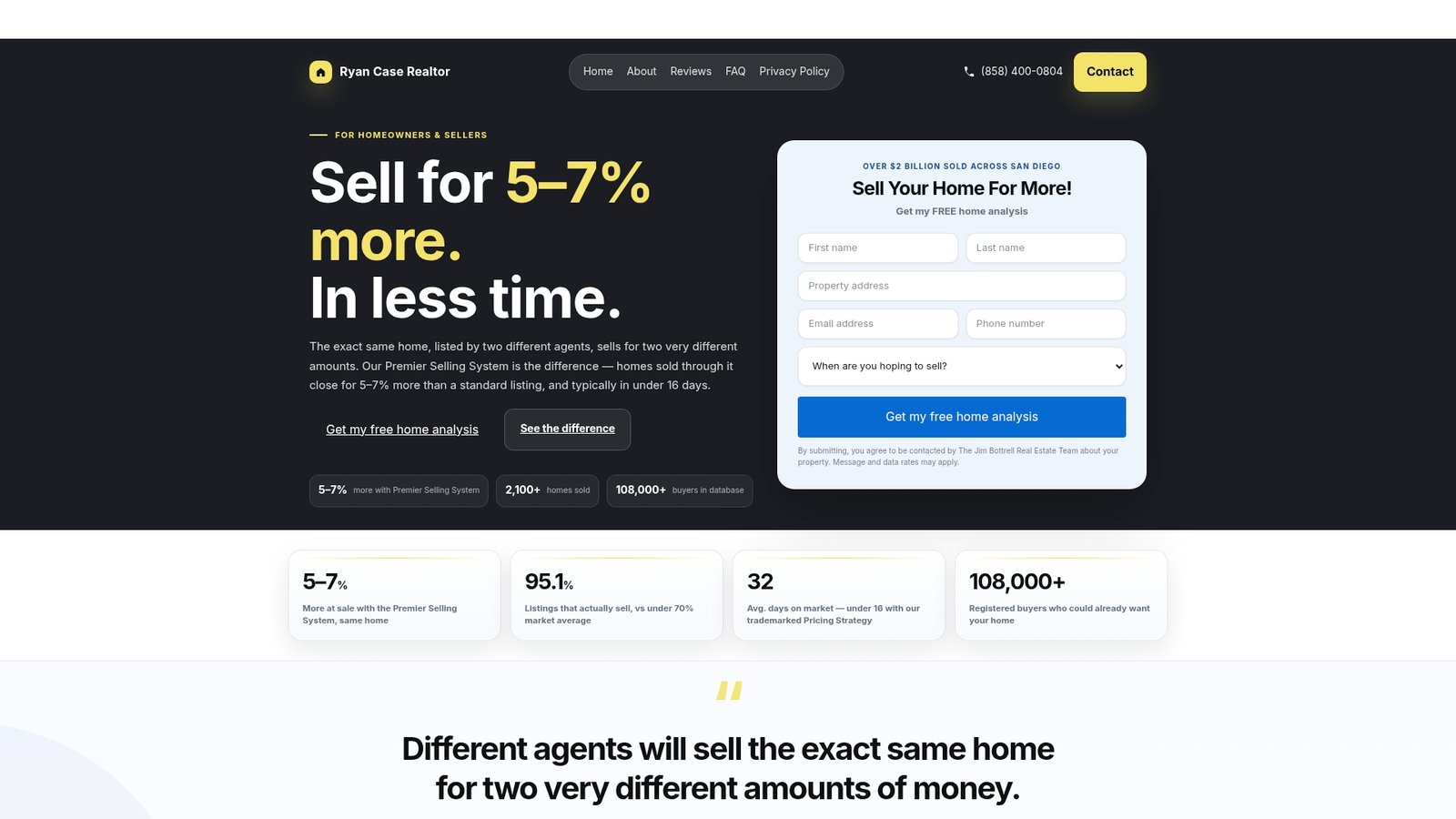
The Premier Selling System also gives sellers a clear advantage when generating competitive offer fields — strategic pricing, Zillow Showcase exposure, and a pre-built buyer database that creates the urgency that leads to multiple-offer situations. Whether you are buying or selling in San Diego County, the process works better when the agent on your side has done this before.
Schedule a consultation with Ryan Case to talk through your offer strategy or your home’s selling potential before the next deadline arrives.
Sources
The following sources were used in preparing this article and are worth bookmarking for deeper reference:
- Highest and best offer – Rocket Mortgage
- Highest And Best Aren’t Always The Same. Price Is Only Half The Story | Inman Real Estate News
- Consumer Guide: Navigating Multiple Offers
- Multiple Offers? How Sellers Pick the Strongest Buyer | EffectiveAgents®
This article is general information, not a substitute for advice from a qualified financial advisor. Consult a qualified financial professional about your own circumstances before acting on anything here.
Pingback: 5 Day Inspection, Higher Earnest Money: Seller Counteroffer Strategy