San Diego sellers typically pay a total commission on the sale price, with the listing agent’s fee and any buyer-agent compensation now negotiated separately following the 2024 NAR settlement. Most full-service listing agents in San Diego charge a listing fee to list your home, and you decide independently whether to offer buyer-agent compensation through the MLS.
- Total commission range: varies depending on service model and buyer-agent offer
- Who pays: The seller, deducted from proceeds at closing
- Immediate action: Multiply your expected sale price by 0.025 and by 0.05 to see your commission range in dollars, then ask every agent you interview for a written net-of-fees estimate
Pro Tip: Ask your agent to show you a seller’s net sheet before you sign anything. It should list every deduction from sale price to your check, including commission, escrow fees, and transfer costs.
Key Takeaways
San Diego sellers who negotiate both the listing fee and the buyer-agent offer separately, then compare agents on documented sale-to-list ratios, consistently retain more net proceeds than those who focus on rate alone.
| Point | Details |
|---|---|
| Current commission range | Total San Diego commission typically runs 2.5%–5%, with listing fees at 2.5%–3% and buyer-agent compensation negotiated separately. |
| Dollar math matters | On a $950,000 sale, a 3% listing fee plus 2.5% buyer-agent offer equals the total commission before other closing costs. |
| NAR settlement impact | Since August 2024, buyer-agent compensation is a separate negotiated term, not a default MLS offer, giving sellers more flexibility. |
| Evaluate on results, not rate | Ask every agent for their last 10–15 closed sales with list price, sale price, and days on market before comparing fees. |
| Ryan Case Premier System | Ryan Case’s Premier Selling System claims 5–7% higher sale prices through strategic pricing, Zillow Showcase, and active negotiation. |
Table of Contents
- What does real estate commission in San Diego actually cost you?
- Who actually pays the commission, and how does the split work?
- How to negotiate your commission in San Diego
- How do local fee models compare in San Diego?
- What do you actually get at different commission levels?
- Selling timeline and how commission fits into your net proceeds
- Ryan Case’s Premier Selling System: what it claims and what to verify
- How the 2024–2026 NAR settlement changed San Diego commissions
- How San Diego’s top local brokerages structure their fees
- How to choose a San Diego real estate agent based on value, not just rate
- What San Diego sellers actually get wrong about commission
- The Premier Selling System: a data-backed alternative to baseline listings
- Sources
What does real estate commission in San Diego actually cost you?
Percentages are abstract until you see the dollar amounts. Commission is calculated on the final sale price, not the list price. Here is how the math plays out across three realistic San Diego price tiers:
The calculator logic is straightforward: sale price × listing rate + sale price × buyer-agent rate = total commission. Plug in your own numbers. If you choose not to offer buyer-agent compensation, subtract that second line entirely, though buyers may negotiate it into the purchase offer anyway.
A few things worth noting:
- Flat-fee or 1% listing models reduce the first number but rarely eliminate the buyer-agent side
- Higher-priced homes often have more negotiating room on the listing percentage
- Some agents charge a transaction coordination fee ($300–$500) on top of the percentage
Who actually pays the commission, and how does the split work?
Under California practice, the seller pays the total commission at closing. It comes directly out of escrow proceeds before you receive your check. The listing broker then splits that amount with the buyer’s broker per a pre-agreed arrangement, typically spelled out in the listing agreement.
Since August 2024, the NAR settlement rules changed how buyer-agent compensation is handled. Buyer-agent fees can no longer be advertised on most MLS systems as a blanket offer. Instead, sellers decide separately whether to offer compensation to a buyer’s agent, and buyers may negotiate it directly into their purchase offer.
- The listing agent’s fee is set in your listing agreement and is non-negotiable once signed
- Buyer-agent compensation is now a separate, negotiable item
- California law requires full written disclosure of all commission arrangements
The California Department of Real Estate (DRE) is the state licensing authority that governs how commissions are disclosed and how agency relationships are documented. Sellers can verify any agent’s license status directly on the DRE website before signing.
Pro Tip: If a buyer’s agent asks you to cover their fee during negotiations, treat it like any other offer term. You can accept, counter, or decline. It does not obligate you to pay it.

How to negotiate your commission in San Diego
Commission rates are not fixed by law. Every fee is negotiable, and the market conditions in San Diego give sellers real leverage.
The main factors that move rates:
- Home price: Agents earn more dollars at the same percentage on a $1.4M home than a $700K one, so there is room to negotiate on higher-priced listings.
- Market conditions: In a seller’s market with low inventory, agents close faster and with less effort, which supports a lower rate ask.
- Marketing scope: A full-service agent who funds professional photography, Zillow Showcase placement, and targeted digital ads is spending real money. A reduced rate often means reduced spend.
- Competing offers: If you are interviewing multiple agents, you have leverage. Use it.
- Dual agency: If your listing agent also represents the buyer, ask for a reduced total fee since they are earning both sides.
Three scripts you can use at a listing appointment:
Pro Tip: Never negotiate commission in isolation. Ask for both the rate and the agent’s average sale-to-list ratio.
How do local fee models compare in San Diego?
San Diego sellers have three main fee model categories to choose from. Each suits a different seller profile.
| Fee Model | Typical Listing Rate | Buyer-Agent Offer | Services Included | Best For |
|---|---|---|---|---|
| Full-service percentage | 2.5%–3% | Seller’s choice (0%–2.5%) | Photos, staging consult, MLS, digital marketing, negotiation, transaction coordination | Sellers who want maximum exposure and hands-off execution |
| Flat-fee / 1% listing | 1% + minimums (e.g., $5,000 minimum listing fee) | Typically still offered | MLS listing, basic photos, limited negotiation support | High-volume or experienced sellers comfortable managing some steps |
| Paperwork-only / limited service | Fixed flat fee | Seller arranges separately | MLS entry, disclosure forms, transaction documents | FSBO-adjacent sellers with real estate experience |
Red flags to watch in any listing agreement:
- Non-refundable upfront fees before the home sells
- Vague marketing language with no specific deliverables listed
- Long exclusive listing periods (over 90 days) with no early-termination clause
- Commission structures that change if the agent also represents the buyer
What do you actually get at different commission levels?
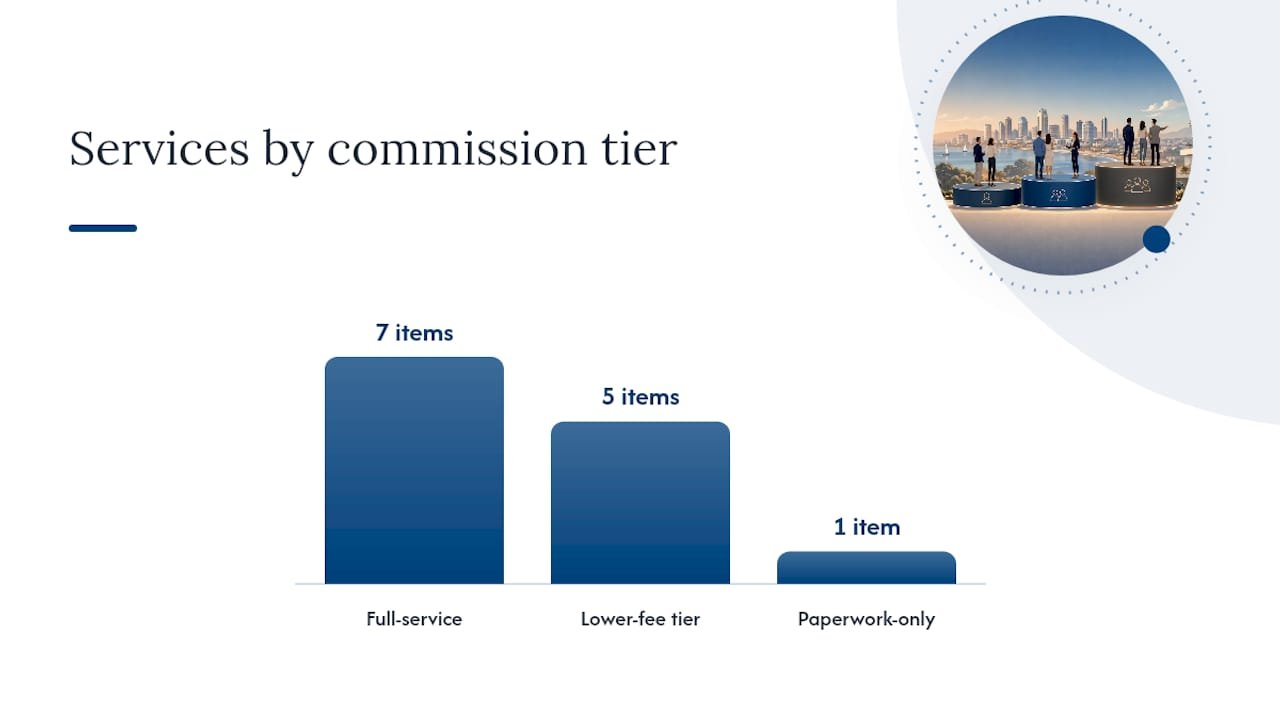
Commission level and service level are not always the same thing, but they usually correlate. Here is what full-service agents in San Diego typically deliver versus what gets trimmed at lower fee tiers.
-
Professional photography and video walkthrough
-
Staging consultation or coordination
-
MLS listing with maximum syndication (Zillow, Realtor.com, Redfin)
-
Targeted digital advertising and social media promotion
-
Open houses and private showings management
-
Active negotiation on offers and counteroffers
-
Transaction coordination through escrow close
-
MLS entry and basic photos (often standard, not professional)
-
Reduced or no staging support
-
Limited open house scheduling
-
Lighter negotiation involvement (you may handle offers directly)
-
Transaction documents provided, but less hand-holding
Paperwork-only / flat fee:
- MLS listing and disclosure forms
- No marketing, no negotiation, no showing coordination
A short checklist for comparing any agent’s listing plan:
- Who pays for photography, and what is the quality standard?
- Will the home appear on Zillow Showcase or similar premium placements?
- How many open houses are included, and who staffs them?
- What is the agent’s specific negotiation process when multiple offers arrive?
- Who handles transaction coordination, and is that included in the fee?
Pro Tip: Ask agents to show you the actual marketing plan in writing, not a verbal summary. A one-page marketing checklist separates agents who have a system from those who are improvising.
Selling timeline and how commission fits into your net proceeds
A typical San Diego sale from decision to close runs about two to three months, though well-priced homes in strong neighborhoods can close faster.
Timeline milestones:
- Pre-listing prep (repairs, staging, photography): 1–3 weeks
- Active listing period: 7–21 days in a healthy market
- Offer acceptance to escrow open: 1–3 days
- Escrow and inspections: 17–30 days
- Close and fund: 1 day
Beyond commission, sellers should budget for these costs:
Worked example on a $950,000 sale:
- Sale price: $950,000
- Less 3% listing commission: ($28,500)
- Less 2.5% buyer-agent offer: ($23,750)
- Less escrow/title: ($3,200)
- Less transfer tax: ($1,045)
- Less repairs and staging: ($5,000)
- Estimated net proceeds: ~$888,505
Pre-listing repairs are one of the most variable costs. For interior updates like door replacements that add visual appeal without major renovation budgets, local vendors like One Day Doors & Closets in San Diego can turn around improvements quickly before your listing goes live.
Ryan Case’s Premier Selling System: what it claims and what to verify
The Premier Selling System is Ryan Case’s structured listing approach, built around three pillars: strategic pricing, targeted marketing, and active negotiation.
How the system works:
- Strategic pricing uses comparable sale data and buyer demand signals to position the home at a price that generates competition rather than just interest
- Marketing channels include Zillow Showcase placement, a proprietary buyer database, targeted digital advertising, and professional photography and video
- Negotiation emphasis focuses on maximizing final sale price, not just accepting the first offer
Documented claims (as published on the Ryan Case site):
| Claim | What to ask for |
|---|---|
| 5–7% higher sale prices vs. market average | Request recent comparable sales with and without the system |
| Faster time on market | Ask for average days on market across the last 12 months of listings |
| Buyer database access | Ask how many active buyers are in the database and how they are contacted |
Reasonable caveats: results vary by neighborhood, price point, and market conditions. Ask Ryan Case for recent case data specific to your zip code before drawing conclusions from aggregate claims.
Pro Tip: Any agent claiming above-market results should be able to show you a list of their last 10–15 closed sales with list price, sale price, and days on market. If they can’t, the claim is unverifiable.
How the 2024–2026 NAR settlement changed San Diego commissions
The National Association of Realtors settlement, effective August 2024, restructured how buyer-agent compensation works across the country, including San Diego.
The key changes sellers need to know:
- Buyer-agent compensation can no longer be advertised as a blanket offer on most MLS platforms
- Buyers must now sign a written buyer representation agreement before touring homes, which specifies the buyer’s agent fee
- Sellers can still offer buyer-agent compensation, but it is now a negotiated term, not a default
In practice, San Diego sellers are seeing more buyers ask for seller-paid buyer-agent compensation as a concession in the purchase offer rather than as an upfront MLS offer. This gives sellers more flexibility but also more complexity at the negotiation table.
The net effect on total commission paid has been modest so far.
How San Diego’s top local brokerages structure their fees
San Diego has a wide range of local fee structures.
Marc Lyman’s focus on higher-end San Diego neighborhoods reflects a premium-service model where marketing spend is proportionally higher.
This model works well for sellers who are comfortable with lighter service and want to reduce the listing-side cost.
These are brokerage structures for agents, not a direct seller-facing fee model, though they can affect how individual agents price their services.
Neighborhood-focused boutique agents like Alex Saavedra (Core Real Estate Services), McT Real Estate Group, and CC Summerfield (with relocation specialization) offer localized expertise that can be valuable in specific San Diego submarkets.
The right model depends on your home’s price point, how much involvement you want, and whether you prioritize maximum net proceeds or minimum upfront cost.
How to choose a San Diego real estate agent based on value, not just rate
The lowest commission is not always the best deal. Here is a practical framework for evaluating agents:
Step 1: Compare service inclusions side by side. Use the checklist from the services section above. Two agents at the same rate may deliver very different marketing plans.
Step 2: Ask for a net-of-fees estimate in writing. A good agent can show you a projected net sheet within 24 hours of seeing your home. If they can’t, that tells you something.
Step 3: Check the DRE license. The California Department of Real Estate lets you verify any agent’s license status and check for complaints or disciplinary actions. Takes two minutes and should be non-negotiable.
Step 4: Review recent local sales data. Ask for the agent’s last 10–15 closed transactions: list price, sale price, and days on market.
Step 5: Evaluate communication style. You will be in near-daily contact during escrow. An agent who responds slowly during the interview will respond slowly when your deal is at risk.
Local agent education and licensing standards are maintained through resources like the San Diego Real Estate School, which trains and certifies agents operating in this market.
What San Diego sellers actually get wrong about commission
Most sellers focus on the listing percentage and ignore the buyer-agent side. That is backwards. The buyer-agent offer is often the bigger number and has the bigger impact on how many agents actively show your home.
Three things worth prioritizing in order:
-
Pricing strategy first. An overpriced home sits. A well-priced home creates competition. No amount of marketing fixes a bad price. Ask your agent specifically how they arrived at the list price recommendation and what comparable sales support it.
-
Marketing spend second. Professional photography, Zillow Showcase, and targeted digital ads are not luxuries on a $900,000 home. They are the difference between 12 showings and 40. Ask what the agent is spending out of pocket on your listing.
-
Staging decisions third. Light staging, decluttering, and targeted repairs (fresh paint, updated fixtures, clean doors) consistently move the needle on buyer perception. The cost is almost always recovered in the sale price.
One red flag worth calling out: any listing agreement with a non-refundable upfront fee before your home sells is a warning sign. Legitimate agents earn their commission at closing.
The Premier Selling System: a data-backed alternative to baseline listings
Most full-service agents in San Diego offer the same checklist: photos, MLS, open house, wait. Ryan Case’s Premier Selling System is built differently. It combines strategic pricing, Zillow Showcase placement, a proprietary buyer database, and active negotiation to create buyer competition rather than passive exposure.
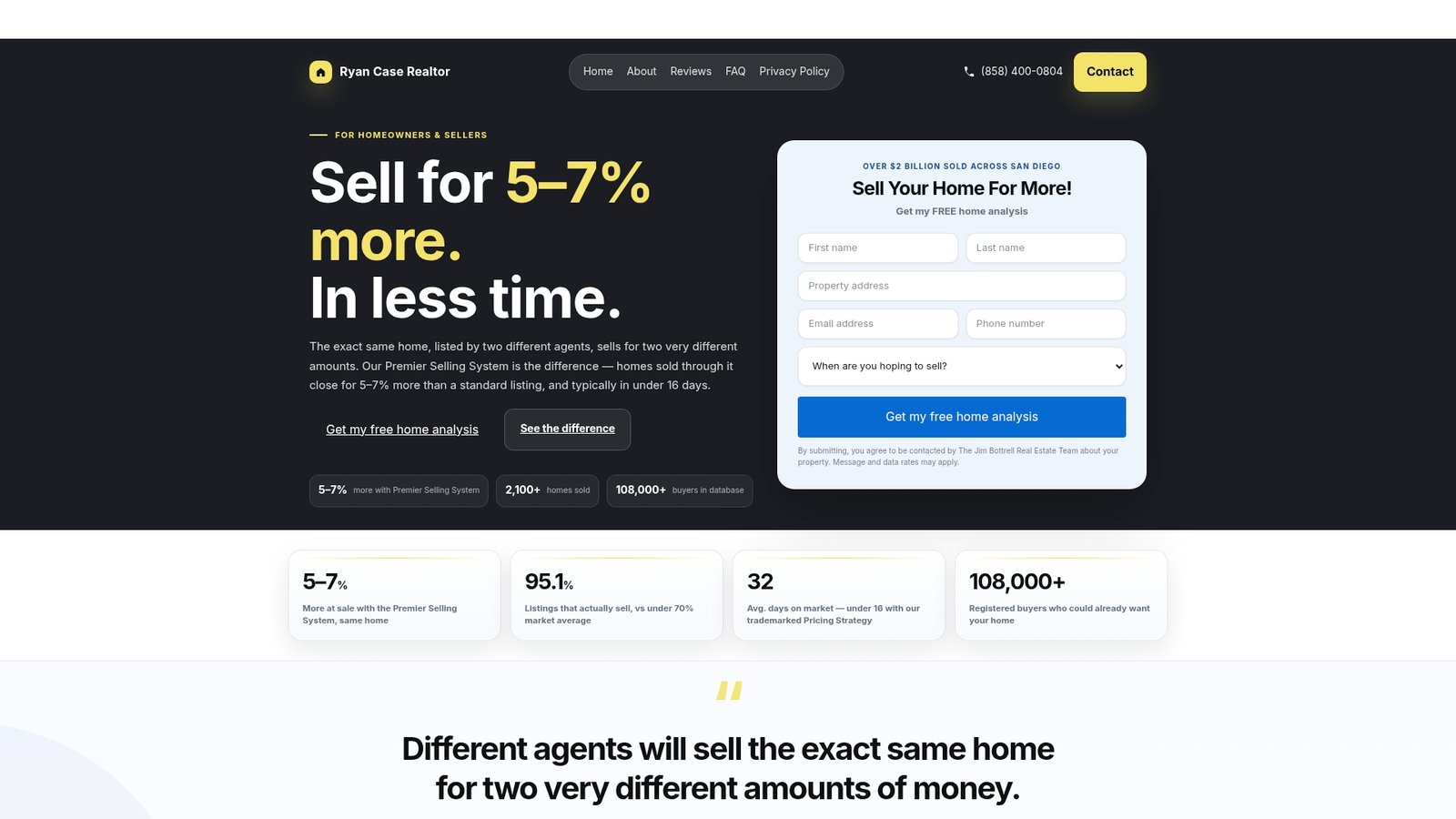
The system is designed for sellers who want measurable results, not just activity. Service tiers range from paperwork-only to a full guaranteed-sale program, so you choose the level of involvement that fits your situation.
To get started, request a personalized home analysis at Ryancaserealtor. Ryan Case will review your property, walk you through a projected net sheet, and show you exactly which marketing channels and pricing strategy apply to your home.
Sources
For local commission comparables, ask any agent you interview to provide recent MLS-sourced closed sale data for your specific neighborhood and price range. Published averages are starting points; your home’s actual result depends on local conditions, pricing, and execution.
This article is general information, not a substitute for advice from a qualified financial advisor. Consult a qualified financial professional about your own circumstances before acting on anything here.