A 1031 exchange starts the day your relinquished property closes and proceeds transfer to a qualified intermediary. From that point you have 45 calendar days to identify replacement property in writing and 180 calendar days total to close on it. Miss either deadline, even by one day, and the entire exchange becomes a taxable sale.
TL;DR:
- Failing to sign an exchange agreement before Day 0 or not pre-underwriting replacement properties increases the risk of missing key deadlines.
- The three-property, 200 percent, and 95 percent rules for identification must be chosen carefully, with written notices submitted before midnight on Day 45.
- Most exchanges fail not from legal issues but due to delays in financing, appraisals, or title work during Days 46 through 180.
- The 180-day deadline is effectively shortened if the tax return filing due date, including extensions, occurs before the 180-day period ends.
- Picking a qualified intermediary and coordinating sale timing prevent the most common errors that trigger tax or disqualification issues.
Table of Contents
- What Is the 1031 Exchange Timeline, Step by Step?
- What Should You Complete Before Day 0?
- How Do the 45-Day Identification Rules Work?
- What Happens Between Day 46 and Day 180?
- Does Your Tax Return Deadline Shorten the 180 Days?
- Why Does the Qualified Intermediary Matter So Much?
- What Are the Most Common Ways to Blow the Deadline?
- Why Coordinated Selling Reduces Exchange Risk
- How Ryan Case Helps Protect Your Exchange Window
- Where to Verify These Deadlines Yourself
- Sources
What Is the 1031 Exchange Timeline, Step by Step?
The clock is unforgiving, but the map is simple once you see it laid out. Everything runs off one anchor date: the closing of your relinquished property.
- Day 0: The relinquished property closes and sale proceeds transfer to your qualified intermediary (QI). This is the trigger date for both deadlines.
- Days 1 through 44: You evaluate, tour, and underwrite replacement properties, but nothing is legally binding yet.
- Day 45: Your written identification of replacement property is due to the QI. No grace period.
- Days 46 through 179: You finalize financing, complete due diligence, and move toward closing on identified property.
- Day 180: Final deadline to close on the replacement property, or the 45-day and 180-day rules end your exchange.
Both deadlines run in calendar days, not business days. Weekends and federal holidays count against you, which catches investors off guard when Day 45 lands on a Sunday or Day 180 falls the week of Thanksgiving.
What Should You Complete Before Day 0?
The exchanges that fail almost never fail on Day 44. They fail because nobody did the groundwork before the sale even closed. Treat the days before Day 0 as the most important stretch of the entire process.
- Sign an exchange agreement with a qualified intermediary before your relinquished property closes. Waiting until after closing is too late.
- Start scouting replacement properties and get preliminary underwriting done on at least two or three candidates.
- Confirm wiring instructions with your closing agent so proceeds route directly to the QI, never to you personally.
- Assemble a document folder now: purchase contract, title commitment, loan payoff figures, and QI contact confirmations.
Pro Tip: Get pre-approval or proof of funds for your top replacement candidates before you close on the relinquished property. Lenders that already know your deal move faster once Day 45 hits, and that speed is what saves exchanges in the final stretch.
How Do the 45-Day Identification Rules Work?
The IRS gives you three ways to identify replacement property, and picking the wrong one can quietly sink an otherwise solid exchange. Under Treasury Regulation 1.1031(k)-1, your identification must be in writing, signed, and delivered to your QI (not just drafted) before midnight on Day 45.
- Three-property rule: Identify a limited number of properties regardless of value. A duplex, a complex, and a retail strip center all qualify, no matter the price tags.
- 200% rule: Identify any number of properties as long as their combined fair market value does not exceed twice the value of what you sold.
- 95% rule: Identify more properties than the other rules allow, but you must acquire nearly all of their total identified value. This rule is less commonly used due to its risk.
You can revoke or replace an identification anytime before Day 45 closes, but never after.
What Happens Between Day 46 and Day 180?
This stretch is where most exchanges quietly die, not from a legal technicality but from ordinary scheduling failure. Lenders take longer than promised, appraisals get delayed, or title finds a lien nobody expected.
- Coordinate lender underwriting, appraisal scheduling, and title work against your Day 180 target the moment identification is filed.
- If your primary replacement falls through, pivot immediately to a backup property from your original identification list. This is exactly why the three-property and 200% rules matter.
- Institutional buyers with cash and in-house underwriting often close in three to four weeks. Retail buyers financing through a conventional lender routinely need six to eight.
- Reverse exchanges flip the sequence: you buy the replacement first, through an Exchange Accommodation Titleholder, then the 45-day identification applies to the property you still need to sell. The 180-day structure stays intact, but timing starts on the parking date rather than a sale closing.
Does Your Tax Return Deadline Shorten the 180 Days?
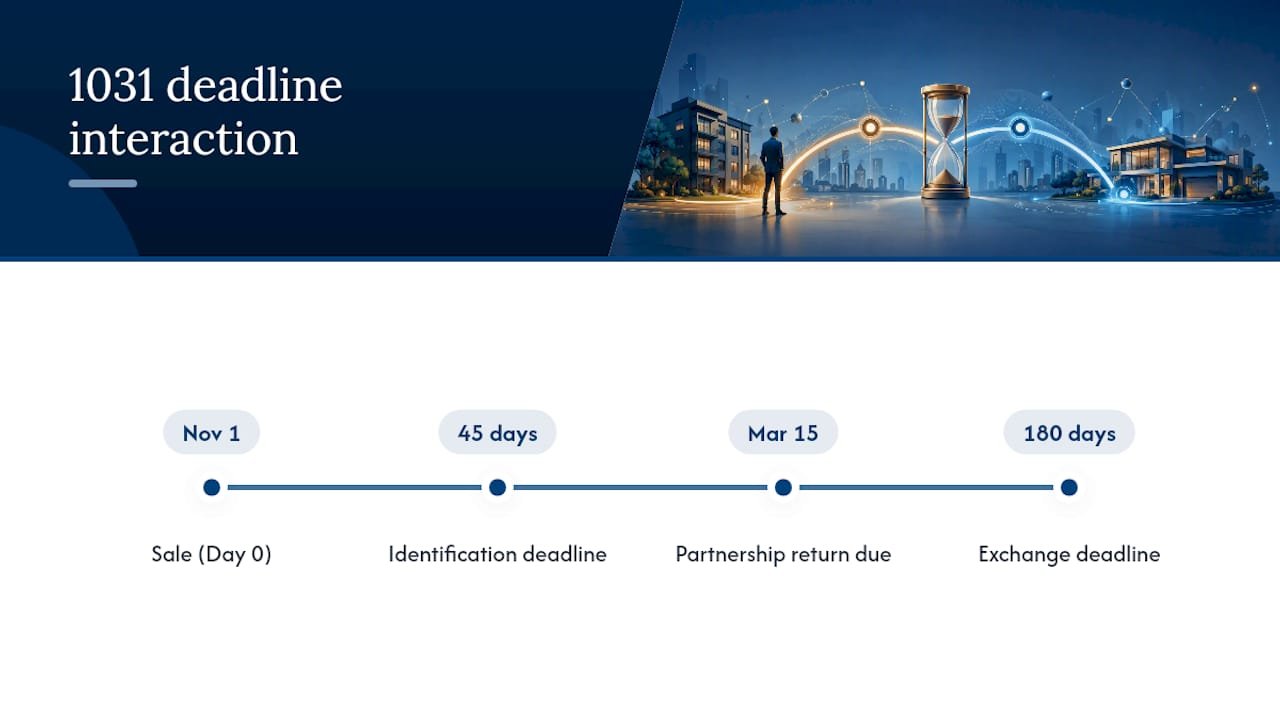
Here’s the detail that blindsides investors who close late in the year: the 180-day deadline is actually the earlier of 180 days or your tax return’s due date, including extensions.
The trap: sell a relinquished property on November 1 and your 180th day lands in late April, but your partnership return is due March 15. Without an extension, you’ve lost roughly six weeks of exchange time you thought you had.
The fix is straightforward. File Form 7004 for a partnership return, or the equivalent extension for your entity type, before your original filing deadline. Do it early in the exchange, not as a scramble in month five.
Why Does the Qualified Intermediary Matter So Much?
A qualified intermediary isn’t a paperwork formality. It’s a legal firewall between you and your sale proceeds, and it’s the single most common way exchanges get accidentally disqualified.
If proceeds touch your bank account, even briefly, the IRS treats that as constructive receipt and the exchange is dead on arrival. The QI holds funds, prepares identification paperwork, and coordinates with both closings so you never take possession of the money.
Documentation you need to keep for the life of the exchange and beyond:
- The signed exchange agreement with your QI
- Written identification notice with delivery confirmation and timestamp
- Closing statements for both the relinquished and replacement properties
- QI confirmation letters showing funds received and disbursed
You’ll report the completed exchange on Form 8824, filed with the tax return covering the year the relinquished property closed, regardless of when the replacement closes within that 180-day window.
What Are the Most Common Ways to Blow the Deadline?
Most failed exchanges trace back to one of a handful of predictable mistakes: waiting until after closing to sign with a QI, identifying only one property that later falls out of contract, or assuming business days when the rule is calendar days. Here’s a date-anchored checklist to run against:
- Before Day 0: QI signed, wiring instructions confirmed, two to three candidates pre-underwritten.
- By Day 30: Shortlist finalized to your three (or fewer) backup properties.
- By Day 45: Written identification delivered to your QI, confirmed in writing.
- By Day 150: Financing fully approved, appraisal and title cleared.
- By Day 180: Closing completed, funds disbursed by the QI.
Pro Tip: If financing looks shaky as Day 150 approaches, look at a bridge loan to close on time and refinance into permanent debt afterward. A short-term rate is cheaper than a busted exchange.
Missing a deadline generally collapses the exchange into a fully taxable sale, with only narrow relief available for federally declared disasters.
Why Coordinated Selling Reduces Exchange Risk
Most 1031 failures aren’t legal problems. They’re scheduling problems dressed up as legal problems. A relinquished property that lingers on market eats into your effective window before Day 0 even starts, and a rushed closing invites constructive-receipt mistakes.
Pre-marketing to a qualified buyer pool and structuring closings around your exchange timeline, rather than the other way around, is what keeps that 180-day clock working in your favor instead of against you.
— Ryan Case
How Ryan Case Helps Protect Your Exchange Window
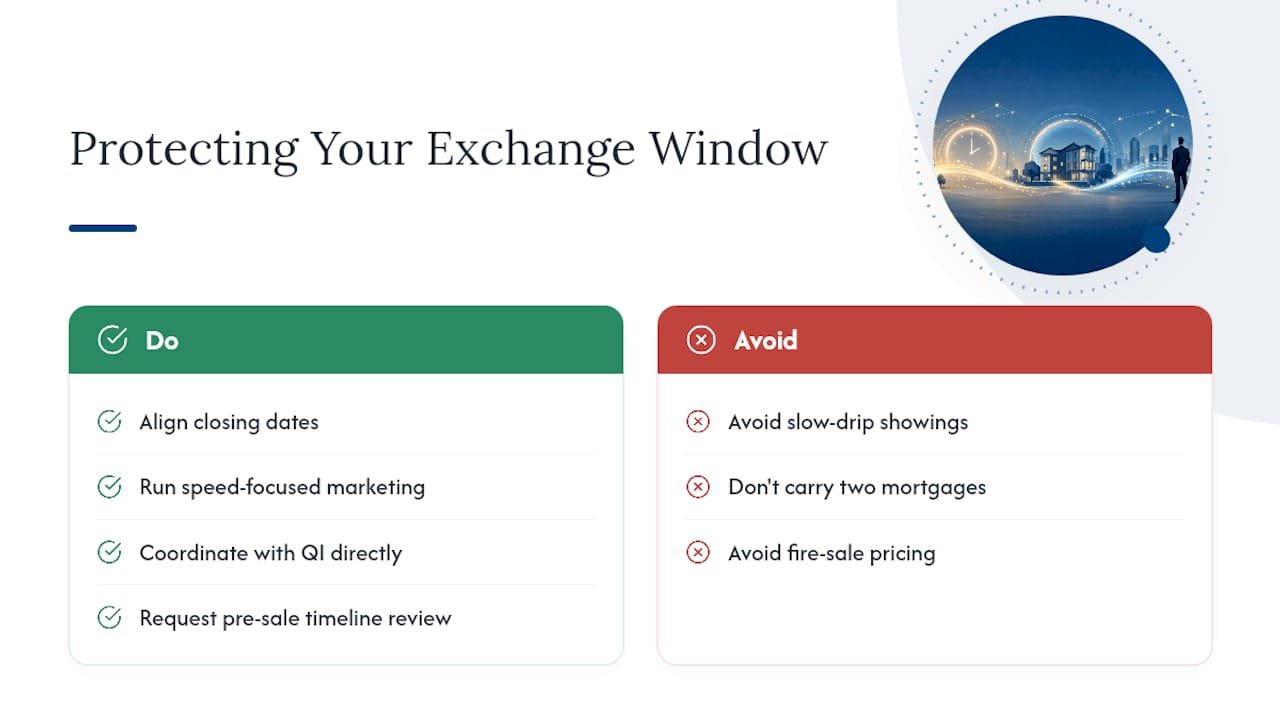
If you’re staring down a 1031 exchange, the biggest risk isn’t the IRS paperwork. It’s a relinquished property that sits on market too long and eats into the 180 days you need for the replacement side.

Ryan Case coordinates the sale side specifically for exchangers: aligned closing dates, a marketing push built for speed rather than a slow drip of showings, and direct communication with your qualified intermediary so proceeds move without delay. For sellers juggling both a sale and a purchase, the buy and sell simultaneously approach avoids the trap of carrying two mortgages while your exchange clock runs. If your relinquished property needs to move fast without a fire-sale price, the Premier Selling System targets exactly that combination.
Request a pre-sale timeline review at Ryancaserealtor before you list, so your Day 0 doesn’t slip further than it has to.
Where to Verify These Deadlines Yourself
Confirm every deadline directly with the IRS like-kind exchange guidance and Form 8824 instructions before you rely on any timeline for your own transaction.
This article is general information, not a substitute for advice from a qualified financial advisor. Consult a qualified financial professional about your own circumstances before acting on anything here.
Sources
- 1031 exchange deadlines: 45-day and 180-day rules explained
- Like-kind exchanges (real estate tax tips) — IRS
- 1031 Exchange Rules: 45-Day & 180-Day Timing