Require a dated proof-of-funds document showing liquid funds equal to or greater than the offer, then act immediately: get a bank-issued letter or a recent account statement and call the bank’s public phone number to confirm it’s real. If the buyer stalls, sends a screenshot instead of a statement, or the documents don’t hold up, pause the deal and insist on escrow or title confirmation before you go any further.
TL;DR:
- Verify that proof-of-funds documents are recent, dated within 7 to 30 days, and show liquid funds equal to or exceeding the purchase price.
- Confirm the funds are accessible by calling the issuing bank directly, not relying solely on the document, and ask specific questions about the balance and the signer.
- Watch out for red flags such as inconsistent fonts, missing details, or funds that are not truly liquid, prompting a pause and additional verification steps.
- Request all relevant account statements and a bank-issued letter on official letterhead, ensuring the buyer redacts sensitive details before sharing.
- Be cautious of wholesale or assignment contracts, and require independent evidence of recent closings under the buyer’s name to ensure they can follow through.
Table of Contents
- How Do You Verify Cash Buyer Funds Before Accepting an Offer?
- The Four-Step Verification Checklist Every Agent Should Run
- Red Flags: Wholesalers, Assignment Offers, and Financed ‘Cash’ Deals
- What to Request From a Cash Buyer, and Exactly How to Ask
- If the Funds Look Suspicious, Pause and Escalate
- An Agent’s View on Verifying Cash Offers in Real Listings
- How Ryan Case Vets Cash Offers So You Don’t Have To
- Sources
How Do You Verify Cash Buyer Funds Before Accepting an Offer?
Verifying cash buyer funds means confirming three things at once: the document is current, the money is actually liquid, and the institution that issued it will vouch for it. Most sellers skip straight to “do they have a bank letter?” and stop there. That’s the mistake. A letter can be real and still not prove the buyer can close, because the number on the page doesn’t tell you whether that cash sits in a checking account or is locked inside a retirement plan.
What counts as acceptable proof of funds
- Recent checking or savings account statements showing a balance that covers the purchase price.
- Brokerage statements, but only if the assets listed are cash or cash equivalents, not unsettled trades or margin balances.
- A bank-issued proof-of-funds letter on official letterhead, naming the account holder and current balance.
What usually doesn’t qualify, or needs extra scrutiny: home equity lines, IRA or 401(k) balances, cryptocurrency holdings, and margin account funds. None of these are truly liquid without a conversion step the buyer hasn’t taken yet, and a proof-of-funds letter differs from a lender preapproval letter in exactly this way. A preapproval promises a bank might lend money later. A POF letter shows money that already exists, right now, in the buyer’s name.
A single screenshot of an app balance, with no bank name, date, or account holder visible, is close to worthless as evidence. Ask instead for a downloaded statement or an official letter, and if funds are split across two or three accounts, request all of them together so the combined total actually clears the offer amount.
The Four-Step Verification Checklist Every Agent Should Run
A proof-of-funds letter means nothing until you’ve run it through a real check. The protocol that catches nearly every forgery comes down to four steps, done in order, every single time.
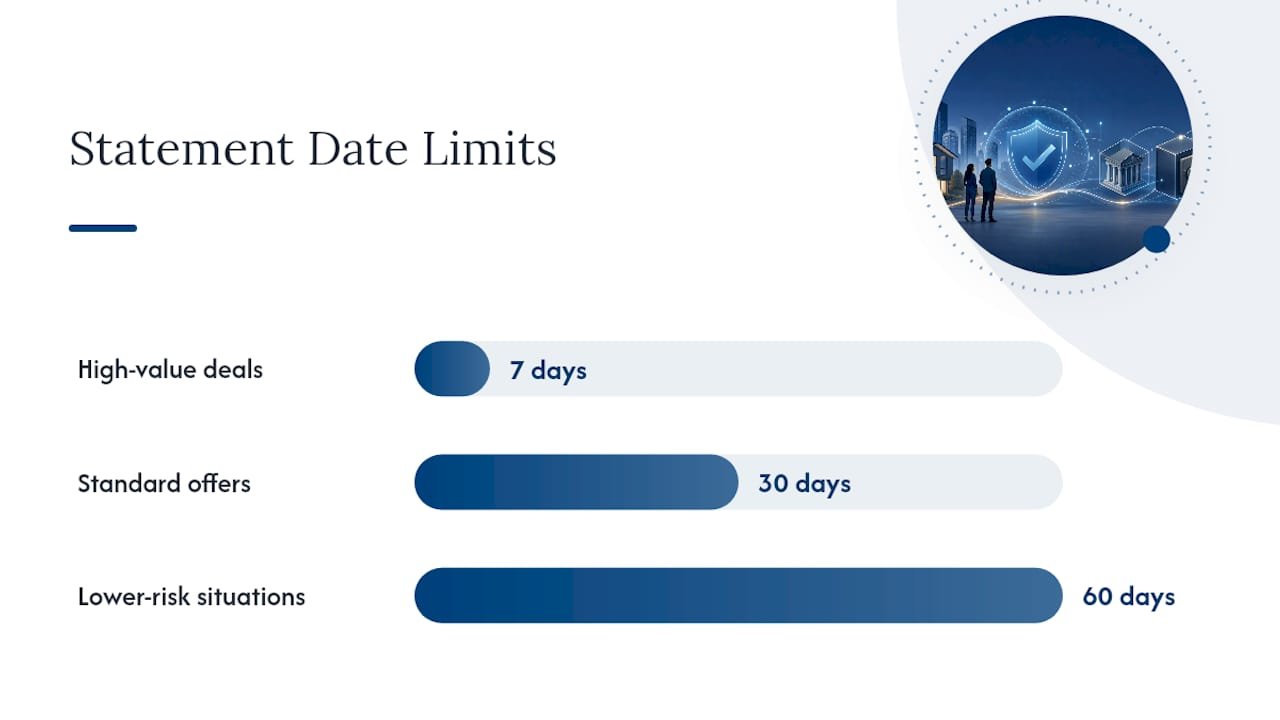
- Check the date. Statements should be dated within 30 days of the offer. Some sellers extend that to 60 days for lower-risk situations, but on high-value deals, tighten it: require a bank letter dated within 7 days.
- Confirm the amount. The stated balance needs to equal or exceed the full purchase price, and it needs to be sitting in a liquid, available account rather than tied up in pending transfers or investments.
- Call the issuing institution. Look up the bank’s number independently, never use a number printed on the document itself, and ask to confirm the letter was issued, the balance as of the stated date, and the name of the officer who signed it.
- Look for inconsistencies. Round numbers with no cents, mismatched fonts or logos, a buyer’s name that doesn’t match the purchase entity, and PDF metadata showing recent edits are all signs of tampering.
That third step is the one most agents skip, and it’s the one that matters most. A visually convincing letter can still be entirely fabricated, and a phone call to the bank catches sophisticated forgeries that a careful read of the document alone will not.
Pro Tip: Log every verification call, date, time, bank representative’s name, and what they confirmed, in your transaction file. If a deal falls apart later, that log is your record that you did the diligence.
Red Flags: Wholesalers, Assignment Offers, and Financed ‘Cash’ Deals
Not every buyer calling themselves a cash buyer intends to be the one who closes. Assignment and wholesale contracts let a buyer sign a purchase agreement, then sell that contract to someone else before closing, often without your knowledge unless you ask directly.
- Ask point-blank: “Are you the end-closing buyer, or do you intend to assign this contract?” Get the answer in writing.
- Watch for slow or evasive delivery of documents, unusually small earnest money deposits, or a signer who changes between the offer and the closing table.
- Cross-check the purchase entity against your state’s business registry to confirm the LLC or corporation is active and that the person signing actually has authority to bind it.
Pairing your document review with a closing-history and public-records check matters because paperwork alone can be technically accurate and still misleading. A buyer can show real funds in a real account and still not be the person who ends up at the closing table. Requiring recently recorded closings under the buyer’s name gives you independent evidence they actually follow through.
What to Request From a Cash Buyer, and Exactly How to Ask
The document packet you want is specific: a bank letter on official letterhead, recent checking or savings statements dated inside your window, brokerage statements if funds are split, and combined documentation if the buyer is pulling from more than one account. Ask the buyer to redact account numbers before sending; you need proof of balance, not a security risk.
- Send a short, direct request: “To move forward with your offer, please provide a bank letter or recent account statement (dated within 30 days) showing available funds at or above the offer price. Account numbers can be blacked out.”
- Never ask for online banking passwords or full account numbers in an email or text. If you need more detail, request a phone call with the bank directly instead.
- When you call the institution, confirm the account holder’s name, the balance as of the stated date, and the name and direct line of the officer who signed the letter.
A bank-issued POF letter typically includes the bank’s contact information, the account holder’s name, the balance, the date, and an authorized signature. If any of those five elements is missing, that’s your cue to ask for a corrected version before you take the offer seriously. For added privacy protection when documents change hands electronically, secure document-sharing practices matter as much as the verification itself.
Pro Tip: Strong cash buyers usually produce this packet promptly without pushback. Speed here is itself a signal; a buyer who takes a week to send a statement is telling you something.
If the Funds Look Suspicious, Pause and Escalate
Evasive answers, documents that don’t match, or a bank that won’t confirm the letter are all reasons to stop negotiating and ask for clearer proof before you move one step further.
- Require the closing to run through a licensed title or escrow company, and confirm wiring instructions directly with escrow, never through email alone.
- Ask for a fresh bank letter dated within 7 days, a larger earnest money deposit, or evidence of the buyer’s recent recorded closings.
- Bring in legal counsel if you suspect outright fraud rather than a simple documentation gap.
A legitimate cash closing always runs through a neutral third-party title or escrow company, and no genuine buyer will ask you to accept upfront fees or informal wire instructions sent directly from them.
An Agent’s View on Verifying Cash Offers in Real Listings
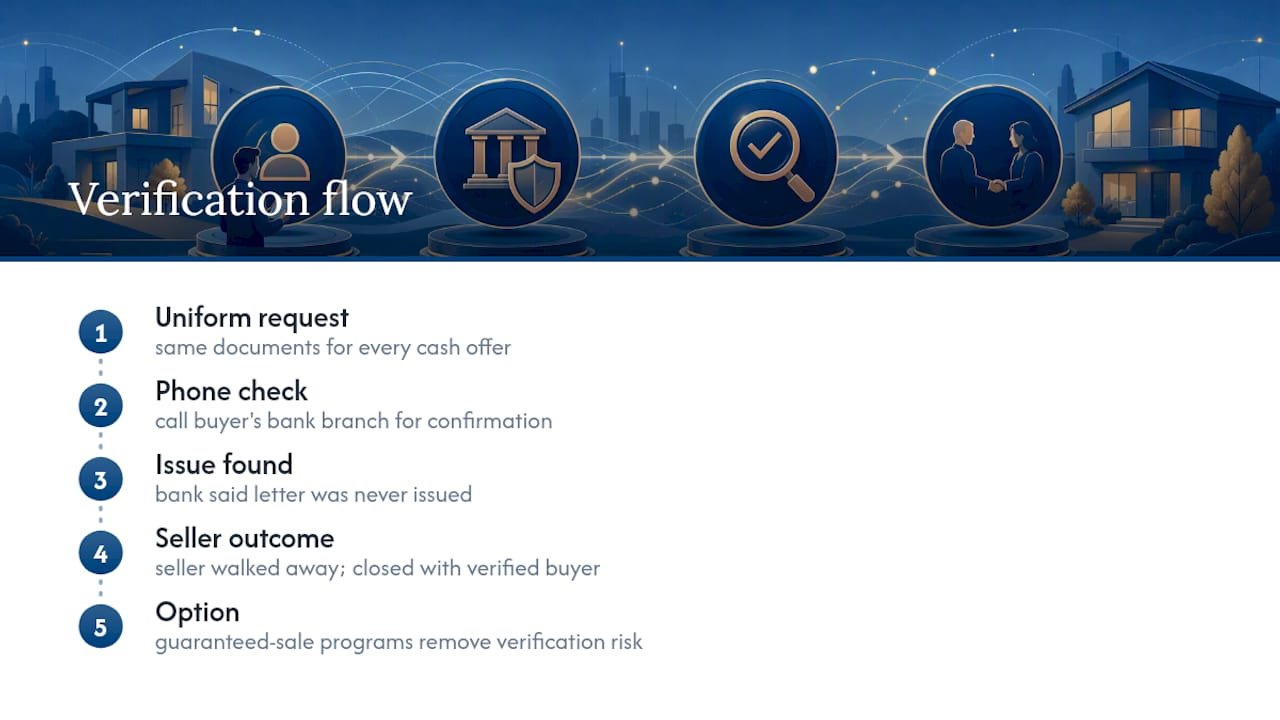
Every cash offer that lands on a listing gets the same document request and the same phone call, no exceptions, even for buyers who seem obviously credible. That consistency is what catches problems. One offer years back looked clean on paper, right amount, right date, until a call to the bank’s branch revealed the letter had never actually been issued by that officer.
The seller walked away from that offer and closed with a verified buyer two weeks later. Guaranteed-sale programs exist partly for sellers who want that verification risk taken off their plate entirely, especially when timing matters more than chasing the highest unverified number on the table.
— Ryan Case
How Ryan Case Vets Cash Offers So You Don’t Have To
Running down a bank’s public number, reading a PDF for edit metadata, and chasing a buyer for a corrected letter is exactly the kind of work that eats a week you don’t have when you’re trying to close on your own timeline. Verification processes are built directly into how offers get vetted on many listings, coordinating with escrow, confirming buyer documentation before it reaches sellers for a decision, and flagging assignment or wholesale structures before a contract is finalized.

For sellers who want the risk of an unverified cash buyer removed altogether, Some agents offer guaranteed-sale and vetted-buyer options that shift the verification burden onto a managed process instead of your own phone calls. If you have a cash offer in hand right now and aren’t sure it will actually close, reach out for a home analysis and offer review before you sign anything.
This article is general information, not a substitute for advice from a qualified financial advisor. Consult a qualified financial professional about your own circumstances before acting on anything here.
Sources
- Proof of Funds: How to Verify a Cash Buyer
- Proof of funds: What is a POF letter in real estate?
- How to Vet Cash Buyers: Proof of Funds & Red Flags
- Cash offers for houses: Legit or scam?
- How Do I Know If a Cash Buyer Is Legitimate?
Pingback: Home Sale Negotiation: Protect Seller Leverage in the First 48 Hours