Yes, you can sell a San Diego house remotely, and for most owners the fastest reliable route is hiring a San Diego listing agent to act as your local project manager. If speed matters more than price, a cash buyer is the alternative. Before anything else, call your escrow or title company and a San Diego agent to flag the California withholding rules that can hold up your proceeds at closing.
TL;DR:
- Remote sellers must prioritize completing California withholding forms early, as escrow cannot close without submitted Form 593, which triggers automatic withholding if missing.
- Hiring a local agent to manage vendor coordination, showings, and communication ensures smooth handling of repairs, staging, and buyer interactions from a distance.
- Sellers with properties held in trusts or LLCs should arrange notarization in advance and confirm all necessary certifications to prevent delays at closing.
- Understanding the cost implications, including seller closing costs and potential discounts from cash or guaranteed sale programs, is essential before accepting offers.
- Proper documentation, timing, and tax compliance are the biggest challenges in remote sales, making upfront planning on paperwork more critical than video tours or e-signatures.
Table of Contents
- Your step-by-step remote sale checklist
- California withholding and closing paperwork you cannot skip
- Managing showings, vendors, and tenants from a distance
- Weighing a retail listing against a cash sale or guaranteed program
- Why a local agent acting as project manager changes the outcome
- What most remote sellers get wrong
- Let a San Diego agent run your remote sale
- Sources
- FAQ
Your step-by-step remote sale checklist
Selling from out of state or out of the country works when you break the process into tasks you can delegate and tasks you must personally sign off on. Here is the sequence most remote San Diego sellers follow.
- Scope the property over video. Walk a trusted person (agent, property manager, or contractor) through the house on a video call and decide whether to make repairs or sell as-is.
- Assign marketing tasks. Your agent orders professional photography, a virtual tour, and MLS syndication so buyers can evaluate the home without you present.
- Set up virtual showings. Confirm how your agent will run live video walk-throughs for buyers, and decide on lockbox access and key handling for in-person showings.
- Review offers remotely. Your agent should send offer summaries and comparisons by video call or screen share, not just a PDF dump in your inbox.
- Handle escrow paperwork electronically. Most disclosures and purchase agreements can be e-signed, but final closing documents in California typically still require notarization.
- Wire funds and close. Confirm wiring instructions by phone with a known escrow contact before sending anything, since wire fraud targets remote sellers specifically.
Before your agent lists the property, gather your government-issued ID, current title or deed, and, if the property sits in a trust or LLC, documentation proving your authority to sign on the entity’s behalf. Your agent or escrow officer should tell you exactly which documents they need and when, so nothing stalls the closing at the last minute.
Pro Tip: Set a standing weekly call with your agent during the listing period so you get photo and status updates without having to chase anyone down.
California withholding and closing paperwork you cannot skip
The biggest risk for a remote seller is not distance, it is paperwork. California requires real estate withholding on most home sales unless an exemption applies, and escrow needs your completed Form 593 before closing to avoid holding back part of your proceeds automatically.
- Confirm with escrow early whether you qualify for the principal residence exemption or another common exemption path.
- If you’re using a 1031 exchange or structuring an installment sale, get tax counsel involved before you accept an offer, not after.
- Ask escrow which version of the Form 593 instructions applies to your sale, since the form covers both a flat percentage method and an alternative calculation.
California requires sellers to submit Form 593 to escrow before closing or funds are automatically withheld. Treat this as an early-escrow task, not a closing-day scramble.
On notarization, California has moved toward legislating remote online notarization, but full statewide availability still requires further implementation steps, according to a legislative analysis of AB 1977. Until that rollout completes, a mobile notary who meets you or a signing agent in person remains the practical way to execute final documents. If your property is held in a trust or LLC, ask title to confirm what certification they need from you well before the signing date so a missing document doesn’t delay funding.

Managing showings, vendors, and tenants from a distance
Control from afar comes down to documentation. Require anyone doing work in your absence, whether a contractor, stager, or photographer, to send before and after photos, itemized invoices, and a short video walk-through when the job is done.
- Vet local contractors and stagers for proof of insurance and recent references before hiring them sight unseen.
- Set payment terms tied to milestones, not full payment up front, so you retain leverage if work stalls.
- If the home is tenant-occupied, California has specific notice and access rules for showings that your agent and an attorney should confirm before you schedule anything.
- Document every key and lockbox handoff with a time-stamped photo, and keep a running log of who has access and when.
Pro Tip: Ask your agent to text a photo the moment they install or remove a lockbox, so you always know who currently has access to the property.
Weighing a retail listing against a cash sale or guaranteed program
The right path depends on what you’re optimizing for: price, speed, or certainty.
- Choose a retail listing with an experienced agent when maximizing sale price matters more than closing quickly, since marketing and multiple offers typically take longer to generate.
- Choose a cash or quick buyer when speed outweighs price, but scrutinize any offer for below-market pricing disguised as convenience and confirm proof of funds before you sign anything.
- Choose a guaranteed-sale program when certainty of closing matters most, but vet the fee structure carefully since these programs often trade a firm sale price for a service fee.
- Weigh seller effort too: a retail listing asks more of you upfront, while a cash sale or guaranteed program asks less but usually nets less as well.
Seller closing costs in San Diego typically eat into net proceeds regardless of which route you pick, so it’s worth understanding how sellers offset those costs before comparing offers side by side. If you’re leaning toward an as-is sale to avoid remote repair coordination, selling as-is is worth reading before you commit to a cash offer.
Why a local agent acting as project manager changes the outcome
A remote sale succeeds or fails on how well someone local manages the details you can’t. An agent functioning as your project manager should own vendor scheduling, showing supervision, offer negotiation, and regular reporting back to you, so you’re never guessing what’s happening at the property.
- Ask any agent you’re considering how often they’ll send photo or video updates during the listing period.
- Ask how they handle buyer showings when the seller can’t be present for questions about the property.
- Ask what their process looks like for coordinating repairs or staging without the owner on site.
- Ask for examples of past remote sales they’ve managed and how those closings went.
A remote seller’s biggest advantage is an agent who treats the listing like a project to be managed, not just a sign to be planted in the yard.
What most remote sellers get wrong
Most advice on selling remotely focuses on the mechanics, e-signatures, video tours, virtual staging, and treat those as the hard part. They aren’t. The hard part is the paperwork deadline you don’t see coming: missing your Form 593 exemption filing, or discovering three days before closing that your notary can’t get your signature because California hasn’t rolled out full remote online notarization yet.
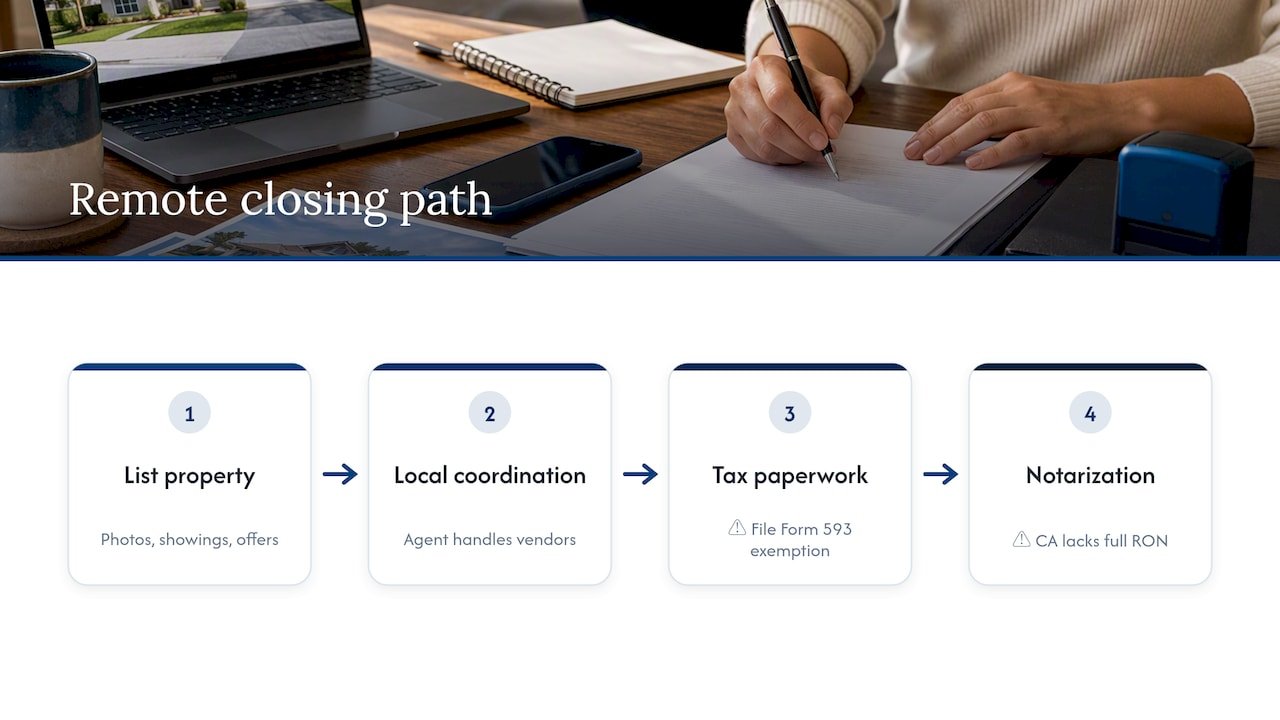
Conventional wisdom treats distance as the obstacle. It isn’t. Documentation and timing are. A seller living in Denver or Tokyo can close on a San Diego home just as smoothly as a local seller, provided someone on the ground is handling withholding forms, notary logistics, and vendor coordination on a fixed schedule.
If you take one thing from this, prioritize your tax paperwork and notarization plan before you ever list. Everything else, photos, showings, offer negotiation, is solvable with a good local agent and a phone. The paperwork is not something you can fix after the fact.
— Ryan Case
Let a San Diego agent run your remote sale
Selling from out of state doesn’t mean losing control of your outcome, it means handing the details to someone local who reports back regularly. Multiple service tiers for real estate selling cater to various seller needs, including full-service marketing and negotiation options and programs aimed at providing closing certainty from a distance.

- A remote intake call to review your timeline, property condition, and any tenant or entity ownership details.
- A documented plan for photography, showings, and vendor coordination while you’re away.
- Regular updates so you always know where your sale stands.
If you want a sale that closes in 6 to 10 weeks without a deep discount, that page walks through what to expect. You can also see the full range of service tiers on the Ryan Case home page.
This article is general information, not a substitute for advice from a qualified lawyer. Consult a qualified legal professional about your own circumstances before acting on anything here.
Sources
FAQ
Is it possible to sell a house remotely?
Yes, sellers regularly close on San Diego homes without being physically present, using e-signatures for most documents and a mobile notary for final closing paperwork. The key is delegating showings, vendor coordination, and document review to a local agent or trusted representative.
Are home prices dropping in San Diego County?
Home price trends shift with mortgage rates, inventory, and seasonal demand, and they vary by neighborhood and property type within San Diego County. Check current local listing data or ask a San Diego agent for a property-specific comparison rather than relying on countywide averages alone.
What is the hardest month to sell a house?
Selling activity tends to slow in the winter months, particularly around the holidays, when fewer buyers are actively touring homes. Spring and early summer are generally considered stronger selling windows in most markets, including San Diego.
How much would a real estate agent make on a $300,000 house?
Agent commissions are negotiated per listing and vary by service tier, so there’s no fixed percentage that applies to every sale. You can review typical San Diego commission structures to understand how different service levels affect what you pay at closing.