The right call comes down to one number: expected net proceeds after repair costs, commissions, carrying costs, and time. If targeted fixes cost less than the price bump they create, make them. If not, sell as-is. Most sellers land in the middle, per NAR’s own remodeling data, fixing safety and deal-killing issues while skipping the full remodel, and an experienced real estate agent can walk sellers through that exact math before they list.
TL;DR:
- Repair costs should be less than the resulting increase in sale price for repairs to be worthwhile, considering carrying costs and market conditions.
- An as-is sale limits repair promises but requires full disclosure of known defects and does not waive inspection rights unless contingencies are waived.
- Repairing safety or structural issues first offers better return on investment, while cosmetic upgrades often recover less at resale, depending on local market conditions.
- Using a pre-listing inspection and contractor bids provides accurate data to compare net proceeds between fixing up and selling as-is.
- Selling as-is is ideal for quick closings, estate sales, or when repairs would extension costs, but may result in a lower sale price and smaller buyer pool.
Table of Contents
- What Does Selling a House As-Is Actually Mean?
- Sell As Is or Fix Up? Weighing the Tradeoffs
- How Do You Calculate Net Proceeds for Repairs vs Selling As-Is?
- Which Repairs Actually Recover Their Cost at Resale?
- Pre-Listing Steps: Inspections, Disclosures, and Lead Paint Rules
- How to Market an As-Is Home Without Scaring Off Buyers
- How an Experienced Agent Runs This Decision for You
- Speed vs Price: The Timeline Tradeoff You Can’t Ignore
- Author Checklist: Fast Answers for Common Seller Situations
- If You Want Help: Services and Next Steps
- Sources
- FAQ
What Does Selling a House As-Is Actually Mean?
Selling as-is means you are marketing the property in its current condition and won’t commit to pre-closing repairs. It does not mean you get to hide problems. Disclosure duties and a buyer’s inspection rights survive the as-is label, and most contracts still let buyers walk if an inspection turns up something serious, unless you’ve separately waived that contingency.
Two things get confused constantly:
- An as-is clause limits your promise to repair, but you still must disclose known defects.
- A waived inspection contingency is a separate decision that removes the buyer’s exit ramp entirely, and it’s riskier for both sides.
Sellers typically position as-is listings one of two ways: as fixer-uppers aimed at investors and flippers, or as move-in-ready homes sold as-is simply to avoid negotiation over minor items.
Sell As Is or Fix Up? Weighing the Tradeoffs
Selling as-is or fixing up first each solve different problems, and the right answer depends on what you’re optimizing for.
Selling as-is gets you:
- A faster close and less upfront cash outlay
- Fewer surprises after an inspection since you’ve already priced in the condition
- A smaller buyer pool and typically a lower gross price
Making repairs before listing gets you:
- A higher list price and access to a much bigger buyer pool
- Real upfront cost, weeks of lead time, and renovation risk if bids run over
There’s a financing wrinkle worth knowing: homes with major deferred maintenance can fail FHA or VA appraisal requirements outright, which knocks a chunk of buyers out of the running for a truly rough as-is property before they ever make an offer.
Pro Tip: Ask your agent to pull recent as-is sale comps, not just general comps. A “distressed” comp set often tells a very different pricing story than the neighborhood average.
How Do You Calculate Net Proceeds for Repairs vs Selling As-Is?
Run the numbers before you run a hammer. Here’s the workflow:
- Get a repaired-value estimate. A comparative market analysis (CMA) tells you what the home would likely sell for in fully updated condition.
- Get contractor bids, not guesses, on the specific repair scope you’re weighing.
- Tally selling costs: commissions, closing costs, and any credits you’ll likely need to offer either way.
- Add carrying costs: mortgage, taxes, insurance, and utilities for every extra week the repairs take.
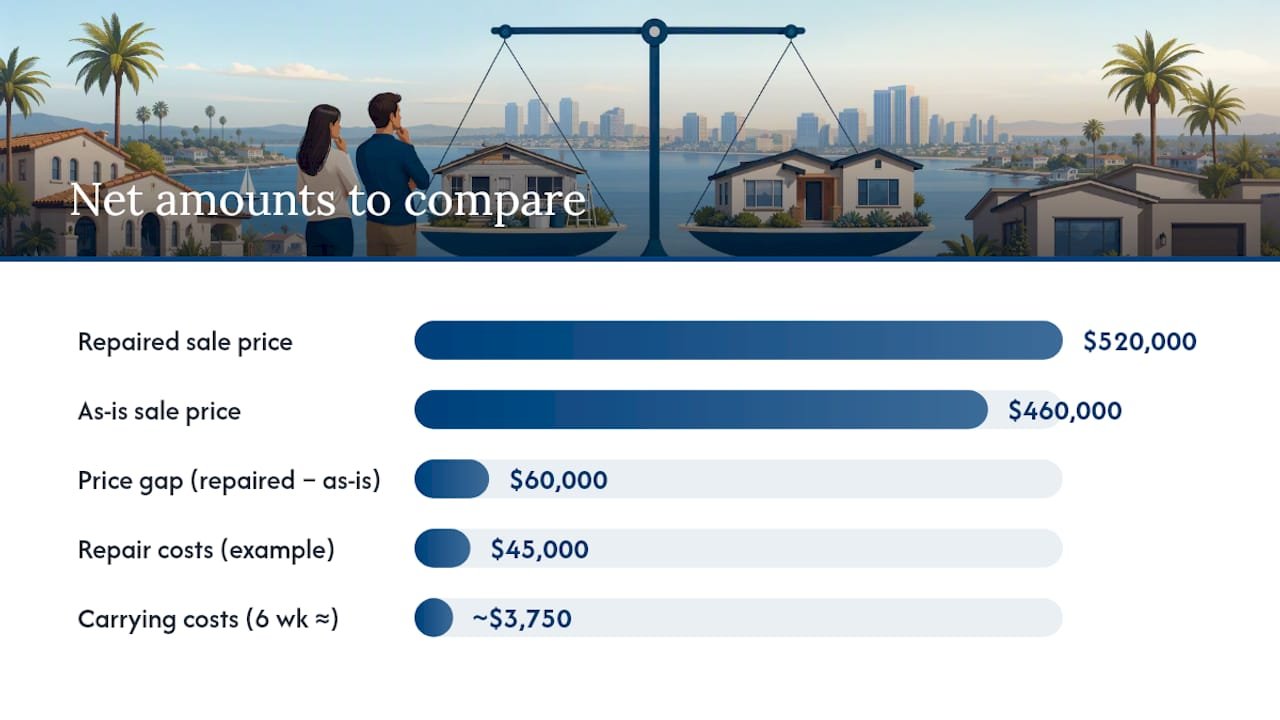
- Compare the two net numbers. Repaired sale price minus repair costs minus selling costs vs. as-is sale price minus selling costs.
A quick example: a home might sell for $520,000 repaired but only $460,000 as-is. If repairs run $45,000 and take six weeks of carrying costs at roughly $2,500 a month, that $60,000 price gap barely covers the outlay. Change the repair bid to $20,000, and the math flips hard toward fixing up.
This is exactly why NAR’s guidance frames repairs as a return-on-investment decision, not a moral one. A pre-listing inspection and real contractor bids replace guesswork with a defensible number.
Which Repairs Actually Recover Their Cost at Resale?
Not every upgrade pays for itself, and the gap between “feels good” and “pays off” is bigger than most sellers expect.
According to NAR’s 12 remodeling projects with the best resale value, national cost-recovery estimates include:
- New steel front door: 100% recovery
- Closet renovation: 83%
- New fiberglass front door: 80%
- New vinyl windows: 74%
- Kitchen renovation: roughly 60%
- Bathroom renovation: roughly 50%
Recovery varies by market, and San Diego’s older bungalow inventory often behaves differently than a new-build suburb, so treat these as national benchmarks, not guarantees.
There’s a second layer NAR’s data reveals: the projects homeowners enjoy most (primary suite additions, full kitchen overhauls) aren’t always the ones that recover the most cash. The practical rule is to fix safety, water intrusion, and structural issues first, then spend cosmetic dollars where recovery is highest.
Pre-Listing Steps: Inspections, Disclosures, and Lead Paint Rules
A little paperwork now prevents a blown deal later.
- Get a pre-listing inspection. It surfaces problems before a buyer’s inspector does, and it gives you leverage in pricing conversations.
- Compile permits, invoices, and warranties for any past work, especially electrical, plumbing, or roofing.
- Disclose known defects regardless of an as-is clause. As-is limits your repair promises, not your honesty. Active concealment isn’t protected, and courts and statutes generally hold sellers liable for hiding known issues even in as-is deals.
- Check the build date. Homes built before 1978 fall under EPA and HUD lead paint rules, meaning any renovation disturbing painted surfaces may require a certified renovator and lead-safe work practices.
How to Market an As-Is Home Without Scaring Off Buyers
- Price it defensibly. Back the number with the inspection report or genuine fixer-sale comps, not a guess.
- Target the right channels. Investor networks, flipper groups, and value-focused MLS positioning reach buyers who expect condition issues and price accordingly.
- Present it honestly and well. Deep clean, declutter, and shoot neutral, well-lit photos. A messy as-is listing photographs worse than the home actually is.
- Use escrow holdbacks or repair credits instead of doing the work yourself when a buyer wants one specific fix addressed.
Pro Tip: A tidy, well-organized property with a clean inspection report almost always sells closer to asking than a similar home with the same defects but no documentation. Buyers discount uncertainty harder than they discount actual problems.
How an Experienced Agent Runs This Decision for You
A listing agent who does this daily brings tools most sellers don’t have on their own: a data-backed CMA, targeted exposure through platforms like Zillow Showcase, access to a working buyer database, contractor referrals for fast bids, and negotiation experience once offers land. Ryan Case’s Premier Selling System and Guaranteed Home Sale program are built around exactly this repair-versus-as-is calculation, applied to your specific numbers rather than a generic rule of thumb.
Speed vs Price: The Timeline Tradeoff You Can’t Ignore
Every week you spend fixing up a house is a week you’re paying for it without selling it. Mortgage payments, property taxes, insurance, and utilities don’t pause for renovation, and that carrying cost eats directly into whatever price bump the repairs were supposed to deliver.
Selling as-is compresses your timeline dramatically. Skip the contractor scheduling, skip the permit wait, skip the multi-week renovation window, and you can often be under contract in a fraction of the time a full repair-and-relist path takes. For sellers facing a job relocation, a probate deadline, or simply the drain of paying two housing costs at once, that speed has real financial value that doesn’t show up in a simple price comparison.
The flip side: rushing to sell as-is when the market has plenty of comparable, move-in-ready inventory can mean leaving real money on the table. If your neighborhood is stacked with renovated comps and buyers have options, an under-repaired home sits longer and draws lower offers, undermining the speed advantage you were trying to capture in the first place.
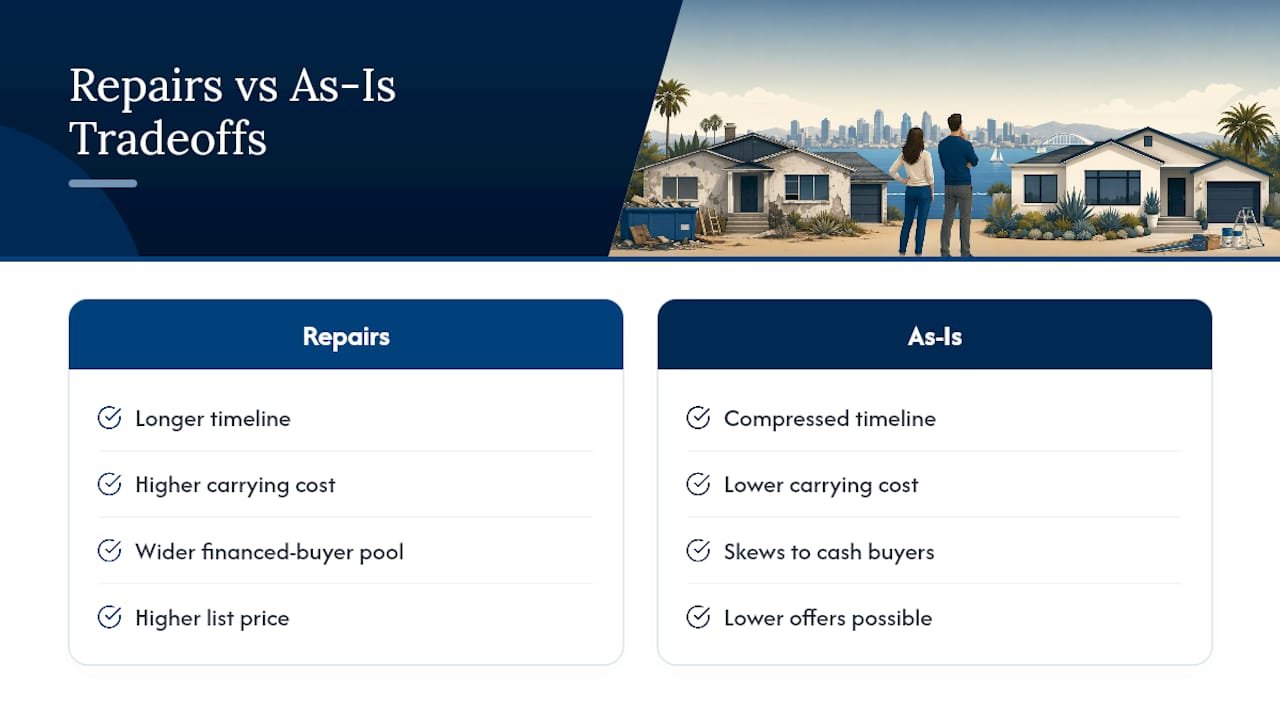
Liquidity works both directions too. A repaired home appeals to a wider financed-buyer pool, which sounds like an advantage until you remember that more buyer competition doesn’t guarantee a faster close, since financed deals move slower than cash offers regardless of condition. As-is sales skew toward cash buyers and investors precisely because they can close in weeks, not months, sidestepping appraisal contingencies that sink slower, financing-heavy deals.
The honest answer is that neither path is free. Repairs trade time and cash for a bigger buyer pool and a higher list price. As-is trades price for speed and certainty. Your specific carrying costs, market inventory, and personal timeline decide which trade is worth making, not a general rule that applies to every seller.
Author Checklist: Fast Answers for Common Seller Situations
Inherited a property or managing it from out of state? Selling as-is is usually simplest. Get a CMA and a cash-offer comparison first. Facing a job move or financial pressure? As-is cuts carrying costs fast. Only minor cosmetic issues? Make the targeted repairs. Major structural or safety problems? Either sell as-is to investors or fix only the safety items.
— Ryan Case
If You Want Help: Services and Next Steps
Running the net-proceeds math yourself is doable, but most sellers get a sharper answer with a second set of eyes on the comps and bids. That’s the gap some experienced agents fill for sellers deciding between as-is and repairs.

The Premier Selling System pairs a data-backed CMA with targeted marketing, including Zillow Showcase exposure and access to an existing buyer database, so you’re pricing against real numbers instead of a guess. Sellers who need speed and certainty more than a bidding war can look at the Guaranteed Home Sale program, while anyone facing a tight window should see how the 6 to 10 week sale timeline compares to a full renovation cycle. If your home needs work you’re not sure is worth doing, a service like Fix. Move. Haul.’s listing-prep offerings can also help with cleanout and staging prep before repairs are finalized. Request a no-obligation home analysis through Ryan Case to get repair bids, comps, and a real net-proceeds comparison for your specific property before you decide.
Sources
- How to Sell a House As-Is When it Needs Repairs | Zillow
- 2025 Remodeling Impact Report | NAR
- Lead Safe Housing Rule and EPA RRP guidance | HUD
- As Is Sales Contract: What It Means for Buyers and Sellers – LegalClarity
FAQ
Is It Better to Sell Your Home As-Is or Fix It Up?
It depends on whether the repair cost is less than the price increase it creates, after commissions and carrying costs. A pre-listing inspection and contractor bids give you the real numbers instead of a guess.
How Much Less Does an As-Is House Sell For?
There’s no fixed discount. The gap depends on the property’s actual condition, local comps, and how much buyer uncertainty the listing carries, since risk pricing often matters more than the repairs themselves.
Is It Wise to Sell a House As-Is?
It can be the smarter move when carrying costs, timeline pressure, or the property’s condition make repairs a poor investment. Fixing only safety and deal-killing issues while selling the rest as-is often beats both extremes.
What Is the 30% Rule for Renovations?
A repair-by-repair net-proceeds calculation, using real bids and comps, gives a far more reliable answer for your specific home.
Does Ryan Case Help With the As-Is vs Repairs Decision?
Yes. Ryan Case builds a CMA-based net-proceeds comparison for San Diego sellers weighing repairs against an as-is sale, using targeted marketing tools like Zillow Showcase. Pricing details for the Premier Selling System and other service tiers are available directly on the Ryan Case website.