If you own a home priced between $1.25 million and $2 million, list now: that band is moving fast and favors sellers. If you are under $750,000, timing matters less than pricing it correctly from day one, since slower-moving bands reward precision over patience. Check the decision checklist below before you commit to a date.
TL;DR:
- Homes priced between $1.25 million and $1.5 million are selling faster, averaging 78 days since September 2026, compared to the county average of 106 days.
- Listing in late May to early June is optimal for inland and suburban areas, while coastal neighborhoods may stay active through midsummer.
- Entry-level homes under $750,000 tend to take around 119 days to sell, making precise pricing from the start crucial in this segment.
- Inventory levels and current sales activity in your specific price band matter more for timing than seasonal trends or broad market conditions.
- Effective timing depends on local demand, mortgage rates, and regional developments, requiring continuous market check-ins before listing.
Table of Contents
- Best months and weeks to list in San Diego
- Local market signals: inventory and price-band performance
- Practical timeline and seller prep for San Diego listings
- Decision checklist and agent questions before you list
- Why agent strategy matters in timing
- How local demand, mortgage rates, and inventory affect timing
- Economic indicators and employment’s effect on selling timing
- Selling in a seller’s market versus a buyer’s market in San Diego
- Local developments and zoning changes that affect timing
- A straight answer on when to list
- How we help you time and execute your San Diego sale
- FAQ
- Sources
Best months and weeks to list in San Diego
Nationally, late spring into early summer is the strongest stretch for sellers, and San Diego mostly follows that pattern with a coastal twist. Local data and agent observations suggest listings in April can net a price premium of roughly 2.96% above the yearly average, and mild weather plus steady tourism can stretch strong buyer activity into July and August in coastal pockets that colder markets lose by June.
Nationwide, homes listed between May and July tend to sell in about 40 to 43 days and closer to asking price than winter listings, according to a 2026 market primer. Zillow’s research points to late May as a sweet spot nationally, with listings then earning a small premium of around 1.7% on average, though it notes West Coast metros often peak earlier than the rest of the country.
For San Diego sellers specifically, the practical guidance looks like this:
- Target late May through early June for inland and suburban neighborhoods where buyer activity mirrors the national pattern.
- Expect coastal and tourist-adjacent areas to stay active through midsummer, giving you a longer window than other regions.
- List on a Thursday when possible, since that timing has historically driven stronger weekend showing traffic.
- Avoid listing between Thanksgiving and New Year’s unless your price band is already moving fast, since buyer traffic drops sharply.
None of this overrides your specific zip code and price tier, which carry more weight than the calendar alone.
Local market signals: inventory and price-band performance
Seasonal timing only tells part of the story. What actually moves a listing in San Diego County right now is which price band it falls into.
Homes priced between $1.25 million and $1.5 million are selling in about 78 days, versus a county average of 106 days, according to the September 2026 market update. Entry-level homes under $750,000 are taking longer to sell, reflecting slower market activity in this price segment, and condos generally move slower than detached homes across every band.
That gap changes how you should approach your sale depending on where your home sits:
- Under $750,000: Price for the current market immediately rather than testing a higher number and waiting for offers, since slower absorption punishes overpricing more severely here.
- $750,000 to $1.25 million: Expect a moderate pace and lean on staging and marketing quality to stand out among a larger pool of competing listings.
- $1.25 million to $2 million: This is currently one of the healthiest bands in the county. List as soon as you are ready and price confidently, since faster absorption gives you room to hold firm on terms.
- Above $2 million: Fewer comparable sales mean pricing requires more judgment; lean on an agent who tracks this tier closely rather than relying on broad averages.
Thinner inventory in a given price band typically shifts negotiating leverage toward sellers on both price and terms, while a glut of similar listings pushes leverage back toward buyers regardless of the season. Checking where your specific band sits matters more than checking the calendar.
Practical timeline and seller prep for San Diego listings
A realistic prep-to-close timeline keeps you from rushing critical steps or missing your target window. Most San Diego sellers should plan on four to six weeks of preparation before the home ever goes live.
- Six weeks out: Schedule a pre-listing inspection, line up any repairs, and start decluttering room by room.
- Four weeks out: Book professional photography and confirm staging, since both directly affect how buyers respond to listing photos.
- Two weeks out: Finalize seller disclosures and pricing strategy with your agent based on the most recent comparable sales.
- Week of listing: Confirm showing availability and plan for a Thursday launch where your schedule allows.
- First two weeks on market: Expect the bulk of serious showings and offers, especially in faster-moving price bands.
Homes in the $1.25 million to $1.5 million band are currently closing in around 78 days total from list to sale, while entry-level listings under $750,000 should plan closer to 119 days. If you are working around a school year or a military transfer date, count backward from your move date using your band’s typical timeline rather than a generic 30-day estimate.
Pro Tip: Order your pre-listing inspection before you schedule photography, since unexpected repairs can push your listing date and waste a photo shoot that no longer matches the home’s condition.

Decision checklist and agent questions before you list
Before you set a listing date, pull together a short set of facts about your exact micro-market rather than relying on county-wide averages.
- Check current active inventory in your neighborhood and zip code, not just the county figure.
- Review recent pendings and closings in your exact price band from the last 30 to 60 days.
- Confirm your target close date and how much flexibility you actually have.
- Assess your readiness for showings, including repairs, staging, and decluttering.
The single number worth tracking closely is your local inventory-to-demand ratio within your specific zip code and price band, since that ratio predicts your outcome far better than the broader county trend.
When you interview a listing agent, ask these questions directly and explore strategies like those detailed in Winning Listings in a Competitive Real Estate Market:
- What have comparable homes in my exact price band sold for in the last 60 days, and how long did they take?
- What does your marketing plan look like beyond putting the listing on the MLS?
- What days-on-market should I realistically expect for a home like mine?
- Can you show recent sale price premiums you have achieved for similar sellers?
Straight answers to these four questions tell you more about timing than any seasonal chart.
Why agent strategy matters in timing
Timing advice only goes so far without execution behind it. Through our selling system, we combine strategic pricing, targeted marketing, and a buyer database to help reduce time on market and support stronger sale prices, regardless of exactly which week a home goes live. A strong agent also reads your specific comps and demand signals, then adjusts the listing date recommendation accordingly rather than defaulting to a generic calendar rule.
When you evaluate any agent’s claims, ask for the specifics behind them.
Proof worth asking for includes recent local sale price data, actual days-on-market figures for comparable homes, and real examples of the marketing used on those listings.
— Ryan Case
How local demand, mortgage rates, and inventory affect timing
Three forces interact to set your actual timing window: how many buyers are shopping, what mortgage rates are doing, and how much competing inventory sits in your price band. When mortgage rates ease even slightly, buyer activity tends to pick up quickly in San Diego, since many buyers who were priced out start qualifying again. That shift can compress days-on-market in bands that were previously sluggish.
Inventory works the other direction. A band with few active listings, like the $1.25 million to $1.5 million tier currently selling in about 78 days, gives sellers more leverage because buyers have fewer alternatives to compare. A band flooded with similar homes forces sellers to compete harder on price, staging, or concessions.
Demand itself is seasonal but also reactive. Rate announcements, local job news, and even school calendars can shift buyer urgency week to week. The practical takeaway is that you should check your specific zip code’s current inventory and recent pending sales shortly before you list, rather than relying on a forecast made months earlier. Conditions in San Diego can shift faster than a quarterly report captures, especially in narrower price bands where only a handful of sales set the tone.
Economic indicators and employment’s effect on selling timing
San Diego’s economy leans heavily on military, biotech, and tourism employment, and shifts in any of those sectors ripple into housing demand faster than in more diversified metros. Hiring trends at major local employers can change how many qualified buyers are actively shopping in a given price band within a matter of months.
Broader economic indicators matter too. When mortgage rates trend downward, affordability improves and buyer pools widen, often most noticeably in the entry-level and mid-tier bands where monthly payment sensitivity is highest. When local job growth slows or stalls, buyer confidence softens first in higher price tiers, where purchases are more discretionary and buyers have more room to wait.
For sellers, the practical implication is to watch local employment headlines alongside national rate news rather than either one alone. A rate dip paired with strong local hiring numbers tends to support faster sales across most bands. A rate dip during a local hiring slowdown may not translate into the demand bump you would expect from national coverage alone. Checking recent pending sales in your band remains the most direct way to see whether these broader forces are actually showing up in buyer behavior near you right now.
Selling in a seller’s market versus a buyer’s market in San Diego
San Diego does not move as one uniform market. Within the same month, one price band can behave like a seller’s market while another behaves like a buyer’s market, which is why county-wide averages can mislead you.
In a seller’s market, defined by low inventory relative to buyer demand, you typically have room to hold firm on price, request fewer concessions, and set a shorter response window for offers. The $1.25 million to $1.5 million band currently fits this description, with homes selling in roughly 78 days against a county average of 106.
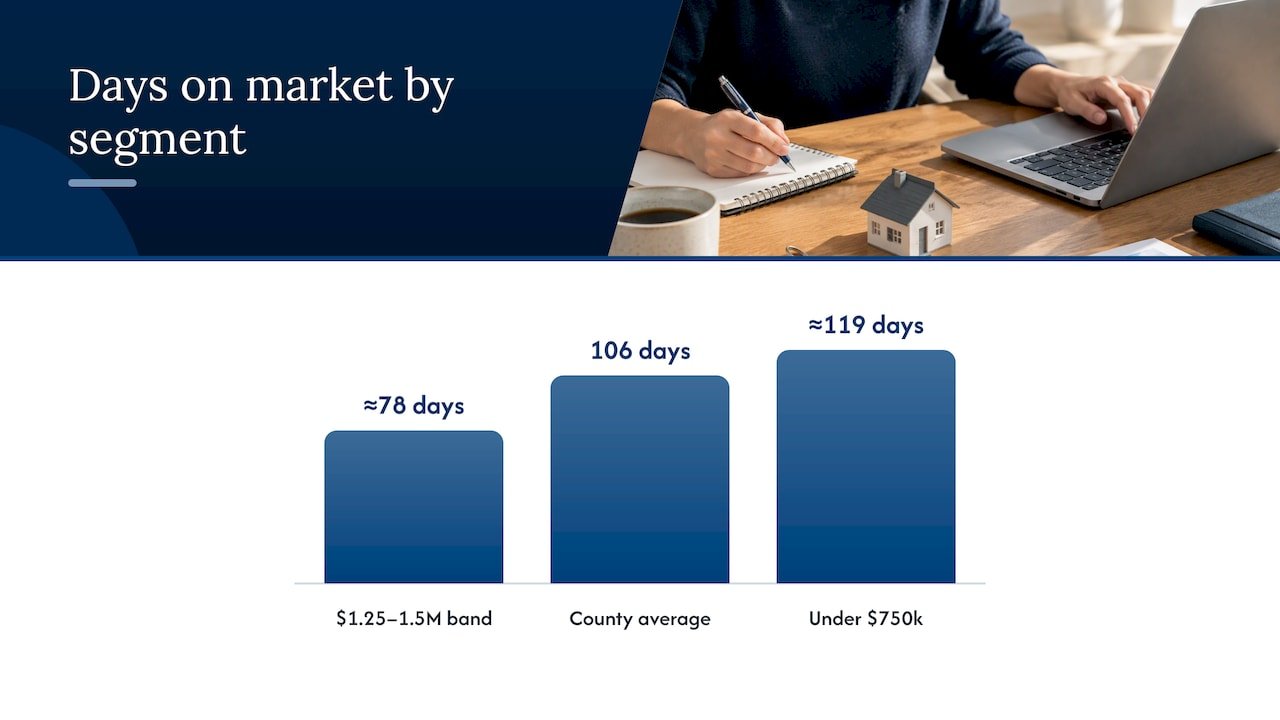
In a buyer’s market, where inventory sits longer relative to demand, pricing accuracy becomes the deciding factor rather than negotiating leverage. Entry-level homes under $750,000 currently fit closer to this pattern, with average days-on-market near 119. In that environment, overpricing even slightly can cost you weeks on market and eventually force a price cut that nets less than pricing correctly from the start.
The practical move is to identify which type of market your specific band and zip code reflect right now, then set expectations around concessions, response time, and listing price accordingly, rather than assuming the county’s overall tone applies evenly to your situation.
Local developments and zoning changes that affect timing
Planned infrastructure, transit expansions, and zoning updates can shift buyer interest in specific San Diego neighborhoods well before the projects are finished. A new transit line, a rezoning that allows higher density, or a major retail or employment development nearby can increase buyer demand in surrounding blocks, sometimes noticeably faster than citywide trends would suggest.
The effect can run in either direction depending on timing. Listing before a widely anticipated improvement is completed sometimes means missing the demand bump that follows its opening, while listing too far in advance of a disruptive project, like extended nearby construction, can suppress showings and offers in the short term.
If you know of a zoning change or development planned near your property, it is worth discussing with your agent before setting a listing date, since the right timing can differ from the seasonal guidance that applies to the broader market. For a closer look at how these local shifts are playing out across the county this year, our San Diego 2026 market forecast breaks down neighborhood-level trends in more depth.
A straight answer on when to list
Most sellers overweight the calendar and underweight their own price band. I generally advise listing now when a seller’s band is already moving quickly and the home is ready, and I advise a short delay only when prep work or a specific local signal, like a pending development, points to a better window within weeks, not months.
Strong negotiation and targeted marketing can offset a less-than-ideal month far more than most sellers expect. If you want a direct read on your specific timing, a market consult settles it faster than guessing.
— Ryan Case
How we help you time and execute your San Diego sale
We match the service to your goal rather than pushing one path for every seller. If top dollar matters most, our selling system combines strategic pricing, targeted marketing, and buyer database access to work toward a stronger sale price. If you are working against a hard deadline, a guaranteed sale service can offer pricing certainty even outside the seasonal peak. If you prefer to handle most of the process yourself, a paperwork-only service covers the essentials without full-service marketing.

A free local market analysis is the fastest way to see where your home’s price band and zip code actually stand right now. Start with a market consultation and get a straight answer on timing before you set a listing date.
This article is general information, not a substitute for advice from a qualified financial advisor. Consult a qualified financial professional about your own circumstances before acting on anything here.
FAQ
Is the San Diego housing market slowing down?
Conditions vary sharply by price band rather than slowing uniformly. County data shows the $1.25 million to $1.5 million tier moving in about 78 days while entry-level homes under $750,000 average around 119 days, so the right answer depends on your specific band.
What is the hardest month to sell a house?
Winter months, particularly between Thanksgiving and New Year’s, are generally the slowest nationwide because buyer traffic drops as schedules fill with holidays. San Diego’s milder climate softens this effect somewhat, but demand still typically dips compared to the spring and summer peak.
Will the housing bubble burst in 2026?
No credible source data in this article points to a bubble or a crash scenario for San Diego in 2026. What local data does show is uneven performance across price bands, with some tiers moving quickly and others, like entry-level homes, taking considerably longer to sell.
Which week in 2026 is the best to sell a house?
National research points to late May through early June as a strong window, with listings then historically earning a small premium. In San Diego, that window generally holds for inland neighborhoods, while coastal areas often stay active later into summer.
How much does it cost to sell a home in San Diego?
Costs vary by the service tier you choose and typically include agent commission along with closing costs. Our seller closing cost guide breaks down what San Diego sellers can expect to budget beyond commission.
Sources
- San Diego Housing Market Update — September 2026
- When Is the Best Time to Sell a House in San Diego, California?
- When Is The Best Time to Sell Your House? | Zillow
- Best Time to Sell a House in 2026