Saves are the stronger lead indicator, not views. A listing pulling 5 saves a day tends to land an offer within about a week, while raw view counts mostly measure curiosity, not intent. Watch your save-to-view ratio, compare it against Zillow’s published benchmarks, and use it to decide whether the problem is your price, your photos, or your exposure.
TL;DR:
- Listings with five saves per day typically receive offers within a week, and ten or more saves often lead to higher-than-asking sale prices.
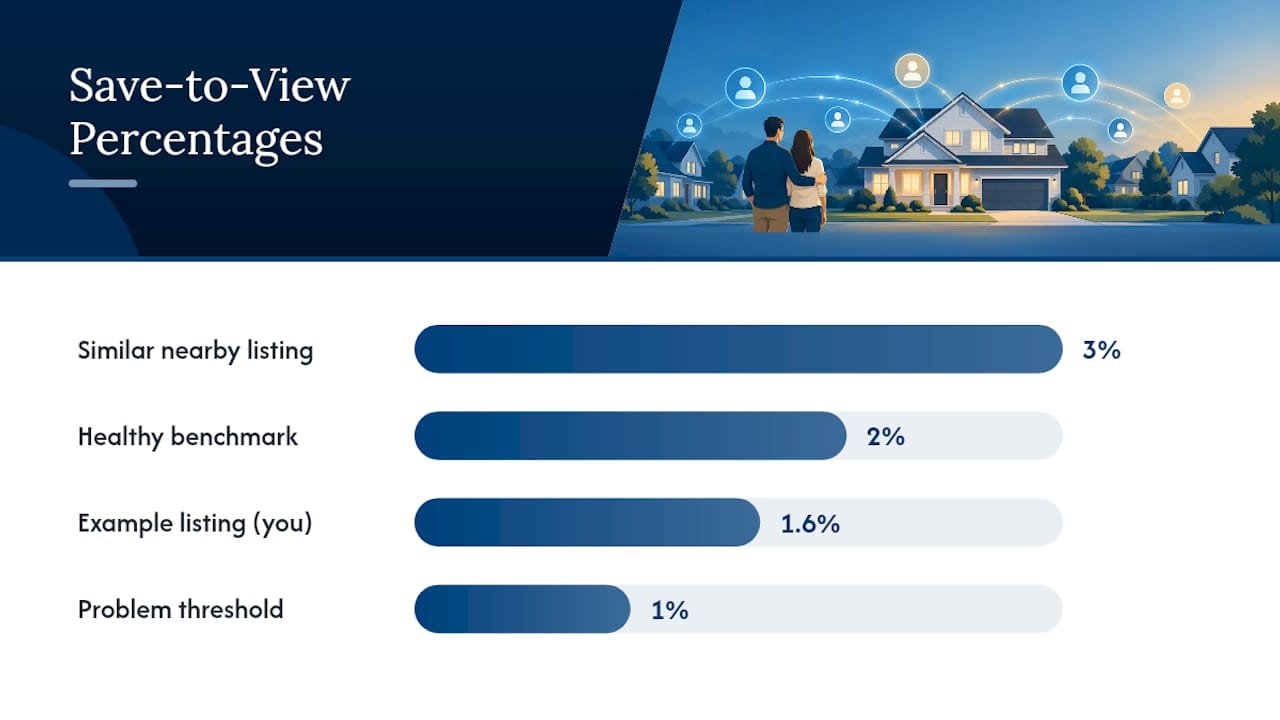
- A save-to-view ratio above 2 percent indicates healthy buyer interest, while anything under 1 percent suggests the listing may be pushing buyers away post-click.
- Fixing presentation elements like photos and descriptions can significantly improve save rates when views are high but saves remain low.
- Traffic numbers fluctuate within the past 30 days and may decrease over time without any listing changes, influenced by viewer behavior and listing activity.
- Comparing interest metrics against local benchmarks and making strategic adjustments can turn online engagement into actual offers.
Table of Contents
- Zillow Views Vs Saves: What The Benchmarks Actually Show
- What Do Views, Saves, and Shares Actually Measure?
- How Do You Calculate Your Save-to-View Ratio?
- Your Listing Has Views but Few Saves: What to Fix First
- Why Do My Zillow Views and Saves Keep Changing?
- How One San Diego Agent Tracks These Signals in Practice
- When to Trust the Data and When to Trust Your Gut
- Ready to Turn Your Zillow Numbers Into a Real Offer?
- Sources
- FAQ
Zillow Views Vs Saves: What The Benchmarks Actually Show
Zillow’s own research team ran the numbers on this, and the pattern holds up. Listings averaging around 250 views a day typically go to pending within roughly a week, and homes clearing 500 daily views often close above list price, according to Zillow’s analysis of views, saves, and shares. Saves tell an even sharper story: hitting 5 saves a day lines up with getting an offer inside a week, and 10 or more saves a day correlates with selling above asking.
Zillow built these numbers by tracking daily averages over a listing’s first seven days, or until it went pending, then sorting listings into buckets and measuring the typical days-to-pending and sale-to-list ratio for each one. That’s a meaningful sample: Zillow’s reach spans hundreds of millions of monthly visits, which is part of why the Zillow Buzz Index can isolate which listing phrases and features actually move engagement.
| Daily activity | Typical outcome |
|---|---|
| Under 25 views/day | Weak buyer interest, likely to sit |
| ~250 views/day | Often pending within about a week |
| 500+ views/day | Frequently sells above list price |
| ~5 saves/day | Associated with an offer in about a week |
| 10+ saves/day | Linked to selling above list price |
A few things worth flagging about that data:
- Zillow’s buckets run wide, from fewer than 25 daily views to more than 2,000, so your listing’s bucket matters more than the raw number alone.
- Shares carry more weight than either views or saves because forwarding a listing to someone else takes real conviction.
- Zillow averages activity over 7 days rather than a single spike, which smooths out one-off traffic bumps from a new listing alert.
What Do Views, Saves, and Shares Actually Measure?
Think of buyer interest as a ladder. An impression means your listing showed up in someone’s search results. A view means they clicked in. A save means they bookmarked it to look at again. A share means they sent it to someone else, usually a spouse or an agent. Each rung up that ladder demands more effort from the buyer, and more effort means more genuine intent.
That’s exactly why raw view counts get noisy. Your own neighbor checking the listing out of curiosity counts as a view. So does someone who clicks in by accident while scrolling, or the seller themselves refreshing the page to check on things. None of that reflects real buyer demand.
Saves filter out most of that static. Nobody bookmarks a house they don’t care about. A few patterns worth knowing:
- Views spike hardest in the first 24 to 48 hours after listing, largely from saved-search alerts, then taper fast.
- Saves accumulate more slowly but hold steadier value as a signal over the following weeks.
- A listing with high views and flat saves usually means the photos or price are turning people away after the click, not before it.
How Do You Calculate Your Save-to-View Ratio?
Divide total saves by total views over the same window, ideally the first 7 days, since that’s the timeframe Zillow itself uses for benchmarking. Multiply by 100 to get a percentage.
- Pull your total views and total saves for the same 7-day stretch from your Zillow owner dashboard.
- Divide saves by views, then multiply by 100 to express it as a percentage.
- Compare that number to similar listings in your area, adjusting for price point and property type.
A rough rule of thumb: a save-to-view ratio above roughly 2% signals healthy interest, somewhere near 1% is borderline and worth watching, and anything meaningfully under 1% usually means something is actively pushing buyers away after they click in.
Say your listing pulled 1,400 views and 22 saves in its first week. That’s a 1.6% ratio, borderline but not alarming. If a similar home three blocks over is running 3% with a comparable price, that gap is your cue to dig into photos, description, or price before the listing goes stale.
Pro Tip: Recalculate your save-to-view ratio every time you make a change, using the same 7-day window logic. Comparing a fresh 3-day snapshot to an older 7-day average will give you a false read.
Your Listing Has Views but Few Saves: What to Fix First
Strong views with weak saves means people are clicking in and leaving unconvinced, a scenario where it’s worth considering selling strategies and presentation tips to improve your home’s appeal. Presentation is almost always the first suspect. Start here:
- Check your cover photo. It’s the single biggest factor in whether someone clicks through in the first place, and a weak one caps your views before saves ever enter the picture.
- Audit the full photo set for lighting, staging, and order. Professional photography consistently outperforms phone shots on engagement.
- Add a floor plan if you don’t have one. Buyers save listings they can mentally walk through.
- Reread your listing description for anything that reads like a warning label rather than a selling point.
If saves stay flat after fixing presentation, the price is probably the real issue, and that’s a conversation worth having against actual comps rather than an automated estimate. Exposure tactics can also help once presentation is solid: Zillow Showcase placement, a targeted social push, an email blast to a buyer list, or a timed open house can all lift saves fast. Give any change 3 to 7 days before you re-measure, since that’s roughly the window Zillow itself uses to judge a shift meaningful.
Why Do My Zillow Views and Saves Keep Changing?
Zillow displays activity from only the most recent 30 days, not the listing’s full lifetime, according to the Zillow Help Center. That means your numbers can drop even when nothing about the listing changed, simply because an early traffic spike has rolled out of the window.
- Saves can shrink when buyers remove a home they’ve already ruled out, a behavior Zillow calls an un-save.
- Views can be inflated by repeat visits, accidental taps, or the seller’s own checking.
- Time on Zillow generally doesn’t reset just from toggling a listing off market briefly, per Zillow’s guidance, so don’t assume a quick relist buys you a clean slate.
How One San Diego Agent Tracks These Signals in Practice
An agent checks save-to-view ratios as part of a selling system, treating a flat ratio as a trigger for action rather than something to wait out. A typical sequence looks like this: swap the lead photo and reorder the gallery, run a 48 to 72 hour exposure push through Zillow Showcase or targeted social, then re-measure the save rate before touching price.
A listing that gets clicks but no saves isn’t a traffic problem. It’s a conviction problem, and conviction comes from what buyers see in the first three photos, not from more eyeballs.
That sequencing matters because it isolates the variable. Fix photos first, measure, then talk price if saves still lag.
When to Trust the Data and When to Trust Your Gut
Engagement numbers should start a conversation, not end one. A flat save-to-view ratio might mean weak photos, or it might mean three other listings on your street just dropped their price. Local comps and a recent inspection finding can override what the dashboard says every time. The best use of these metrics is timing: knowing when to make a move, not treating a percentage as gospel.
— Ryan Case
Ready to Turn Your Zillow Numbers Into a Real Offer?
Most sellers stare at their Zillow dashboard wondering if a number is good or bad, with nobody to compare it against. Ryan Case built the Premier Selling System around exactly that gap: real-time save-to-view benchmarking paired with the pricing and exposure moves that actually shift those numbers, aiming for 5 to
higher sale prices in less time on market.

That starts with a free seller analysis that walks through your listing’s current engagement against comparable homes nearby, and where Zillow Showcase placement or a presentation refresh could close the gap. If your home is already getting traffic but not saves, that conversation usually pays for itself. Get your free home analysis and Premier Selling System started, or read more about how Zillow Showcase fits into the pricing and exposure plan.
Sources
- The Impact of Zillow Views, Saves and Shares on the Price and Speed of a Home Sale – Zillow Research
- Why are the views and saves for my home’s listing declining? – Zillow Help Center
- The Best Zillow Tips for Home Buyers and Sellers | PCMag
FAQ
Are Zillow Views and Saves Accurate?
They’re accurate as a 30-day snapshot, not a lifetime total, so a raw number without context can mislead you. Compare your ratio against similar listings rather than judging a single figure in isolation.
What’s a Good Save-to-View Ratio on Zillow?
A ratio above roughly 2% generally signals healthy interest, while anything under about 1% is worth investigating. Zillow’s own benchmarks tie 5 saves a day to receiving an offer within about a week, per Zillow Research.
Why Do I Have Lots of Saves but No Showings?
Saves show interest, but a stalled price or a listing agreement that limits showing flexibility can stall the next step. Check your comps and confirm your showing instructions are current before assuming the metric is wrong.
Do Zillow Views and Saves Reset?
They don’t reset in a hard sense, but the displayed count reflects only the most recent 30 days, so older activity naturally rolls off according to Zillow’s Help Center. Relisting or toggling off market briefly typically doesn’t reset Time on Zillow unless the home is off market for 31 or more consecutive days.