A short “coming soon” window of about one to two weeks is worth running if your San Diego home needs final prep or your agent has a real outreach plan lined up. It backfires when it drags on with no set end date, since homes marketed only through smaller private networks sell for less and slower than those with full MLS exposure. Done right, it buys you time to finish staging, book professional photos, and line up buyer interest before a coordinated public launch.
TL;DR:
- Properly filed coming soon listings in San Diego should last between one and two weeks, with a firm go-live date set before the campaign begins.
- Compliance with MLS rules is crucial, as public marketing before proper filing can lead to permanent exclusion from major portals like Zillow.
- During the coming soon phase, agents should actively track broker previews, showing requests, and buyer engagement, using real signals for scheduling the public launch.
- Homes needing finishing touches or priced for testing are ideal for coming soon, while high-demand or urgent-sale homes benefit more from immediate active listing exposure.
- Transition from coming soon to active should be seamless, with final price, professional marketing materials, and showings confirmed before the official launch.
Table of Contents
- What “Coming Soon” Pre-Market Listing Means for San Diego Sellers
- How to Run a 7 to 14 Day Coming Soon Campaign
- Which San Diego Homes Are Good Fits for Coming Soon?
- Legal and Disclosure Rules for San Diego Coming Soon Listings
- What Happens If You Don’t Follow MLS Rules
- Managing Seller Expectations During the Coming Soon Phase
- Reading the Signals: When to Adjust Before Full Launch
- Moving From Coming Soon to a Full Active MLS Listing
- How Ryan Case Applies Coming Soon Inside the Premier Selling System
- Work With Ryan Case to Run Your Coming Soon Launch
- Sources
- FAQ
What “Coming Soon” Pre-Market Listing Means for San Diego Sellers
A coming soon listing is filed with the local Multiple Listing Service but held back from public syndication to Zillow, Redfin, and other portals. Agents can see it, tour it, and pitch it to buyers in their pipeline. The public cannot find it on portals via search yet.
That’s a different animal than a social media teaser post announcing a home “coming soon” with no MLS filing behind it, and it’s a different animal than a true off-market pocket listing that never hits the MLS at all. The distinction isn’t cosmetic. The National Association of Realtors has clarified that local MLSs set their own rules for delayed marketing under frameworks like Clear Cooperation and the Multiple Listing Options for Sellers policy. Filing correctly with your MLS keeps you compliant. Skipping the filing and marketing publicly anyway is where sellers get into trouble, both with their MLS and with portals that penalize the practice.
How to Run a 7 to 14 Day Coming Soon Campaign
The single most important decision you make before signing anything is the go-live date. Practical pre-marketing guides recommend committing to a firm transition date before the coming soon period starts, not “whenever it feels ready.” Open-ended coming soon periods are exactly what invite the buyer pool problems described below.
Here’s a workable sequence for a San Diego home:
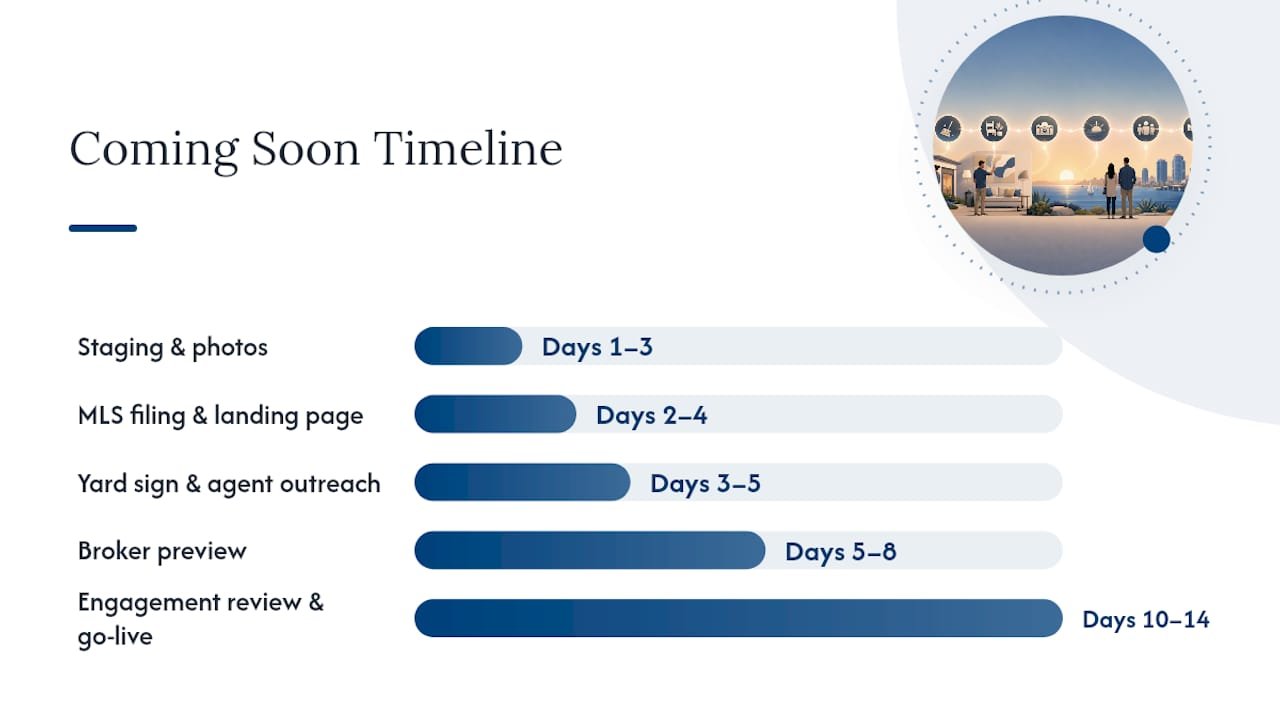
- Days 1 to 3: Finish staging and any quick repairs. Book professional photography, ideally with twilight or drone shots if the property has views.
- Days 2 to 4: File the coming soon status with your MLS and build a simple landing page buyers and agents can reach directly.
- Days 3 to 5: Put up a yard sign with a QR code linking to that landing page, and start direct email outreach to agents with active buyers in your price range.
- Days 5 to 8: Schedule a broker preview so local agents can walk the home before it’s public.
- Days 6 to 10: If it fits your situation, use a tool like Zillow Preview to test buyer interest early, gathering view counts, saves, and tour requests as real signal.
- Days 10 to 14: Review engagement data with your agent, adjust price if the numbers say so, and confirm the go-live date for full MLS syndication.
If the pre-marketing period produces strong traffic, some agents recommend setting a short offer deadline shortly after public launch to convert that early interest into competing offers rather than letting it fizzle.
Pro Tip: Track every showing request and every agent inquiry in a simple spreadsheet during the coming soon window. If you’re getting fewer than two or three qualified touches by day 7, that’s your signal to rethink price or marketing before you go fully public, not after.
Which San Diego Homes Are Good Fits for Coming Soon?
Coming soon works best for homes that need a few more days of prep, not homes that are already market ready and priced right. If your kitchen needs staging furniture, your landscaping needs a trim, or you’re waiting on a final repair estimate, a short pre-market window lets your agent build interest while those pieces come together.
It also suits sellers who want to test a price point without the visible “days on market” clock starting. A home priced at the upper edge of its comp range benefits from broker feedback and early buyer reaction before it’s exposed to the general public, where a price cut after 30 days can look like desperation.
Coming soon is a weaker fit for homes in high-demand San Diego neighborhoods where buyer competition is already intense at listing. If your home is going to draw multiple offers within days of going live anyway, delaying that exposure just costs you time. It’s also a poor fit for sellers in a genuine hurry. A distressed timeline, a job relocation with a hard deadline, or a probate sale needing quick resolution usually calls for going straight to active status rather than layering in a pre-market runway.
Move-in ready homes in competitive coastal or North County submarkets, and homes needing one to two weeks of finishing touches, are the two clearest qualification profiles.
Legal and Disclosure Rules for San Diego Coming Soon Listings
San Diego sellers work through the San Diego MLS (part of the California Regional Multiple Listing Service network), and that MLS sets its own permitted delay window and disclosure requirements for coming soon status. Before you agree to any pre-market timeline, confirm with your agent exactly what your specific MLS allows, since rules on delay length and showing policy vary by MLS and change periodically as NAR and local boards update their Clear Cooperation guidance.
Seller consent has to be documented in writing. Your listing agreement should spell out that you’re authorizing a delayed-marketing period, for how many days, and what activities are permitted during that window, like broker previews and private showings. This isn’t paperwork for paperwork’s sake. It’s the record that protects you if a buyer’s agent later questions why the home wasn’t immediately visible to their client.
California’s standard seller disclosure obligations, including the Transfer Disclosure Statement and natural hazard disclosures, apply on the same timeline regardless of coming soon status. Coming soon doesn’t delay or change what you owe buyers in disclosures once you’re in contract. It only changes when and how broadly the listing is marketed before that point. Confirm with your agent whether your MLS requires the coming soon status itself to be entered into the MLS system, even though it isn’t syndicated publicly, since most California MLSs do require the filing.
What Happens If You Don’t Follow MLS Rules
Getting this wrong carries real consequences, not just an awkward conversation with your agent. Public marketing of a home before it’s properly filed with the MLS, think a Facebook post with photos and a price before any MLS entry exists, can trigger portal-level penalties. Zillow’s policies allow it to exclude a listing permanently from its site if the platform detects public marketing that skipped a compliant MLS filing.
That’s not a slap on the wrist. A permanent portal exclusion means your home never shows up on one of the largest home search sites in the country, for the life of that listing. There’s no appeal that reliably reverses it once it’s flagged.
On the MLS side, agents who violate Clear Cooperation or local delayed-marketing rules can face fines from their MLS and disciplinary action from their local Realtor association. As the buyer’s agent, that liability mostly falls on your listing agent, but it still disrupts your sale timeline if your listing gets pulled or re-filed mid-campaign while the issue gets sorted out.
The safest path is straightforward: file coming soon status correctly with your MLS from day one, keep every public-facing marketing piece limited to what your MLS permits during that phase, and get the go-live date in writing before you start. A five-minute conversation with your agent about your specific MLS’s rules costs you nothing. A portal exclusion costs you exposure to thousands of buyers.
Managing Seller Expectations During the Coming Soon Phase
The biggest source of frustration during a coming soon period isn’t the strategy itself, it’s sellers expecting portal-level traffic during a phase that’s designed to be quieter by definition. Set that expectation on day one: you will not see Zillow saves and Redfin views piling up during coming soon, because the home isn’t syndicated there yet. What you should see is agent inquiries, broker preview attendance, and direct showing requests.
Ask your agent for a specific reporting cadence before the campaign starts. A daily or every-other-day update covering showing requests, agent feedback on price and condition, and any early offers keeps you informed without turning into a distraction. If your agent can’t tell you how many agents attended the broker preview or what feedback came back on price, that’s a gap worth flagging immediately, not after the full launch.
Coming soon works only when it’s used actively, meaning your agent is calling other agents, tracking who’s interested, and adjusting the plan based on what comes back. A passive coming soon listing that just sits there with a sign in the yard isn’t a strategy, it’s a delay with no payoff. Ask directly what outreach happened this week and to whom.
Also agree upfront on what would trigger an early public launch. If interest is strong by day 5, do you go live early to capture momentum, or hold the full 14 days? Deciding that in advance, rather than in the middle of a promising week, keeps the decision level-headed instead of reactive.
Reading the Signals: When to Adjust Before Full Launch
Engagement during coming soon tells you things a listing description never will. Track three numbers specifically: broker preview attendance, direct showing requests, and, if you’re using a tool like Zillow Preview, saved-home and tour-request counts during that early exposure window.
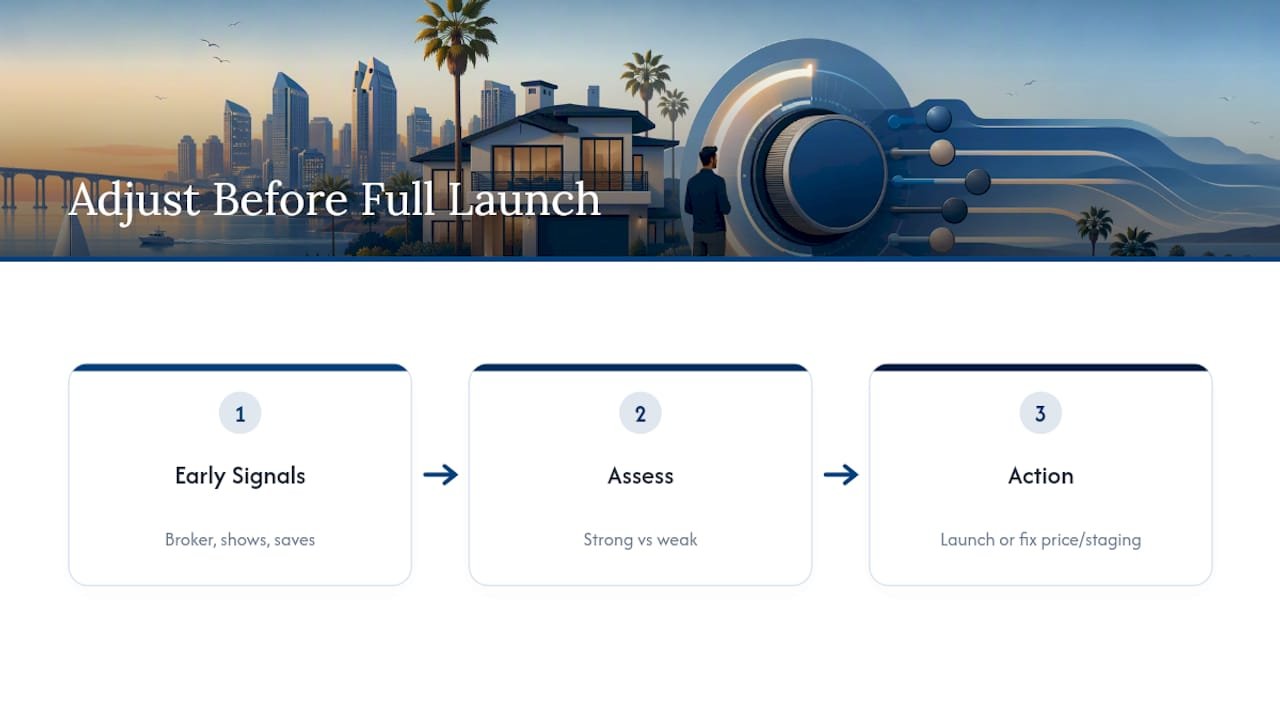
Strong numbers across the board, several agent-led showings, multiple saves, early verbal interest, suggest your pricing and presentation are working and you can launch on schedule with confidence, possibly even setting a short offer deadline right out of the gate. Weak numbers tell a different story, and they usually point to one of two causes: price or presentation.
If broker feedback consistently mentions price as a sticking point, that’s your clearest signal to adjust before the home goes fully public. A price correction during coming soon, when the “days on market” clock hasn’t started for public buyers, costs you far less credibility than a public price cut three weeks into an active listing. If instead feedback centers on condition or staging, that points back to the prep work rather than the number on the sign.
The mistake to avoid is waiting out the full 14 days on hope rather than data. If day 7 shows no agent interest and no showing requests at all, that’s not a reason to wait it out, it’s a reason to call your agent and rework the plan immediately.
Moving From Coming Soon to a Full Active MLS Listing
The transition itself should be almost invisible if the coming soon phase was run well. On the pre-agreed go-live date, your agent updates the MLS status from coming soon to active, which triggers syndication to Zillow, Redfin, Realtor.com, and every other portal your MLS feeds.
Before that flip happens, confirm three things are locked in: final list price, based on whatever adjustments came out of your coming soon feedback, all photography and marketing materials finalized and loaded, and showing instructions updated for the public phase, since broker-only previews often run on different access rules than open public showings.
Once the listing goes active, expect a fast shift in traffic and pace. Homes that generated strong coming soon interest often see that translate into showings and offers within the first few days of going live, sometimes fast enough to justify the short offer deadline mentioned earlier. Homes with weak coming soon signal that launch without adjustment tend to repeat the same quiet response publicly, just with a visible “days on market” counter now ticking against them.
Coordinate the announcement, too. A same-day social post, MLS syndication confirmation, and any planned open house should all line up with the go-live date rather than trickling out over several days, which dilutes the sense of a coordinated launch buyers respond to.
How Ryan Case Applies Coming Soon Inside the Premier Selling System
Inside the Premier Selling System, a coming soon runway isn’t a passive waiting period. It’s paired with targeted outreach to Ryan Case’s buyer database, tools like Zillow Showcase for presentation, and Zillow Preview data to track real engagement before setting the final list price. Every showing request and every piece of broker feedback gets used to sharpen pricing ahead of the public launch, not after it.
— Ryan Case
Work With Ryan Case to Run Your Coming Soon Launch
Running a coming soon campaign well means juggling MLS filings, broker outreach, photography timing, and pricing decisions, all inside a two-week window with no room for guesswork. Ryan Case handles that entire sequence directly, combining the Premier Selling System’s strategic pricing approach with tools like Zillow Showcase and a working buyer database, rather than leaving you to coordinate photographers, signage, and agent emails on your own.

For homes that need a couple weeks of prep before launch, the Full Service Listing tier manages staging coordination and the broker preview process alongside the coming soon filing itself. Sellers who want price certainty going in can also look at the Guaranteed Sale Program, which removes the uncertainty of an open-ended timeline entirely. If your San Diego home might be a fit for a short, well-run coming soon runway, start with a home analysis at Ryan Case to see what timeline and pricing strategy makes sense for your property.
Sources
- Coming-soon was a good idea. What we’ve done to it isn’t. (Inman)
- Zillow Preview: Launch your home early with confidence (Zillow)
- NAR releases statement on pre-marketing and coming-soon listings (NAR)
- Pre-marketing tasks (Builds and Buys)
FAQ
What Is a Coming Soon Listing in San Diego?
It’s a home filed with the local MLS but not yet syndicated to public portals like Zillow or Redfin, visible to agents while the seller finishes prep or builds buyer interest.
How Long Should a Coming Soon Period Last?
Most practical guides and agent practice point to about one to two weeks, with a firm go-live date set before the period starts rather than left open-ended.
Can Zillow Remove My Listing for Marketing It Wrong?
Yes. Zillow can permanently exclude a listing if it detects public marketing before a compliant MLS filing exists, so coming soon status needs to be entered in your MLS from the start.
Does Coming Soon Delay My Legal Disclosure Requirements?
No. California’s Transfer Disclosure Statement and hazard disclosures apply on the same schedule once you’re in contract, regardless of your pre-market timeline.
Who Should Handle My Coming Soon Campaign in San Diego?
An agent who actively works the phone and email during the window, tracking broker feedback and showing requests, gets far better results than one who simply posts a sign and waits; Ryan Case’s Premier Selling System is built around that active outreach model.
Pingback: Coming Soon: SDMLS Caps San Diego Listings at 30 Days in California