If your appraisal comes in under your offer price, you have four real paths forward: renegotiate the price with the seller, cover the shortfall with cash, request a Reconsideration of Value, or cancel the deal if you have an appraisal contingency. An appraisal gap coverage clause, if you added one at offer time, may already commit you to part of that shortfall. Either way, your lender will loan against the appraised value, not your offer, so the gap has to be closed in cash somewhere.
TL;DR:
- Buyers should verify the appraisal report thoroughly and confirm contingency deadlines before deciding on any action.
- A low appraisal often requires a quick decision to renegotiate, bring cash, dispute the appraisal, or walk away within a limited response window.
- An appraisal gap coverage clause obligates you to pay a set amount toward any shortfall, while an appraisal contingency protects your right to renegotiate or cancel.
- Different loan types respond to appraisal gaps uniquely, with conventional loans offering more flexibility than FHA, VA, or jumbo loans.
- Pre-offer research into market conditions and setting a firm maximum cash limit helps prevent surprises and strengthens your negotiation position.
Table of Contents
- Why an Appraisal Gap Costs You More Than It Sounds Like
- What to Do When the Appraisal Comes in Low, Step by Step
- Appraisal Gap Coverage Clause vs. Appraisal Contingency: Know the Difference
- Preparing Before You Offer So the Gap Never Catches You Off Guard
- An Agent’s Read on What Actually Moves Sellers
- Beyond Price: Concessions and Repair Credits That Can Close the Gap
- How the Gap Hits Different Loan Types Differently
- Appraisal Gap Strategy in Competitive Markets
- Why the Clock Matters as Much as the Number
- What I’d Tell You to Do in the Next 72 Hours
- Where to Read More on Appraisals and Contract Protections
- Sources
Why an Appraisal Gap Costs You More Than It Sounds Like
An appraisal gap is the difference between what you agreed to pay and what the appraiser says the home is worth. Say you offered $420,000 and the appraisal comes back at $400,000. Your lender doesn’t loan against your enthusiasm. It loans against the appraised value, full stop.
Once the appraisal lands at $400,000, the lender caps your loan around $360,000 (assuming the same loan-to-value ratio). To still buy the house at $420,000, you need more cash at closing than originally planned. That additional amount didn’t disappear. It just moved from “financed” to “due at closing.”
Lenders underwrite to whichever number is lower, purchase price or appraised value, never the higher one. That single rule is the reason appraisal gaps become cash problems instead of financing problems. It’s also why loan-to-value ratio, down payment size, and even private mortgage insurance thresholds can all shift the moment the appraisal number changes.
Timing makes this worse. Most contracts give the lender a few weeks to order and receive the appraisal, and your appraisal contingency typically has a limited response window after you receive the report. Miss that window and you may lose the right to renegotiate or cancel at all.
What actually happens in that window usually breaks down into a short list of moves:
- The buyer and seller renegotiate the price toward the appraised value.
- The buyer agrees to bring extra cash to bridge some or all of the gap.
- The buyer’s agent requests a Reconsideration of Value from the lender.
- The buyer exercises an appraisal contingency and cancels, if one exists and deadlines are met.
Every one of those has a cost, a timeline, and a level of leverage attached to it. None of them is automatic.
What to Do When the Appraisal Comes in Low, Step by Step
You generally have four workable options once the appraisal lands short: renegotiate, split the difference, bring more cash, dispute the number, or walk away. Which one makes sense depends on how big the gap is, how much cash you have left after closing, and how much the seller wants this deal to survive.
- Renegotiate the price down to the appraised value. Send the seller the appraisal report along with two or three stronger comparable sales your agent pulls, ideally ones closed within the last 90 days and within a half mile of the property. A workable script sounds like this: “The appraisal came in below our offer. We’d like to amend the price closer to the appraised value and move forward without further delay.” Sellers who are motivated, especially ones already under contract on their own next purchase, often accept something close to the appraised number rather than restart the whole search.
- Propose splitting the difference. If the seller won’t drop all the way to appraised value, offer to split the gap. On a $20,000 shortfall, that might mean you bring $10,000 in extra cash and the seller knocks $10,000 off the price. This works often enough to be a default counter, mainly because the seller knows the next buyer will likely hit the same appraisal wall, so relisting doesn’t guarantee a better outcome.
- Bring extra cash to close the gap yourself. Calculate this precisely before you agree to it. Take the shortfall, add any increase in required down payment to maintain your loan-to-value ratio, and add a buffer for post-closing reserves your loan program requires. A gap can become larger in cash due to reserve requirements and possible mortgage insurance adjustments. Never commit this cash without confirming your reserve minimums with your lender first.
- Dispute the value through a Reconsideration of Value. This is not a complaint process. An ROV succeeds when you bring objective evidence the appraiser missed, not when you simply disagree with the number. A workable ROV packet includes corrected facts (wrong square footage, an unlisted bedroom or garage), two to three stronger comparable sales the appraiser overlooked, MLS sheets, and subject property photos, submitted through your lender promptly and within your contingency window. Realistic expectation: this has a limited success rate and takes one to two weeks, so weigh that delay against your contingency deadline before you start.
- Walk away using your appraisal contingency. If your contract includes one, a low appraisal typically lets you cancel and recover your earnest money, provided you act within the stated deadline and put the cancellation in writing through your agent. Miss the deadline and you may forfeit that protection even if the contingency exists on paper.
Pro Tip: Before you counter the seller with anything, run the exact cash math first. Buyers who negotiate from “here’s what I can actually bring” instead of “let’s split it and figure it out later” close faster and lose less goodwill along the way.
Walking away is a legitimate option, but confirm your comparable market analysis actually supports it. A CMA pulled the same week can tell you fast whether the appraisal is an outlier or a fair read of the market.
Appraisal Gap Coverage Clause vs. Appraisal Contingency: Know the Difference
These two contract terms get confused constantly, and mixing them up can cost you real money. An appraisal contingency protects you. An appraisal gap coverage clause obligates you.
Appraisal contingency: This clause gives you the right to renegotiate the price or cancel the contract if the appraisal comes in below your offer, with your earnest money returned as long as you act inside the contract’s stated window. No contingency means no automatic exit if the number falls short.
Appraisal gap coverage clause: This is a promise, made at the time you write your offer, to pay a specific dollar amount toward any shortfall between the appraised value and the purchase price. It’s often used to make an offer more competitive in a multiple-offer situation because it tells the seller you’ll close even if the appraisal runs low, up to a defined cap.
The two aren’t mutually exclusive; plenty of contracts include both, with the coverage clause acting inside the contingency’s overall framework. Where buyers get hurt is drafting these carelessly:
- Never write a coverage clause cap you can’t actually fund without draining your closing reserves.
- State the cap in a clear dollar figure, not a percentage that gets confusing under pressure.
- Coordinate the cap with your lender ahead of time. Reserve requirements vary by loan program, and a cap that looks fine on paper can violate underwriting minimums.
- Remember that a coverage clause up to $15,000 does not protect you from a $30,000 gap. Above the cap, your original contingency rights, if you kept any, take back over.
Buyers who waive appraisal protection entirely to win a bidding war should only do so after confirming financing and reserves in advance, because waiving removes your exit ramp completely if the number comes in low.
Preparing Before You Offer So the Gap Never Catches You Off Guard
Most appraisal gap surprises are preventable. The work happens before you write the offer, not after the appraiser leaves.
- Pull your own comps before you decide on an offer price. Look specifically for outliers, homes that sold well above the neighborhood pattern due to a bidding war, cosmetic staging, or a rushed sale. If your offer is being built on an outlier, you’re setting yourself up for a gap.
- Request seller disclosures and any recent repair invoices. Appraisers factor in condition and recent upgrades. Documentation of a new roof or updated electrical can support a higher value; its absence can drag the number down.
- Consider a pre-offer valuation check. A broker price opinion or a professional comparable market analysis pulled before you write the offer gives you a second, independent read on where the number is likely to land, and it arms you if you later need to challenge the bank’s own appraisal.
- Decide your appraisal gap coverage cap before you’re under pressure to bid. Set a number you can genuinely fund without touching required reserves, and have that conversation with your lender before you’re in a multiple-offer situation at 9 p.m. on a Sunday.
- Confirm your contingency deadlines with your agent before signing. Know exactly how many days you have to respond once the appraisal report lands, and put a calendar reminder on it. A missed deadline can quietly convert into a waived right.
None of this eliminates appraisal risk. It just moves the decision-making from a panicked 48-hour window into a calm conversation you have weeks earlier, when you still have options.
An Agent’s Read on What Actually Moves Sellers
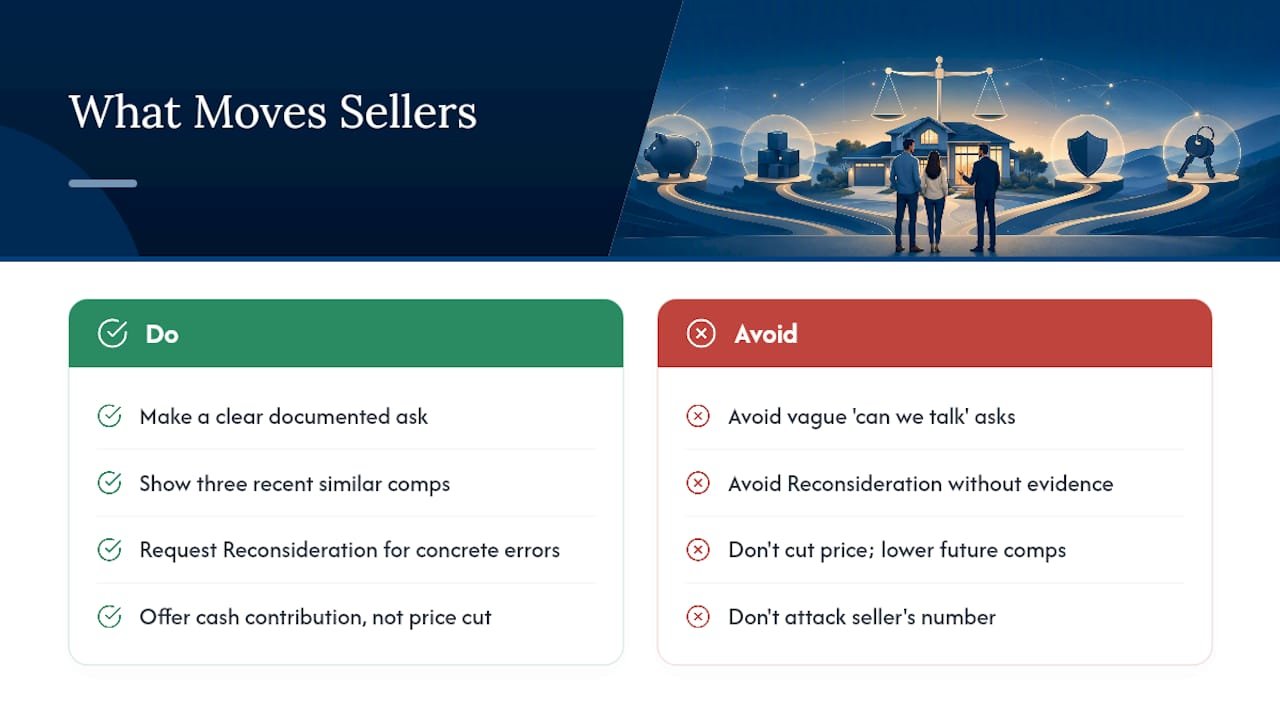
Sellers don’t respond to logic. They respond to certainty. When a buyer comes back after a low appraisal with a clear, documented ask instead of a vague “can we talk about the price,” the negotiation moves faster and stays friendlier.
The comps matter more than the argument. A seller who sees three recent, nearby, similar closed sales sitting below their number tends to accept reality faster than one who just hears “the appraisal came in low.” Bring the data before you bring the ask.
Reconsideration of Value requests succeed when there’s something concrete the appraiser missed, a wrong square footage figure, an unlisted bedroom, a comparable sale that closed the week before the report was pulled. When the request is really just “we think it’s worth more,” it rarely moves the number and mainly burns your contingency clock.
Sellers almost always prefer a buyer who brings cash to the table over one who cuts the price, even when the dollar amount is identical. A price cut lowers their number on paper and follows them into every future appraisal on that property. A cash contribution from the buyer keeps their sale price intact for comps down the road, and that distinction shapes how they respond more than people expect.
Framing decides whether the seller sees your counter as reasonable or as an attack on their number. “We’d like to split the $20,000 gap so we can both move forward” lands very differently than “your house didn’t appraise, so you need to drop the price.” Same math, completely different response.
If you’re navigating a specific offer or trying to figure out where your gap risk sits before you write it, working through the numbers with an agent who negotiates these regularly, like Ryan Case, can save you from guessing under pressure.
Beyond Price: Concessions and Repair Credits That Can Close the Gap
Price isn’t the only lever. When a seller won’t move on the number itself, seller concessions can bridge the gap without either side touching the sale price on paper.
A seller can offer a credit toward your closing costs, effectively freeing up cash you’d otherwise need to bring for the appraisal shortfall. A repair credit works similarly: if the appraisal or inspection flagged deferred maintenance, the seller can credit you the estimated repair cost, which offsets some of the cash pressure from the gap.
This matters for a specific reason: some loan programs cap how much of the purchase price can come from seller concessions, so check your lender’s limit before you build a negotiation strategy around it. It also matters for comps. A price drop shows up in public records and affects the neighborhood’s next appraisal. A closing cost credit generally doesn’t, which is part of why sellers often prefer this route.
Rate buydowns funded by the seller are another variant worth asking about, especially if your monthly payment is the bigger worry rather than the closing-day cash requirement. None of these erase the appraisal gap. They just redistribute where the financial pain lands, and for a lot of buyers, moving the hit from “cash due at signing” to “slightly smaller closing cost credit” is the difference that makes the deal work.
How the Gap Hits Different Loan Types Differently
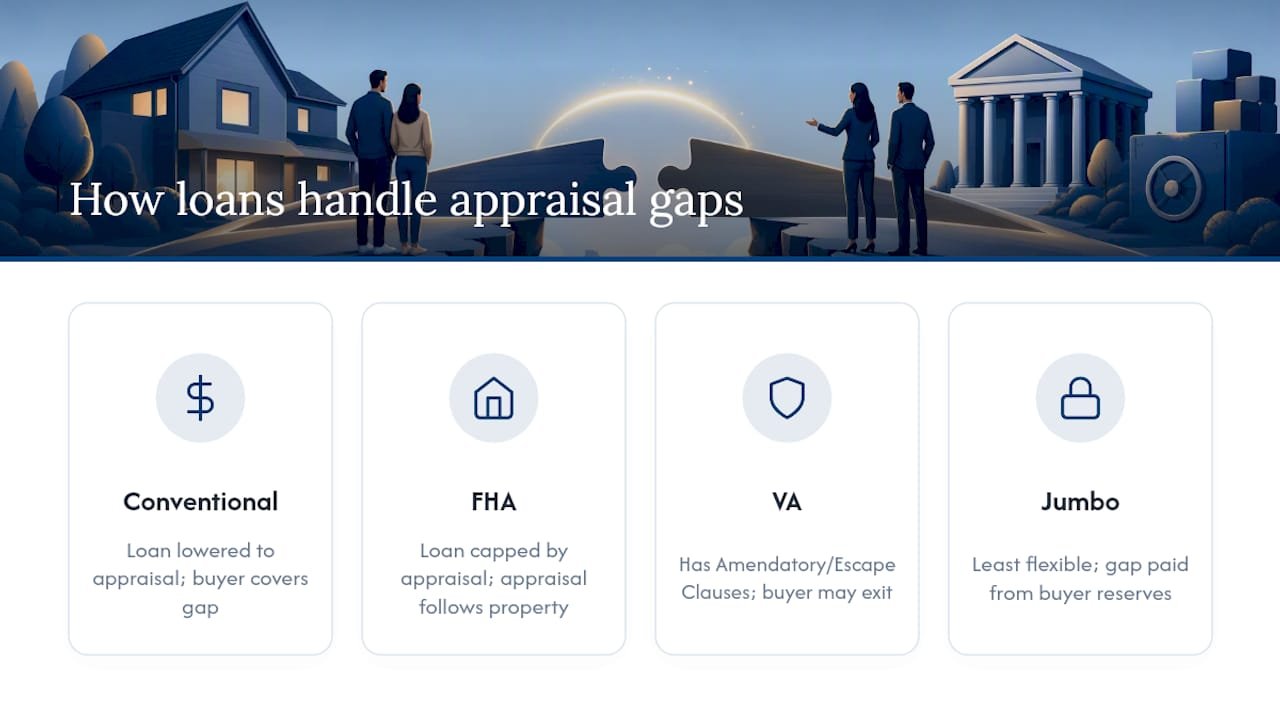
Not every loan absorbs an appraisal gap the same way. Conventional loans are the most flexible: the lender simply reduces the loan amount to match the appraised value, and you make up the rest in cash or renegotiate. Your loan-to-value ratio shifts, and if it crosses certain thresholds, private mortgage insurance requirements can kick in or increase.
FHA and VA loans work differently and, in some respects, more strictly. Both loan types generally require the lender to use the appraised value as the ceiling for the loan amount, and FHA appraisals are notoriously tied to the property, not just the buyer, for a set period after the report. That means a low FHA appraisal can follow the house into a next transaction if the deal falls apart. VA loans include a specific escape valve called the Amendatory Clause and Escape Clause, letting VA buyers exit the contract without penalty if the appraised value comes in low, which functions similarly to an appraisal contingency but is baked into the loan type itself.
Jumbo loans tend to have the least room for error. Because they already sit outside conventional guidelines, lenders are often less flexible on down payment adjustments, which pushes more of the appraisal gap directly onto the buyer’s cash reserves. If you’re financing with a jumbo loan, confirm your reserve cushion before you even consider an appraisal gap coverage clause.
Appraisal Gap Strategy in Competitive Markets
In a market where a home draws six offers in a weekend, appraisal gap coverage clauses have become close to standard for buyers trying to win. Sellers, in turn, have gotten more comfortable rejecting offers that don’t include one, because they’ve seen what happens when a deal falls through over a valuation dispute two weeks before closing.
Sellers navigating a hot market often price knowing a gap is likely, sometimes intentionally testing the ceiling with an aggressive list price to see what the market and the buyer’s cash reserves will absorb together. That’s not deceptive so much as a reflection of how disconnected asking prices and appraised values can get when bidding wars push prices up faster than recent comparable sales can justify.
Buyers competing in these conditions do best when they separate their maximum offer price from their maximum appraisal gap coverage. You might be willing to offer $450,000 for a house but only willing to cover a $15,000 gap in cash. Stating both clearly, rather than just throwing out a high number and hoping, keeps you from getting stuck agreeing to cover more than you can actually fund.
Sellers in these markets also lean on backup offers as leverage. If a buyer’s appraisal comes in low and negotiations stall, a seller with a strong second-place offer waiting in the wings has far less incentive to compromise. Knowing whether you’re the only offer or one of several changes how hard you can realistically push.
Why the Clock Matters as Much as the Number
An appraisal gap doesn’t just cost money. It eats time, and the contract’s deadlines don’t pause while you figure out your next move.
Most purchase contracts build in a specific window, often between 17 and 21 days from acceptance, for the appraisal to be ordered and delivered. Once it lands short, your appraisal contingency typically gives you a separate, shorter window, commonly 5 to 10 days, to respond in writing: renegotiate, accept the gap, or cancel.
Requesting a Reconsideration of Value adds real time to this clock, often one to two weeks, and that request doesn’t automatically extend your contingency deadline. If your contingency expires while the ROV is still pending, you can lose your right to cancel without ever getting an answer on the dispute. Coordinate any ROV request with your agent and lender specifically to confirm whether your contingency deadline needs a written extension first.
Closing dates rarely move on their own to accommodate an appraisal fight. If your renegotiation or dispute pushes past the original closing date, that typically requires a signed extension from both parties, and a seller under no obligation to grant one can simply let the original date pass and treat the contract as expired. That’s the real cost of delay: not just stress, but leverage that quietly shifts to the seller the longer the clock runs.
What I’d Tell You to Do in the Next 72 Hours
The first move isn’t negotiating. It’s verifying. Read the appraisal report line by line and check the basics: square footage, bedroom and bathroom count, lot size, condition notes. Appraisers make factual mistakes more often than buyers expect, and a wrong number is the fastest path to a successful challenge. While you’re at it, confirm exactly how many days remain on your contingency response window. That date drives everything else you do.
Next, get a quick comps pull from your agent, not a full CMA necessarily, just a gut check on whether the appraisal is reasonable or genuinely off base. If it’s off, that’s your Reconsideration of Value case. If it’s roughly in line with the market, stop fighting the number and start solving the cash problem instead.
Run the real math before you say yes to anything: extra down payment needed, any shift in mortgage insurance, and the reserve minimums your loan program requires after closing. Do this with your lender, not with a mental estimate.
Finally, if you have an appraisal contingency, don’t jump straight to canceling unless the gap is genuinely unaffordable. A clear, documented renegotiation request almost always gets a better outcome than an immediate walk away, and it keeps every option on the table a little longer.
— Ryan Case
Where to Read More on Appraisals and Contract Protections
For federal guidance on appraisal disclosures and mortgage consumer protections, the Consumer Financial Protection Bureau is the most reliable starting point. For a deeper look at how appraisers select comparable sales, this seller’s guide to the appraisal process breaks down the mechanics well.
On contract protections specifically, see how home sale contingencies work alongside appraisal terms, and how Zestimates compare to formal appraisals if you’re trying to sanity check a number before you’re under contract.
Sources
- What Is an Appraisal Gap? | SoFi
- Appraisal gap definition and options | The Mortgage Reports
- Appraisal contingency: Why you might need one | Chase