A bridge loan makes sense when you have strong equity in your current home, room in your debt-to-income ratio, and a real need to submit a non-contingent offer in a competitive market. If any of those three is shaky, especially equity or DTI, the math usually tips toward a cheaper or safer alternative. Skip to the decision checklist below to run your own numbers before you talk to a lender.
TL;DR:
- A bridge loan costs between $12,000 and $22,000 for six months, including interest, origination, appraisal, and closing fees, which should be weighed against seller discount offers.
- Approval requires at least 20% equity, credit scores of 680 or higher, a clear exit strategy, and a debt-to-income ratio that includes the bridge payment.
- The bridge loan’s impact on your debt-to-income ratio often disqualifies more borrowers than the equity requirement, especially if the loan isn’t carved out during underwriting.
- Running the math assuming your home takes an extra 60 days to sell is critical to determine if a bridge loan remains financially feasible.
- Alternative options include HELOCs, buy-before-you-sell programs, and contingent offers, with consideration of market competitiveness and the potential costs or restrictions each carry.
Table of Contents
- How Bridge Loans Work: Collateral, Structures, and Underwriting
- What Does a Bridge Loan Actually Cost You?
- What Do Lenders Look For Before Approving a Bridge Loan?
- Is a Bridge Loan Worth the Risk for Your Situation?
- HELOC, Buy-Before-You-Sell Programs, or a Contingent Offer?
- Decision Checklist: Compare the Bridge Cost to Your Contingency Discount
- What Should You Ask a Lender Before Signing?
- Realtor Perspective: How Listing Strategy Reduces Bridge Risk
- If You’re Buying Before You Sell, Get the Selling Side Right First
- Selected Authoritative Resources
- Sources
How Bridge Loans Work: Collateral, Structures, and Underwriting
A bridge loan gives you cash to buy a new home before your current one sells, using the equity in that departing property as collateral. It’s short-term financing designed to close the timing gap, not a long-term mortgage replacement, and lenders expect it repaid the moment your old house sells.
Lenders structure these two main ways. Some write a second mortgage against your current home, stacked on top of whatever you still owe. Others issue a standalone short-term loan secured by the equity, separate from your existing mortgage entirely. The mechanics differ, but the goal is the same. Unlock cash you haven’t collected yet.
Advance rates typically run against your net equity, meaning the lender calculates your home’s value, subtracts what you still owe, and lends against a percentage of what’s left. That money usually lands at closing on the new home, either as a lump sum or a draw you can access on demand.
Payment structure varies by lender:
- Interest-only payments during the bridge term, keeping monthly cash flow lower while you carry two properties.
- Deferred interest that accrues and gets paid off in one lump sum, often called a balloon payment, when the old home sells.
- Combination structures where some lenders let you choose based on how confident you are in your sale timeline.
Here’s the part most buyers miss: even though you plan to pay off the bridge fast, the new mortgage underwriter still counts that bridge payment against your debt-to-income ratio unless the lender has a specific carve-out for it. That single fact disqualifies more borrowers than the equity requirement does. If you’re weighing this against carrying two full mortgages long-term, coordinating simultaneous closings is worth understanding as a comparison point.
What Does a Bridge Loan Actually Cost You?
A six-month bridge loan on a mid-size mortgage commonly totals between $12,000 and $22,000 once you add interest, origination, and closing costs together, according to industry cost breakdowns. That number is the one you should hold against the discount a seller would demand for a contingent offer.
Short terms are what make bridge loans feel expensive even when the rate itself doesn’t look outrageous. You’re paying an origination fee, appraisal costs, and closing expenses on a loan you’ll retire in months, so those upfront costs get amortized over a much shorter window than a 30 year mortgage would spread them over.
Budget for these categories:
- Interest, often running higher than a standard mortgage rate because of the short duration and risk profile, as detailed in current Bank Statement Loan Rates Today.
- Origination fees, typically 1% to 2.5% of the loan amount, charged upfront.
- Appraisal and title costs, generally amounting to around $1,000 to $2,000, similar to what you’d pay on any secured loan.
- Closing costs, layered on top of the origination fee.
- Extension fees, charged if your home doesn’t sell inside the original term and you need more time.
That last item, extension fees, is where borrowers get burned. A loan that looked affordable at six months can turn expensive fast if your home sits on the market into month seven or eight. Run the math on both scenarios, on-time payoff and a delayed one, before you sign anything.
What Do Lenders Look For Before Approving a Bridge Loan?
Bridge loan approval hinges on a narrower set of criteria than a standard purchase mortgage, and lenders are less forgiving on the margins.
Expect these baseline requirements:
- Equity of 20% or more in your current home, since the loan is secured against that stake.
- Credit scores commonly at 680 or higher, with the best terms reserved for borrowers closer to 720.
- A defined debt-to-income cap, usually calculated with both the bridge payment and the new mortgage payment counted together.
- A credible exit strategy, which almost always means a signed listing agreement or, better yet, a pending sale on your current home.
That exit strategy requirement is not a formality. Lenders would rather see your home listed with a real agent and a real marketing plan than take your word that it will sell eventually. Get your appraisal ordered early, pull together proof of income, and line up your listing agreement before you approach a lender. Doing that work upfront often shortens approval time, and some lenders may issue conditional pre-approval once they see a signed listing agreement in hand.
Is a Bridge Loan Worth the Risk for Your Situation?
Bridge loans solve a real problem: they let you compete without a contingency in a market where sellers reject contingent offers outright. That speed and competitiveness is the entire reason buyers pay the premium.
The trade-offs are just as real:
- Pro: You can make a non-contingent offer, which matters enormously in a seller’s market.
- Pro: You move once instead of twice, skipping temporary housing or a rushed sale.
- Con: Total cost runs higher than most other financing routes once fees and interest stack up.
- Con: You’re carrying two properties, and two sets of obligations, until the sale closes.
- Con: If your home doesn’t sell inside the term, you face extension fees, mounting interest, and in worst cases, foreclosure risk on the bridge collateral.
Your risk profile depends heavily on where you sit going in.
Pro Tip: Run your numbers assuming your home takes 60 days longer to sell than you expect. If that scenario still works financially, you’re in reasonable shape to bridge.
HELOC, Buy-Before-You-Sell Programs, or a Contingent Offer?
A bridge loan isn’t your only path to buying before you sell, and it isn’t automatically the cheapest one.
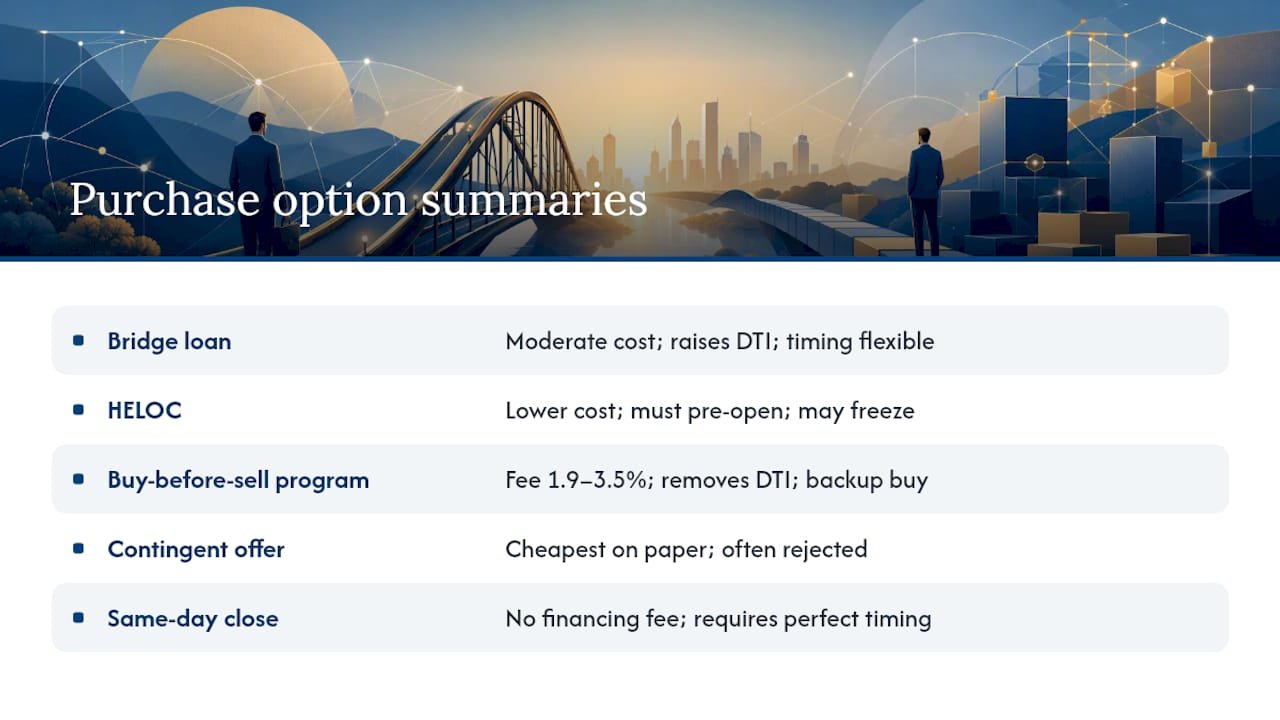
HELOC. A home equity line of credit against your current property usually costs less than a bridge loan and gives you flexible access to funds. The catch is timing and availability. You need to have opened the HELOC before listing your home in many cases, and some lenders restrict or freeze the line once your house is under contract.
Buy-before-you-sell programs. These third-party programs charge a flat fee, often 1.9% to 3.5% of your home’s value, but they remove your departing mortgage from the DTI equation entirely and typically include a guaranteed backup purchase if your home fails to sell. For buyers constrained by DTI rather than cash, that structural difference often makes these programs the lower-risk choice over a bridge loan.
Contingent offers. The cheapest option on paper, since there’s no bridge financing to pay for. The weakness shows up in competitive markets, where sellers routinely reject contingent offers or accept them only with a kick-out clause that lets them keep shopping.
Same-day close. Coordinating your sale and purchase to close on the same day costs nothing extra in financing fees, but it demands near-perfect timing from both sides of the transaction. One delay on either closing and the whole plan unravels.
Decision Checklist: Compare the Bridge Cost to Your Contingency Discount
A useful rule of thumb: run the total expected cost of bridging against the price discount a seller would likely accept for your contingent offer, then pick whichever number is lower. That single comparison, recommended by real estate finance analysts, cuts through most of the noise.
Work through these steps in order:
- Estimate your usable equity and confirm it clears the 20% threshold most lenders require.
- Get a real quote on bridge fees: interest, origination, closing, and the extension fee schedule.
- Ask your agent for a realistic estimate of the discount a seller would want for a contingent offer in your market.
- Check your DTI with the bridge payment included, using the new mortgage’s underwriting rules.
- Confirm your lender’s extension policy in writing before you commit.
- Set a fallback, whether that’s a rent-back agreement or a price cut plan if your home sits unsold past 60 days.
Here’s a compact version of the math: say your bridge costs $15,000 in total fees and interest over six months. If a contingent offer in your market would cost you roughly $20,000 in a lower accepted price, the bridge is the better deal. Flip those numbers, and the contingency wins. The lower expected cost takes it, but weigh that against how much downside risk you can actually absorb if your sale slips past the loan term.
What Should You Ask a Lender Before Signing?
Ask these questions before you commit to any bridge loan offer:
- “What are your extension fees, and what triggers them?”
- “Is this interest-only, or does interest accrue and get paid at payoff?”
- “What lien position does this loan hold against my current home?”
- “Do you require a signed listing agreement or a pending sale before you’ll fund this loan?”
Walk away if a lender won’t answer the extension question in specifics, quotes an all-in cost that seems out of line with the ranges above, or refuses to put a sample payoff scenario in writing showing what you’d owe at different sale prices and timelines.
Pro Tip: Ask for payoff scenarios at both an on-time sale and a sale 90 days late. If the lender hesitates to run that second number, that hesitation tells you something.
Realtor Perspective: How Listing Strategy Reduces Bridge Risk
The single biggest lever most buyers ignore is how fast their old home actually sells, and that’s a marketing problem before it’s a financing problem. Strategic pricing and targeted exposure, the core of what the Premier Selling System is built around, shortens days on market and shrinks your bridge exposure window. When a seller pairs that speed with a guaranteed sale option, the reliance on bridge financing often drops further still. Get a real days-on-market estimate before you assume you’ll need a bridge at all.
— Ryan Case
If You’re Buying Before You Sell, Get the Selling Side Right First
Every scenario above depends on one variable you can actually influence: how fast your current home sells. Certain selling systems aim to compress that timeline through strategic pricing, targeted buyer database outreach, and marketing exposure on platforms like Zillow Showcase, so you’re not stuck guessing whether a bridge loan will pay off before extension fees kick in.

A faster, better-marketed sale means less time carrying a bridge, a smaller extension risk, and a stronger negotiating position on your purchase offer. If you’re in San Diego County and weighing a bridge loan against a faster sale strategy, schedule a home analysis with Ryan Case to get a realistic days-on-market estimate and pricing plan before you lock in financing terms. That single conversation often changes which option makes financial sense for your specific timeline.
Selected Authoritative Resources
For deeper reading, check Rocket Mortgage’s bridge loan overview, the Corporate Finance Institute’s risk breakdown, NAR’s guidance on buying and selling simultaneously, and NMLS Consumer Access to verify any lender’s licensing before signing.
This article is general information, not a substitute for advice from a qualified financial advisor. Consult a qualified financial professional about your own circumstances before acting on anything here.
Sources
- What is a bridge loan and how does it work? | Rocket Mortgage
- What is a bridge loan? | Corporate Finance Institute
- Bridge Loan: Buy Before You Sell | My Financial 101
- Bridge loan | Investopedia