Yes, a targeted seller concession such as a closing cost credit or a limited rate buydown can help you win a sale in San Diego, but it changes your net proceeds and must comply with lender rules. Most sellers here use one of three formats: a closing cost credit, a temporary rate buydown, or a repair credit. Before you offer any of them, run a net proceeds model and confirm the structure with the buyer’s lender.
TL;DR:
- Concessions that enhance attractiveness, like repair credits or rate buydowns, must be carefully modeled to avoid reducing net proceeds unexpectedly.
- Seller-paid commissions, transfer taxes, and escrow fees significantly impact closing costs and vary based on individual deals and local rules.
- A mortgage or loan type may limit concession amounts allowed, requiring lender approval and proper documentation to prevent loan value reductions.
- Offering concessions can be effective in a cooling market or when addressing specific buyer objections but may be counterproductive if the listing is overpriced or poorly marketed.
- Running a net proceeds calculation before negotiations helps sellers determine the most financially advantageous and compliant concession strategies.
Table of Contents
- What seller concessions actually are
- Typical closing costs San Diego sellers pay
- Common concession types and how they work in escrow
- How to decide how much to offer and when
- Lender rules that cap what you can offer
- Local transfer taxes and buyer assistance that change the calculus
- How the Premier Selling System approaches concessions
- When concessions help and when they quietly hurt you
- Get a net proceeds estimate before you negotiate
- FAQ
- Sources
What seller concessions actually are
A seller concession is money or value you agree to give the buyer, on top of the agreed sale price, to help them close the deal. It shows up as a line item on the closing statement, not as a lower purchase price, and that distinction matters because lenders and appraisers treat the two very differently.
Concessions typically cover:
- A credit toward the buyer’s closing costs, such as escrow or title fees.
- A temporary or permanent reduction in the buyer’s mortgage interest rate.
- A credit for repairs identified during inspection.
- A paid home warranty for the buyer’s first year of ownership.
Some costs in a San Diego sale are customary seller responsibilities regardless of negotiation, including the owner’s title policy premium and, in many contracts, the documentary transfer tax. Concessions are the items you choose to add beyond those customary costs to make your listing more attractive.
Typical closing costs San Diego sellers pay
Before deciding what to concede, you need a clear picture of what you already owe at closing. Here are the main line items San Diego sellers see on a settlement statement:
- Listing agent commission, typically the largest single cost and fully negotiable with your agent.
- Buyer’s agent commission, often covered by the seller under local custom, though this is now subject to direct negotiation after recent industry changes.
- Escrow fees, split between buyer and seller per the purchase contract.
- Title insurance, usually the seller’s responsibility for the owner’s policy.
- Documentary transfer tax, assessed on the sale price within city limits.
- Reconveyance fee, paid to release the lien once your existing mortgage is paid off.
- Prorated property taxes, covering the portion of the tax year you owned the home.
- HOA or assessment payoffs, if applicable to your property.
The City of San Diego charges documentary transfer tax at $0.275 per $500 of the sale price, paid by the party who issues the deed, which on a typical home adds a few hundred dollars to closing costs depending on sale price. For a deeper breakdown of how these line items add up and how to offset them, see this local closing costs guide.
The biggest variable in your total is commission structure, which varies by agreement and can shift your net proceeds more than any single concession.
Common concession types and how they work in escrow
A closing cost credit is the most straightforward option. You agree to a fixed dollar amount that escrow applies against the buyer’s loan fees, title charges, or prepaid items, and it gets written directly into the purchase agreement.
Rate buydowns are more complex. A temporary buydown lowers the buyer’s monthly payment for a set period, usually one to three years, while a permanent buydown reduces the rate for the life of the loan. FHA loans have specific restrictions on discount points and buydowns for purchase transactions, so this format needs lender sign-off before you commit to it.
- Repair credits let the buyer handle fixes themselves instead of you completing the work before close.
- Seller-completed repairs keep you in control of quality but add time to your sale.
- A home warranty purchase is a low-cost concession that reassures nervous buyers without touching your proceeds much.
- HOA or special assessment payoffs are sometimes customary and sometimes negotiated, so check your HOA’s governing documents early.
Pro Tip: Write every concession as “seller credit to buyer” with an itemized list of what it covers, so the buyer’s lender can classify it correctly instead of treating it as a price reduction.
How to decide how much to offer and when
Concessions work best as a scalpel, not a blanket discount. Here is a practical sequence for deciding what to offer:
- Read the market first. In a hot San Diego submarket with multiple offers, you may need no concessions at all. In a cooling one, a modest credit can be the difference between an offer and a showing with no follow-up.
- Model the net proceeds impact. Compare a $10,000 price cut against a $10,000 closing cost credit. The price cut reduces the number the appraiser and comparable sales will reference going forward, while a credit does not.
- Attach conditions. Offer a concession only if the buyer waives a specific contingency or closes by a set date, so you get something back for what you give up.
- Favor small, targeted moves over large credits. A modest buydown paired with strong marketing photos and pricing often outperforms a large blanket credit, because it addresses the buyer’s actual objection instead of discounting broadly.
For sellers weighing a quick sale against a concession-heavy negotiation, this comparison of cash buyers and traditional agents walks through the trade-offs in more depth.
Lender rules that cap what you can offer
Concessions are not unlimited. Fannie Mae treats seller concessions as interested party contributions, and any amount that exceeds the permitted financing concession limit must be deducted from the sale price and treated as a sales concession rather than a financing concession. That reclassification can lower the appraised value basis the lender uses for the loan.
FHA and HECM for Purchase loans carry their own restrictions. HUD restored limits on discount points and interest rate buydowns for HECM for Purchase transactions and tightened documentation requirements for interested party contributions.
Before finalizing any concession:
- Confirm the buyer’s loan type and program with their lender.
- Ask whether the concession amount falls within that program’s cap.
- Document the concession clearly in the purchase agreement and escrow instructions.
Local transfer taxes and buyer assistance that change the calculus
San Diego’s documentary transfer tax applies to the full sale price within city limits, and in rare cases of double taxation or recording errors, the San Diego County Recorder’s office provides a refund claim process with required supporting documents.
Buyer assistance programs also shift how much you need to concede. The San Diego Housing Commission offers first-time homebuyer assistance, including deferred loans and closing cost grants in some programs, and the county runs parallel down payment assistance options. Key points to coordinate on:
- Ask early whether your buyer is using SDHC or county assistance, since it may reduce their need for your concession entirely.
- Program timelines can affect your closing date, so build in flexibility if a buyer is layering in assistance funds.
- A buyer using assistance funds may still need a smaller, targeted credit for items the program does not cover.
How the Premier Selling System approaches concessions
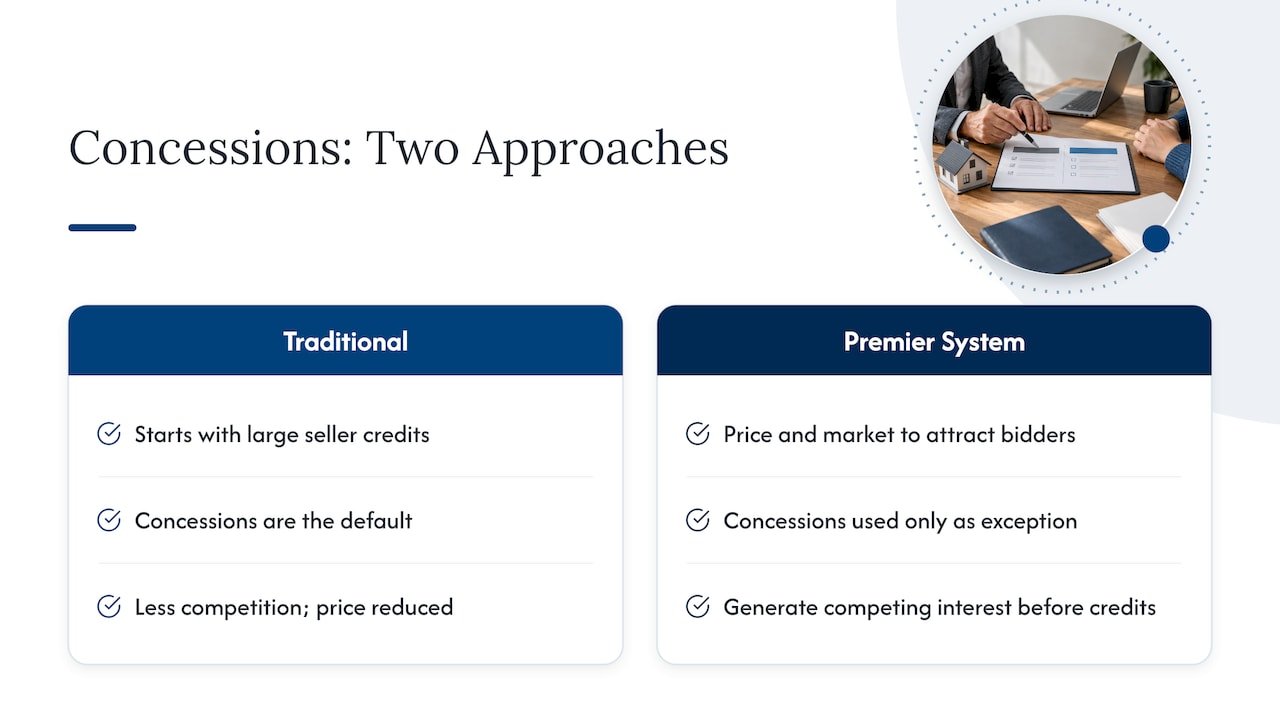
Rather than defaulting to large credits, the Premier Selling System prices and markets a home to generate competing interest first. The goal is to make concessions the exception, not the starting offer.
When concessions help and when they quietly hurt you
Concessions earn their keep when they remove a specific objection, a buyer short on cash for closing, a rate that feels too high, a repair that scares off financing. They hurt when sellers default to them instead of fixing pricing or presentation first, because a credit rarely overcomes a listing that is priced wrong or marketed weakly. Run the net proceeds numbers before you offer anything, and get your escrow or title company to confirm how a specific credit affects your bottom line.
— Ryan Case
Get a net proceeds estimate before you negotiate
Knowing your exact numbers before you field an offer puts you in control of the negotiation instead of reacting to it. A team builds a net proceeds model specific to the home and San Diego’s fee structure, then maps out where a concession makes sense and where marketing or pricing does the job instead.

If you want certainty without relying on concessions to get a deal done, the Guaranteed Home Sale program is worth a look, and sellers planning a faster timeline can see how the quick-sale approach works on the 6 to 10 week selling page. Start with a free seller analysis at Ryancaserealtor to see your numbers before you price or negotiate anything.
FAQ
What is the city tax in San Diego on a home sale?
The City of San Diego charges a documentary transfer tax at a rate of $0.275 per $500 of the sale price, paid by the party issuing the deed. It applies to transfers within city limits and is typically handled through escrow at closing.
What are concessions when you’re selling a house?
A seller concession is money or value you give the buyer beyond the agreed sale price, such as a closing cost credit, a rate buydown, or a repair allowance. It appears as a separate line on the closing statement rather than as a reduction to the purchase price itself.
How much are closing costs on a $400,000 house in California?
Closing costs vary by commission structure, title fees, and local transfer taxes, so there is no single fixed figure for every sale. A seller can get an exact number by requesting a net proceeds estimate from their agent or escrow company before listing.
What is the 3-3-3 rule in real estate?
Definitions of this rule vary across markets and are not tied to a single official standard. If you come across it in a San Diego context, ask the source to clarify exactly which timelines or ratios it refers to before relying on it, or see this guide on how long a real estate agent has to present an offer.
Sources
- Article 7: Documentary Transfer Tax on The Sale of Real Property (City of San Diego municipal code)
- Interested party contributions (IPCs) | Fannie Mae
- Mortgagee Letter 2024-06 (HUD/FHA)
- San Diego Housing Commission first-time homebuyer programs
- Real Property Transfer Tax Refund Claim (San Diego County Recorder/Assessor)