If you need cash to cover closing costs, ask for a repair or closing credit. If you want a lower loan amount and fewer lender complications, push for a price reduction instead. The right call depends on your lender’s limits, the appraisal, and how much cash you have on hand, all covered below with a worked example and a decision checklist.
TL;DR:
- A seller credit reduces closing costs without changing the sale price and does not impact the loan amount or appraisal value.
- A price reduction lowers the purchase price, decreases the loan amount, and results in a smaller monthly payment and interest savings over time.
- Lender limits on concessions, appraisal requirements, and agency caps can restrict the amount of credit allowed, possibly forcing last-minute adjustments.
- Buyers should opt for a credit if they are short on cash or need funds for repairs, while a price reduction benefits those seeking a smaller long-term loan.
- Sellers should prefer price reductions in slow markets or when signaling value publicly, whereas credits are more effective for cash-strapped buyers or quick closings.
Table of Contents
- What repair credits and price reductions actually mean on paper
- The buyer’s math: $10,000 credit vs $10,000 price drop
- Lender rules that decide whether a credit is even allowed
- Why sellers sometimes favor a price drop over a credit
- What buyers should confirm before choosing either option
- How to actually negotiate the concession after inspection
- When to pick credits over a price drop: a fast decision guide
- What years of San Diego negotiations have taught me about this choice
- How a real estate agent helps you choose the right concession
- Primary sources worth bookmarking
- Sources
- FAQ
What repair credits and price reductions actually mean on paper
A repair credit, sometimes called a closing cost credit, is money the seller agrees to contribute toward the buyer’s costs at settlement. It does not change the sale price in the contract. A price reduction amends the actual purchase price, which flows through to the loan amount, the down payment math, and the appraisal.
The two look similar in a negotiation email but behave very differently once they hit paperwork. A credit shows up as a line item on the Closing Disclosure, typically labeled as a seller credit or seller concession, and it reduces what the buyer owes at the table. A price reduction changes the sales price itself, which is why it also changes the loan-to-value ratio the lender uses to underwrite the file.
That distinction matters for anyone trying to use either tool strategically:
- A credit reduces cash due at closing but does not touch the mortgage balance.
- A price reduction lowers both the purchase price and, usually, the loan amount, since most loans are a percentage of price.
- Credits must be itemized and disclosed, since lenders are required to document the total amount of Interested Party Contributions on settlement paperwork.
- Price reductions require a contract amendment signed by both parties, not just a settlement entry.
Buyers sometimes assume a $10,000 credit and a $10,000 price cut are financially identical. They are not, and the next section shows exactly why.
The buyer’s math: $10,000 credit vs $10,000 price drop
Here is how a $10,000 seller credit compares to a $10,000 price reduction.
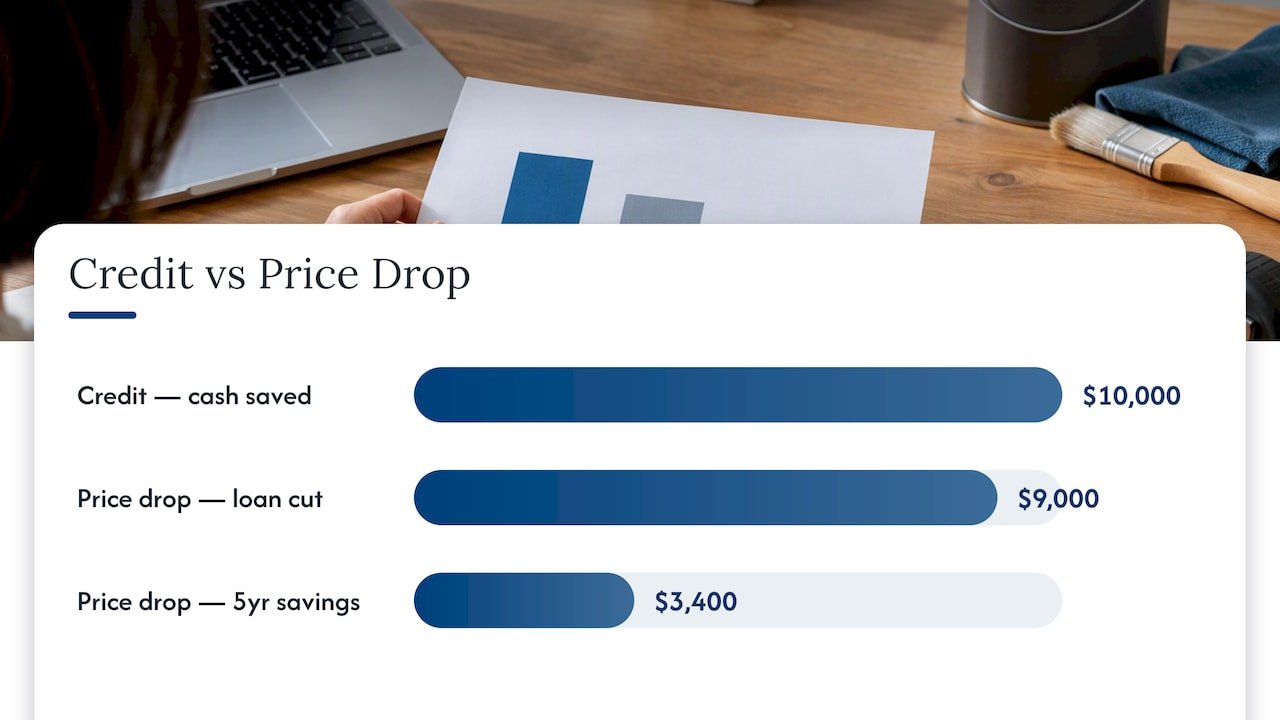
- With a $10,000 credit: the price stays at $500,000, the down payment stays at $50,000, the loan amount stays at $450,000, and the buyer’s cash-to-close drops by roughly $10,000 because the seller covers that much of the closing costs.
- With a $10,000 price drop: the price falls to $490,000, the down payment at 10% drops to $49,000, the loan amount falls to $441,000, and the monthly principal and interest payment drops by around $57 a month at that rate.
Over five years, the price reduction saves the buyer roughly $3,400 in interest and principal payments, while the credit saves nothing on the loan itself because the loan amount never changes. The credit’s benefit is immediate: more cash in the buyer’s pocket on closing day. The price reduction’s benefit compounds slowly through a smaller monthly payment and slightly less interest paid over time.
The trade-off in one line: a credit helps most when a buyer is short on cash to close; a price reduction helps most when a buyer wants a smaller long-term loan.
Tax treatment adds another wrinkle. Repair credits are generally not taxable income to the buyer since they reduce the cost basis of the transaction rather than providing cash in hand, and the same logic applies to a lower purchase price. Neither option typically creates a tax event at closing, but a buyer planning to refinance or resell within a few years should weigh the smaller loan balance from a price drop against the immediate liquidity of a credit, since refinancing costs and resale timing can erase the interest savings the credit side never had to begin with.
Lender rules that decide whether a credit is even allowed
Before anyone agrees to a credit amount, it is worth checking what the lender will actually permit. Fannie Mae calculates maximum financing concessions using the lower of the sales price or the appraised value, and any amount above that limit gets reclassified as a sales concession and deducted from the sales price for loan-to-value purposes. That reclassification is not a formality. Desktop Underwriter job aids show that when a concession exceeds the allowable limit, the system automatically adjusts the sales contract price and seller credit fields, which can change the buyer’s required down payment overnight.
A credit negotiated above the lender’s cap does not just get trimmed, it can force a last-minute recalculation of the buyer’s cash-to-close. That is the scenario everyone wants to avoid a week before closing.
HUD’s Mortgagee Letter 2024-06 updated documentation requirements and limits for Interested Party Contributions to FHA loans, clarifying which funding sources are acceptable and requiring lenders to identify the total contribution amount on settlement documentation. HUD’s broader Fair Housing Act overview reinforces why accurate, transparent disclosure of every concession matters, not just for compliance but for keeping the transaction defensible if questions come up later.
A few practical checkpoints before finalizing any concession:
- Ask the lender for the applicable Interested Party Contribution limits for this specific loan program.
- Confirm whether the credit amount will be verified against the appraised value, not just the sales price.
- Get the lender’s confirmation in writing, since automated underwriting enforces these limits programmatically and a verbal assurance from a loan officer carries no weight once the file runs through Desktop Underwriter.
Why sellers sometimes favor a price drop over a credit
Sellers often default to offering credits because it feels like it preserves the list price, but that preservation can be an illusion. A price reduction lowers the number the agent’s commission is calculated against, which can modestly reduce total closing costs for the seller, while a credit leaves the commission base untouched and simply subtracts cash from proceeds at the end.
Credits also carry appraisal risk that price reductions do not. A large credit relative to the sale price can trigger the sales concession adjustment described above, which can unwind the deal’s financing assumptions late in the process. A price reduction, by contrast, sets a new number everyone underwrites against from the start.
There is also a market-signaling angle. A clean price drop tells buyers browsing listings that the home is now priced differently, which can revive interest from people who passed at the old number. A credit is invisible to anyone scanning listings and only matters to the buyer already under contract.
A short seller checklist:
- If commission savings and a clean underwriting file matter more than headline price, choose the reduction.
- If you want to preserve the list price for comparables in the neighborhood and can absorb slightly higher fees, a modest credit can work.
Pro Tip: Run both scenarios through your closing cost estimate before deciding, since the commission math alone can tip the decision one way or the other.
What buyers should confirm before choosing either option
Buyers tend to default to asking for credits because it feels like free money at the table, but the right choice depends on your cash position and your loan program.
- Choose a credit when you are tight on cash to close, need help covering prepaid items like insurance and taxes, or want money to fund repairs after closing without touching your down payment.
- Choose a price reduction when you want a smaller loan balance, you are already comfortable with your cash-to-close, or your lender’s concession caps make a meaningful credit impossible anyway.
- Ask your lender directly whether credits reduce your loanable amount, what the maximum Interested Party Contribution is for your loan type, and whether Desktop Underwriter will flag the amount you are requesting.
Your down payment size and loan program change this calculation more than most buyers expect.
How to actually negotiate the concession after inspection
Once the inspection report comes back, the negotiation usually moves fast. Start by getting written contractor estimates for anything that will be disputed, and sort issues into three buckets: safety and structural items, major systems like roofing and HVAC, and cosmetic items that rarely move a lender’s opinion.

Requesting a credit versus a price amendment calls for different language in the response to the inspection notice. A credit request should specify a dollar amount applied at closing toward buyer closing costs, while a price reduction request should state the new agreed sales price directly, since that number needs to match what goes into the appraisal and loan file.
Watch for these red flags during the back and forth:
- A credit amount that exceeds what the lender’s program allows, which forces a recalculation days before closing.
- Settlement statement entries that describe the credit vaguely instead of itemizing what it covers.
- An appraisal contingency that was written before the concession was finalized, creating a mismatch between the appraised value and the adjusted terms.
Pro Tip: If repair costs exceed what your lender will allow as a credit, you still have options: put the extra amount in escrow for post-closing repairs, ask the seller to complete the repairs before closing instead of paying for them, or shift the request to a straight price reduction that sidesteps the concession cap entirely.
When to pick credits over a price drop: a fast decision guide
Most of this decision comes down to four questions, and the answers usually point clearly in one direction.
- If the buyer needs cash at closing and the lender confirms the credit fits within program limits, take the credit, in writing.
- If the requested concession would exceed the lender’s financing concession cap or risks an appraisal mismatch, switch to a price reduction.
- If the local market favors buyers and price sensitivity is driving showings, a price reduction signals value more effectively than an invisible credit.
- If the seller wants to protect the list price for comparable-sale purposes and can absorb slightly higher commission costs, a modest credit remains workable.
| Scenario | Better option | Why |
|---|---|---|
| Buyer short on cash to close | Repair credit | Reduces cash due at settlement without changing the loan |
| Concession near lender’s cap | Price reduction | Avoids appraisal and underwriting recalculation |
| Slow market, price-sensitive buyers | Price reduction | Signals value to buyers browsing listings |
| Seller protecting comparables | Modest credit | Keeps list price intact for neighborhood pricing data |
What years of San Diego negotiations have taught me about this choice
Most sellers I work with want to preserve their list price out of instinct, but the Premier Selling System treats price and credits as two levers on the same net-proceeds equation, not as a moral choice between “giving in” and “holding firm.” A seller who understands the real cost of a credit versus a price cut negotiates from a stronger position than one who just picks whichever feels less like losing.
In practice, I recommend a price adjustment when the buyer pool is thin and a clean new number will reopen interest from buyers who already passed once. I recommend a targeted credit when the home is otherwise priced right and the only sticking point is a specific repair item the buyer’s lender needs resolved before closing. The deciding factor is rarely the dollar amount. It is which option gets the deal closed without reopening the appraisal or the buyer’s loan approval.
— Ryan Case
How a real estate agent helps you choose the right concession
Deciding between a credit and a price drop gets easier with a home analysis that accounts for your specific loan, local comparables, and estimated commission calculations rather than a generic rule of thumb. Coordination with lenders and contractors can help figure out which concession protects net proceeds and keeps the closing on schedule.

If you are weighing this decision right now, start with a home analysis through the Premier Selling System or visit our page for selling without a deep discount to see how we structure these negotiations for San Diego sellers.
Primary sources worth bookmarking
For lending rules, read HUD Mortgagee Letter 2024-06 and the Fannie Mae DU job aid on excess concessions. For a quick valuation check before deciding, try this free home valuation tool.
Sources
FAQ
What’s the difference between a credit and a price reduction?
A credit is money applied toward the buyer’s closing costs without changing the sale price, while a price reduction lowers the contract price itself and, with it, the loan amount. Credits show up as a line item on the Closing Disclosure; price reductions require a signed contract amendment.
How do I negotiate repair credits?
Start with written contractor estimates for the disputed items, then request a specific dollar amount applied at closing rather than a vague repair promise. Confirm with your lender beforehand that the amount fits within Interested Party Contribution limits for your loan program before you finalize the number.
What is the average seller credit for repairs on a home?
There is no fixed standard amount since credits are negotiated case by case and capped by lender rules tied to the loan program and appraised value. Fannie Mae’s guidance on financing concessions is the right place to check the maximum allowed for a specific transaction rather than relying on a market average.
Can I negotiate a price reduction after a home inspection?
Yes, a price reduction after inspection is a standard outcome when the inspection reveals issues the seller agrees to account for, and it requires a signed amendment to the purchase contract. Unlike a credit, it changes the loan amount and the figure the appraisal is measured against, so both parties should confirm the new number before moving forward with financing.
Do repair credits or price reductions affect resale value?
Neither directly affects resale value since the home’s market value is set by comparable sales and condition, not by how a previous concession was structured. A price reduction does become part of the public sale price history, while a credit generally does not appear in comparable sales data the same way.