If your listing just expired, order the full file from your prior agent (MLS printout, showing log, feedback notes, prior offers) and book a diagnostic with a San Diego listing specialist before you sign anything new. That review tells you whether you need a straight identity reset, a price and condition correction, or a pivot to a different sale path. Check the listing status definitions and your signed agreement first: both control what “starting over” actually means for your home.
TL;DR:
- Rechecking the full MLS file and feedback from the prior agent reveals whether the listing expired due to timing, price, condition, or marketing issues.
- A diagnostic guides the choice between resetting the listing’s identity, adjusting the value, or pivoting to alternative sale strategies based on specific cause analysis.
- Confirming the old listing agreement’s expiration date and protection clauses prevents sellers from owing multiple commissions on the same sale.
- Relaunching with updated pricing based on hyper-local comps, fresh marketing materials, and a clear schedule can significantly improve the chances of sale in a competitive market.
- Local market conditions, such as inventory levels and neighborhood trends, strongly influence whether relisting quickly or waiting for seasonal improvements is more advantageous.
Table of Contents
- What to collect and how to read it: the diagnostic relaunch checklist
- Relaunch pathways: identity reset, value relaunch, or pivot, which to pick
- Contract and MLS mechanics: what to confirm before signing and relaunching
- How to reset price, listings, and showings so the relaunch gains traction
- Local market data sellers must factor into the relaunch decision
- A San Diego listing specialist’s view on relaunching an expired property
- How Ryan Case helps: services that relist and sell expired properties in San Diego
- Primary sources and local data to check
- Sources
- FAQ
What to collect and how to read it: the diagnostic relaunch checklist
An expired listing leaves a paper trail, and that trail tells you more than any guess about “what went wrong.” Before you talk pricing or photography, pull the full record from the outgoing agent.
- Full MLS file, including every status change and remark history.
- Showing log with dates, agent names, and buyer feedback where available.
- Online traffic reports from the MLS and any syndicated sites like Zillow.
- Copies of listing photos and marketing copy used during the run.
- Records of prior offers, including any that fell through and why.
Once you have these, check the status history against CRMLS’s definitions: Expired means the listing agreement’s time frame ran out and the home went off-market, and Days on Market stops accumulating while it sits in that state. That matters because it separates a home that simply timed out from one that was pulled and relisted repeatedly, which reads differently to buyers’ agents scanning history.
Low showing counts paired with strong online views usually point to a price or presentation problem. Low views paired with decent showings but no offers usually points to condition or price relative to what buyers saw in person. Before you do anything else, confirm the listing agreement’s actual expiration date and whether it includes a protection or holdover clause, since that determines who gets paid if a prior buyer resurfaces.
Pro Tip: Ask the prior agent for the raw showing feedback comments, not just a summary. The specific words buyers used tell you more than a numeric rating ever will.
Relaunch pathways: identity reset, value relaunch, or pivot, which to pick
Once the diagnostic points to a cause, three paths cover most expired listings in San Diego County.
- Identity reset. Choose this when the diagnostic shows a marketing execution problem rather than a price or condition issue: weak photos, thin online exposure, or a showing policy that discouraged agents from booking appointments.
- Value relaunch. Choose this when comps show the prior price sat above what similar homes were closing at, or when repeated buyer feedback flagged the same condition issue.
- Pivot. Choose this when the seller’s timeline or goals have changed, or when repeated relaunch attempts have not worked.
For an identity reset, the required steps are a new listing agreement, professional photography, a rebuilt MLS presentation with fresh copy, and a revised showing policy that removes friction for buyer’s agents.
For a value relaunch, start with targeted repairs aimed at the specific objections buyers raised, not a general renovation. Recalibrate the price against closed and pending comps in the same micro-market rather than the prior list price, and weigh staging against simple cosmetic fixes like paint and decluttering, which often move the needle for less money.
Pivot options include:
- Selling as-is to a cash buyer when the seller wants speed over maximum price.
- Renting or holding when market timing, not the home itself, is the obstacle.
- Enrolling in a guaranteed-sale program when certainty of closing matters more than testing the open market again.
Whichever path you pick, the sequence stays the same: confirm the diagnostic findings, choose the path that matches the actual cause, then document the plan in writing before relaunch.
Contract and MLS mechanics: what to confirm before signing and relaunching
Before you sign a new listing agreement, confirm two things in the old one: the exact expiration date and any post-listing protection or holdover language that could entitle the prior brokerage to a commission if a buyer they introduced ends up purchasing later. Skipping this step is the most common way sellers end up owing two commissions on one sale.
On the MLS side, CRMLS guidance treats Expired, Canceled, and Withdrawn as distinct statuses, and the on-market date and DOM calculation depend on documentation your new agent submits, not just on when you decide to relaunch.
Opting out of MLS submission trades exposure for privacy: MLS distribution reaches participating agents and syndicated sites, so a private, off-market launch narrows your buyer pool by design, a tradeoff worth naming outright rather than discovering after weeks of quiet showings.
Before relaunch, put these in writing in the new agreement:
- The confirmed on-market date and how it will be reported to the MLS.
- The MLS submission plan and timeline for going live.
- Marketing permissions, including photo and video use across platforms.
- Any compensation clauses carried over from the previous listing.
How to reset price, listings, and showings so the relaunch gains traction
Price the relaunch using closed and pending sales in your specific micro-market and price band, not the county-wide median. A home that sat too long at the wrong number needs a number buyers can compare favorably against what already sold nearby, not a modest trim off the old list price.
Marketing refresh checklist:
- New photography shot for the current season and staging.
- Rewritten listing copy that addresses the objections the diagnostic surfaced.
- A showing policy that removes scheduling friction for buyer’s agents.
- Paid exposure through tools like Zillow Showcase alongside standard MLS syndication.
- A plan for open houses timed to the first two weekends after relaunch.
Set a metric-based watch period for the first 21 days: track showings booked, online views, and any offers or price feedback. Agree in advance on adjustment triggers, for example a specific showing count by day 14 that would prompt a price reduction rather than waiting another month to react.
Pro Tip: Set your adjustment trigger in writing before relaunch, not after two quiet weekends. Deciding the rule in advance removes the emotional guesswork when the data comes in.
Costs vary by scope: professional photography, minor staging, and paid placement typically run into the hundreds to low thousands of dollars depending on home size and service tier, while the relaunch marketing push itself usually plays out over three to six weeks before the trigger points force a decision.
Local market data sellers must factor into the relaunch decision
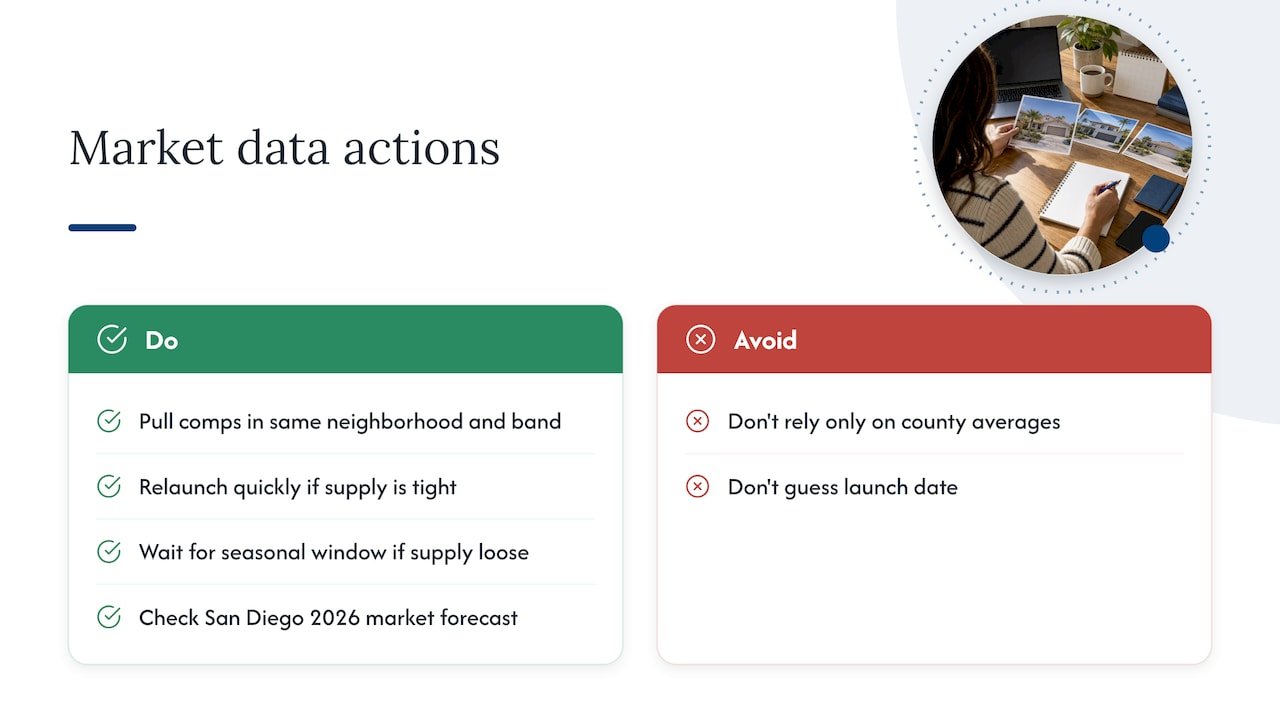
County-level numbers set the backdrop, but they rarely explain why one specific listing expired. San Diego County market data tracks median sale price, inventory, months of supply, and days on market, and these shift month to month and year over year.
Tighter inventory in a given price band tends to favor sellers who relaunch quickly with a corrected price, according to San Diego County market reporting, while looser supply can reward sellers who wait for a stronger seasonal window rather than relisting immediately.
The more useful exercise is pulling comps from your own neighborhood and price band, not the county average, since two homes ten minutes apart can face very different buyer pools. Check the San Diego 2026 market forecast for a fuller read on where local conditions are heading before you lock in a launch date.
A San Diego listing specialist’s view on relaunching an expired property
The pattern I see most often is a seller treating “expired” as a verdict instead of a status. It usually is not. Most expired listings I relaunch go through the same sequence: pull the prior file, run the diagnostic, and match the findings to a plan, whether that is a full identity reset with new photography and copy, or a value relaunch built on corrected pricing.
A proven selling system applies that sequence directly, pairing the diagnostic with targeted buyer outreach through an existing buyer database rather than starting exposure from zero. If your listing just expired, the first move is simple: order the prior file and book a diagnostic call before you sign anything new.
— Ryan Case
How Ryan Case helps: services that relist and sell expired properties in San Diego
Most agents relist an expired property the same way it was listed the first time, which is part of why it expired. This selling system is built around the diagnostic-first sequence described above, matching an identity reset or value relaunch to what the prior file actually shows.

- Premier Selling System fits homes that need a full identity reset or a corrected value relaunch.
- Guaranteed Sale Program fits sellers who want closing certainty over another round on the open market.
- Sell-as-is guidance fits sellers pivoting away from traditional listing entirely.
A diagnostic call reviews your prior MLS file and produces a documented relaunch plan, not a generic pitch. Start at the Ryan Case seller page or go directly to Sell in 6-10 Weeks Without a Deep Discount to book your diagnostic call.
Primary sources and local data to check
- CRMLS status definitions explain why Expired stops DOM and how it differs from Canceled or Withdrawn.
- California Association of REALTORS® listing forms guidance shows what a new listing agreement must document.
- San Diego County market reporting gives current price, supply, and DOM context.
- A general pricing playbook offers useful framing on launch-pricing tactics from outside the San Diego market.
Sources
- CRMLS — Listing status definitions and effects on Days on Market
- California Association of REALTORS® — Seller instruction to exclude listing (standard forms guidance)
- ERA Brokers — San Diego County market research
FAQ
What does an expired listing mean on MLS?
An expired listing means the signed listing agreement’s time frame ran out before the home sold, and the property goes off-market as a result. CRMLS defines Expired separately from Canceled or Withdrawn, and Days on Market stops accumulating while the listing sits in that status.
Are house prices dropping in San Diego?
San Diego County price trends move month to month and vary sharply by neighborhood and price band, so a county-wide figure rarely applies evenly to any one home. Check current San Diego County market data alongside comps specific to your micro-market before drawing a conclusion.
How do you find expired real estate listings?
Sellers typically find their own expired listing history by requesting the full MLS file and status record from their prior listing agent. A local agent can also pull comparable expired listings in your area through MLS access to help set relaunch pricing.
What is the hardest month to sell a house?
There is no single hardest month that holds true everywhere, since local supply, buyer activity, and seasonal patterns vary by market. San Diego sellers should weigh current local market signals and neighborhood comps rather than relying on a general seasonal rule.
Pingback: Coming Soon: SDMLS Caps San Diego Listings at 30 Days in California